Context study / QUINQUE
Maurizio Valch - QUINQUE | Abstract Painting in Concrete Gallery
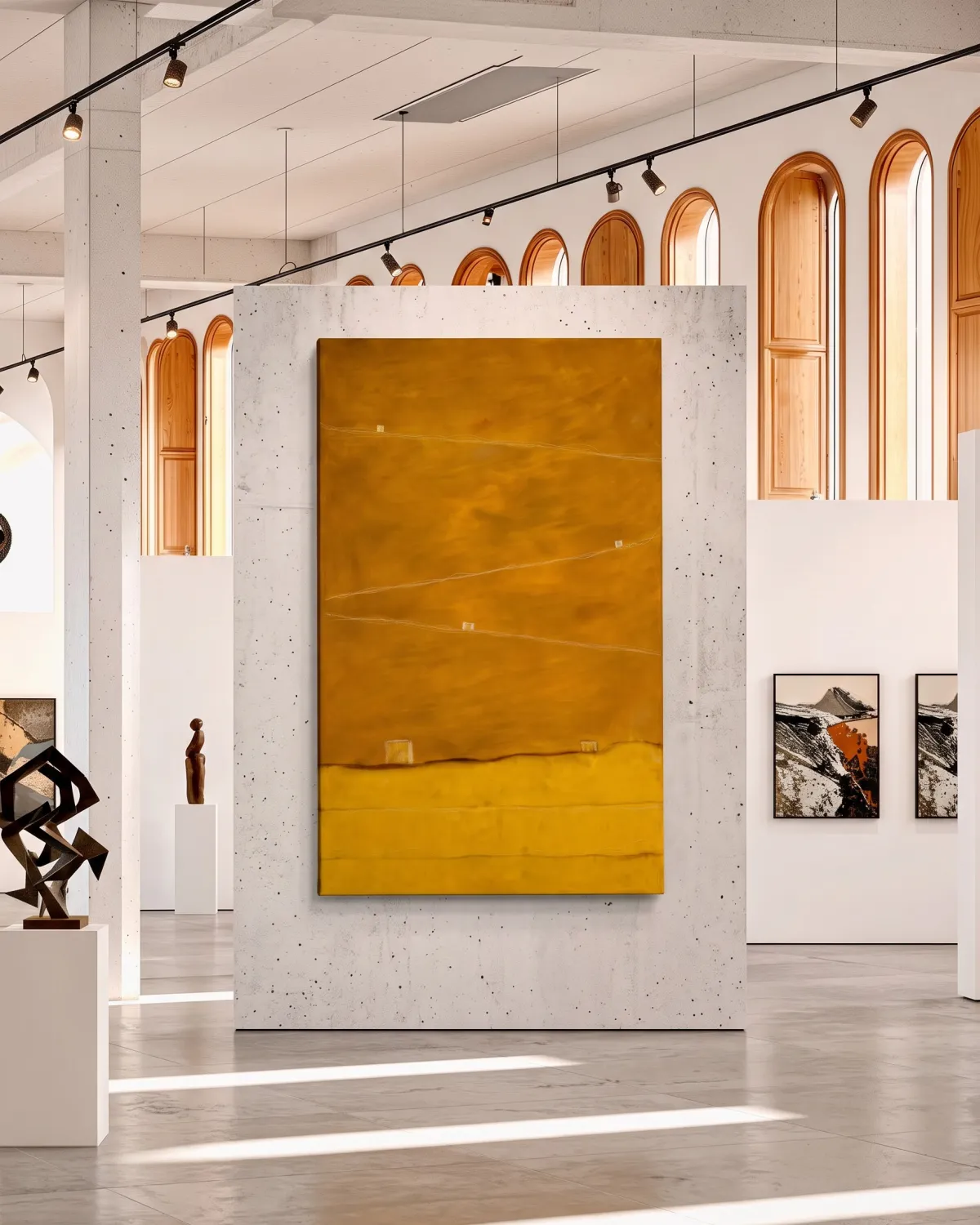
Hanging upon that freestanding wall of textured concrete, surrounded by the monumental scale of an architecture that breathes natural light and wooden arches, QUINQUE imposes itself not as a window inviting us to look elsewhere, but as a material boundary where thought is forced to halt. The sharp division between the dense, opaque upper ochre and the lower band of burning yellow establishes a physical border that does not seek to simulate a landscape, but rather to embody a tension of weights and temperatures. Against the cold monumentality of the concrete supporting it, the painting reveals its condition as a vulnerable body, a surface that has accumulated time, pressure, and sediment. There is no narrative here to decipher, nor a destination to reach; the gaze stumbles upon the presence of matter and, in doing so, discovers that the urgency to translate the work into abstract concepts begins to lose its force.
Sometimes, while working with the palette knife and oil, I find myself trying to justify every gesture, as if the canvas were an exam I must pass before my own mind. But upon lifting that dark seam separating the ochre from the yellow in QUINQUE, and settling those two compact blocks upon the horizon, something in that process of physical accumulation forced me to fall silent. Those blocks do not illustrate a theory about protection or loss; they simply occupy a necessary space, resisting the immensity of the color with the pure stubbornness of their relief. Painting then becomes an exercise in disarmament: an attempt to strip away the explanations I gather throughout the day to allow the surface to retain only the trace of action, free from the need to prove anything.
The resistance of the viewer to remain before what is not fully explained usually manifests as a rush to label, to turn color into emotion and form into symbol. In the upper portion of QUINQUE, three fine incised lines run horizontally across the ochre field, serving as an unlikely support for three tiny blocks that seem to float in the void. This subtle intervention evokes the sober precision of Richard Diebenkorn’s compositions, where the territorial structure sustains the space without resorting to a rigid geometric perspective. The incisions in Valch’s painting are not reading guides or paths leading to a resolution; they are interruptions, cuts in the matter that suspend the gaze in a present without denouement, where understanding consists not in solving the enigma of the gravity of those small blocks, but in accepting the nature of their suspension.
To wound wet oil paint with a stylus is, at its heart, an act of faith in the power of subtraction to sustain the weight of the work. When I traced those three upper lines, I was not seeking to draw a route or a navigation map, but to open a physical slit in the density of the pigment, a furrow where light could graze the depth of the canvas. Placing those three small fragments on top of the scraped strokes was a way of testing how much emptiness a presence can bear before vanishing into dispersion. I do not need to know if these elements are falling or ascending, nor what system of thought has placed them there; it is enough for them to remain on that subtle tactile shore, inhabiting the cut as the only possible refuge.
In this presentation, where the work coexists with the severity of the concrete and the warmth of the side light, it becomes evident that true silence does not arrive by silencing our surroundings, but by understanding the noise of our own interpretations. QUINQUE does not offer a theological conclusion or a spiritual revelation to repair the fractures of the territory; it offers itself as a space of suspension where the pictorial fact prevails over its possible psychological readings. By relinquishing the demand for a closed meaning, the viewer abandons the fatigue of the interpretative quest and rests on the surface. Understanding painting, after all, is not about deciphering it, but about experiencing the silent sufficiency of a matter that remembers and sustains itself within its own limits without needing to justify itself.
- Original artwork
- QUINQUE
- Actual dimensions
- 31.5 × 47.2 in / 80 × 120 cm
- Presentation
- Digital contextual visualization
Context references
ochre and yellow abstract painting · minimalist abstract painting on concrete wall · maurizio valch contemporary art exhibition · giant abstract paintings for modern living rooms
About this visualization
This visualization places the artwork within an architectural context to help collectors and viewers imagine its presence in a real space. It is an interpretive reference, not an exact reproduction: the original work remains the sole authority for scale, color, surface and material presence.