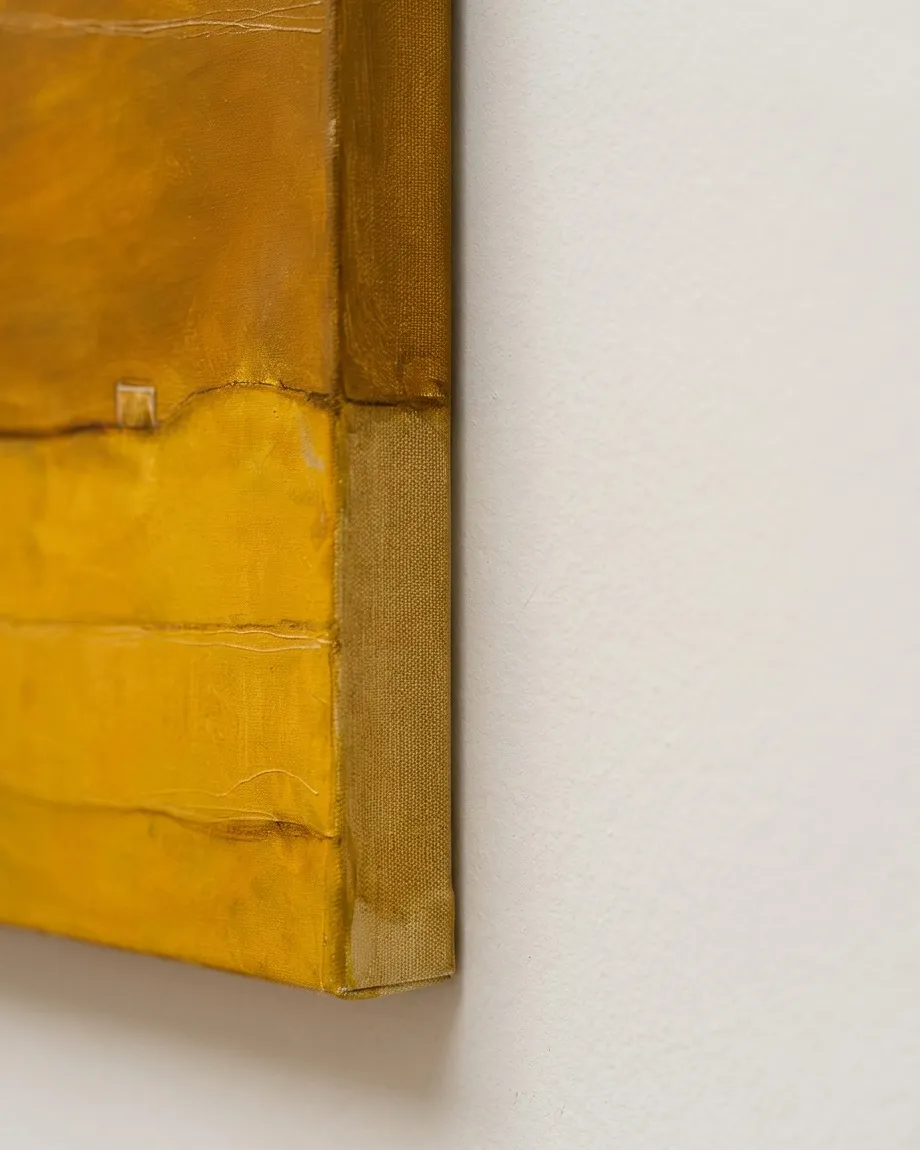
Context study / QUINQUE
Texture and Edge Detail of QUINQUE Abstract Painting - Maurizio Valch
QUINQUE does not allow itself to be told with the obedience of a display case. The title proposes five, and the eye, from a distance, accepts the rule as it accepts a password: a clear signal above, others suspended in the breathing of the field, two near the lower band. But when trying to fix them, the count is altered. One seems to double at the edge of a line; another perhaps is not a form but the instant when the amber has yielded light. Five does not designate a secure quantity here: it is the irregular pulse that prevents the terrain from becoming pure emptiness. In its 80 by 120 centimeters, the vertical extension is not offered as a panorama but as a surface that has had to learn to stand upright.
Gilles Deleuze, a philosopher who thought of reality as a network of forces, escapes, and transformations that never allow themselves to be fully fixed. From that concern, the small white presences would not be objects or miniatures deposited on a landscape: they would be sites where the threads change behavior. A diagonal thins out upon touching them, another seems to avoid them, a dark horizontal line acquires a different tension when passing nearby. Almost nothing happens, and yet something deflects something. Why do these five tiny things not seem to be placed in the landscape, but seem to be teaching the landscape not to fall? The question does not ask for a function; it opens a suspicion: perhaps the amber calm is a worked calm, sustained by tiny interruptions that do not quite become distress signals.
I do not know if those shapes support something or if they are the only thing the painting has managed not to lose. I wanted to approach the emptiness, but emptiness always pulls away slightly from what I imagine; when I thought I left it alone, these small insistences appeared. Now I look at them and cannot decide if they are inside the field or if the field has accommodated itself around them.
Then the surface becomes an ear. The very fine threads crossing the ochres—barely diagonals, almost scratchings of a washed writing—ask to be followed, but disappoint with delicacy: they do not lead to the white, they do not organize a route, they do not close a figure. They can look like cables, flight trajectories, abandoned measurements, scars that have learned to disguise themselves. No single possibility fully imposes itself. The eye moves through them like someone listening to a conversation on the other side of a wall: recognizing that there is a connection, but failing to know between whom.
Manuel Álvarez Bravo, a Mexican photographer who knew how to find mystery, humor, and poetic density in what appeared daily or silent. His attention corrects the haste of turning the five marks into abstract forces. It is necessary to let them be. One has the domestic size of an opening; another looks like a small construction too proud of its whiteness; another keeps a charming clumsiness, as if placed there by someone who did not know that the entire terrain was going to look at it. They are not human figures, but the field is full of expectation. The yellow does not smile: it has weight, temperature, a kind of retained air.
The dark line separating the brighter lower section from the upper zone does not quite become a horizon. Instead, it behaves like a tense seam between two yellows that do not want to mix: below, an ochre that seems to approach the body; above, a more distant extension, more opaque, more difficult to breathe. There, the light presences acquire a strange gravity. If they were houses, they promise no refuge. If they were measurements, no one delivers the scale. If they were crumbs, no return is guaranteed.
A child might ask: "Are the white things holding up the dark line so it doesn't fall onto the yellow below?" The question shifts the entire painting. One no longer looks at the border as a passive division, but as a weight. And the five signals cease to be merely inhabitants or accidents: they could be small hands without arms, support points without a building, minimal acts of resistance. Not because the painting confirms it, but because now it is hard to see that line again without feeling that it pushes downward.
The body then enters the reading. The ochres dilate the breath; the almost empty field offers space and, at the same time, withdraws it. One wants to get closer until the line becomes a path or a scar, but up close it remains both and neither. The diagonals, once light, become tensions crossing the view. The scale breaks down: a signal could be a door, a surveyor's mark, a silent apparatus, or the minimal gesture of someone who passed through there and left no body. Deleuze would want them to move, to continue deflecting the forces of the surface. Álvarez Bravo insists that they remain still, for only stillness allows their concrete strangeness to appear.
But the painting forces them to correct themselves. The line, Deleuze's intelligence admits, can possess intimacy: not all tension seeks to escape; some stick to an edge, almost with modesty. And Álvarez Bravo's attention accepts that such a small form may not belong entirely to any recognizable world: neither house, nor sign, nor remnant, even if it touches all those names. Between both disagreements, QUINQUE ceases to be a scene to become a territory that measures its own instability. Five is the count of its supports, but also the way the count resists closing.
I cannot assure that those marks are mine once the painting remains in front of someone. There is one of them—the closest to the line, or perhaps the one that seems to touch it—that has separated from what I thought I saw. I look at it as one looks at a small forgotten thing in a room: I do not know who left it there, but it has already changed the weight of everything else.
There remains, next to the lower band, a minimal clarity that seemed at first a simple interruption. Now it weighs little and supports much. It does not illuminate the ground: it teaches it, barely, where not to yield.
- Original artwork
- QUINQUE
- Actual dimensions
- 31.5 × 47.2 in / 80 × 120 cm
- Presentation
- Digital contextual visualization
Context references
acrylic and oil painting textures · contemporary abstract painting details · frameless painting side finish · incisions in abstract painting
About this visualization
This visualization places the artwork within an architectural context to help collectors and viewers imagine its presence in a real space. It is an interpretive reference, not an exact reproduction: the original work remains the sole authority for scale, color, surface and material presence.