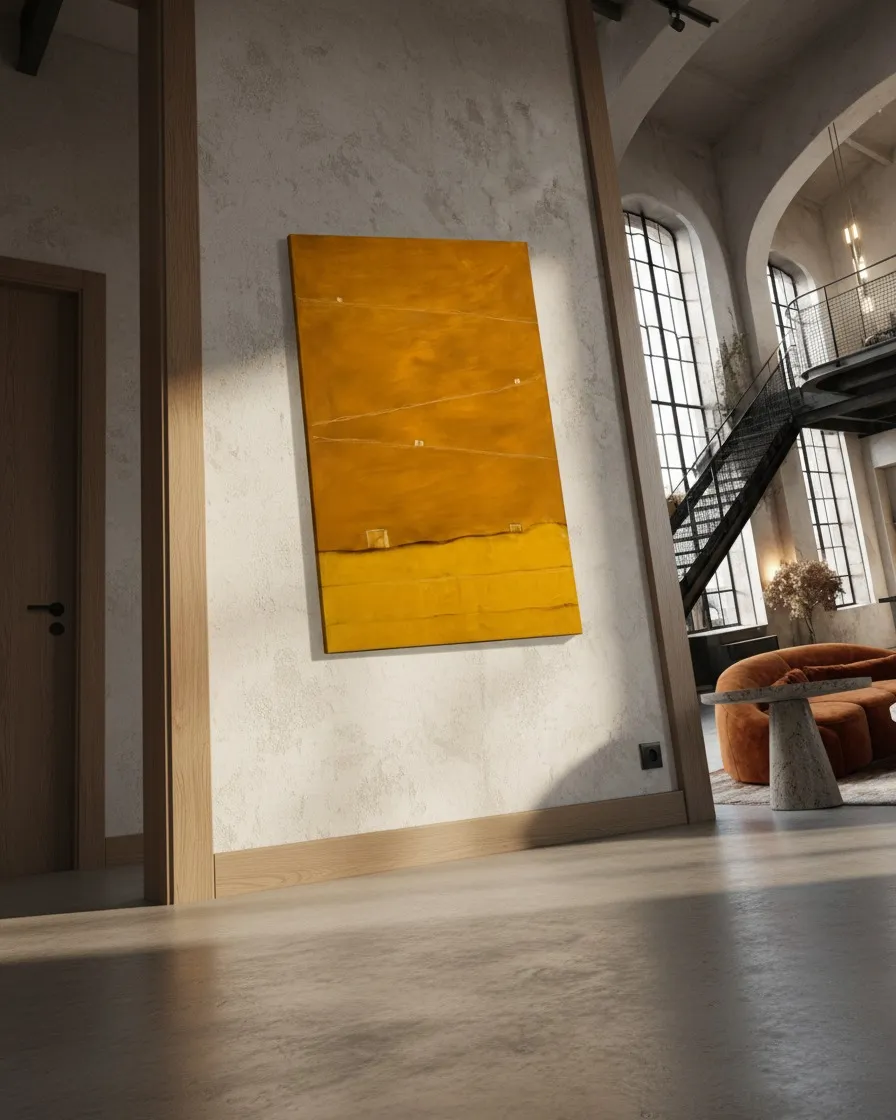
Context study / QUINQUE
Yellow Abstract Painting QUINQUE by Maurizio Valch in Loft Living Room
"QUINQUE" presents itself to the viewer as a block of contained radiation, where the palette of yellows and ochers operates not merely as a decorative resource, but as an emitter of warmth of an almost geological character. The pictorial plane, divided horizontally into two large bands of dense yet subtle textures, invites an experience that transcends the merely retinal, demanding an active attitude of listening. It is not an empty silence that inhabits the canvas, but a quietude charged with tactile vibrations. The fine longitudinal incisions crossing the surface should not be understood as drawing strokes or conventional compositional lines; they are, rather, physical furrows or frequencies registered upon the matter, grooves that seem to emit a low-frequency hum. For the observer pausing before this yellow wall, vision yields its primacy to an acoustic perception of color, where every tonal variation and every scratch on the surface becomes subtle signals of a sedimentary landscape that must be learned to be heard amidst the material silence of the painting.
When I face the plane of "QUINQUE," I understand that the act of scratching and scraping the oil and acrylic on the canvas is not an imposition of my will, but an exercise of absolute surrender. Sliding the metal tip over this surface charged with a dense, almost living warmth, I feel how the matter opposes an initial resistance only to then yield, opening in a clean cut exposed to accident. To let go of rigorous control over the line is to accept that the tool has its own pulse and that the support remembers every pressure, every hesitation of my hand. In this process of subtraction, where I remove paint to reveal what lies beneath, shedding control becomes a pact with the support itself. I do not seek the perfection of the stroke, but the honest trace of friction—the vestige of a physical encounter where the heat accumulated in successive layers of pigment is pierced by a cold cut that accepts drift and error as fundamental parts of the composition.
Standing out in the morphology of the work is a series of tiny cubes or monolithic blocks that seem to rest, with an almost precarious delicacy, on the edges of the incisions or near the undulating border separating the darker, ocher upper area from the lower, more luminous and flat yellow strip. These small three-dimensional elements act as landmarks in an internal cartography—fragments or remnants deposited in a state of surrender associated not with neglect or desolation, but with the freedom of that which no longer requires any external force to remain in its place. The composition generates a remarkable structural tension: while the upper part evokes a suspended atmosphere charged with dense particles in twilight, the lower section functions as a firm, compacted ground. It is in that intermediate zone of friction where the blocks settle, marking the exact boundary where the weight of matter and the emptiness of the surface find a provisional truce, free from the need to justify their presence.
In my working process, the construction of "QUINQUE" required me to fine-tune a somatic listening—a silent attention directed not toward what I wanted to project, but toward what the matter itself demanded during drying and the layering of glazes. The small blocks of pigment and accumulated matter that I place in the work are not whimsical details; I conceive them as notes on a mute score, points of support marking pauses and silences in the reading of the canvas. Painting this piece was an attempt to retain the physical memory of a warmth that does not burn, but ripens: the heat of the Mediterranean land in dry months, when the entire landscape seems to fold back upon itself. By positioning these small landmarks on the canvas, I want the observer to pause, abandon the haste to decipher a purely conceptual meaning, and learn to inhabit that same temperature, feeling the chromatic vibration as an echo that slowly reverberates in their own body.
Ultimately, "QUINQUE" operates as a catalyst where the distance between the viewer's gaze and the painted surface collapses. When the observer renounces purely discursive analysis and delivers themselves to the surrender of rational explanations, the only possible path opens toward a true listening of the work. The canvas ceases to be a representation and reveals itself as a physical membrane of tactile friction, a wall of silent warmth where the wounds of the incisions and the firmness of the mineral blocks coexist harmoniously. Maurizio Valch's work thus achieves an equilibrium stripped of mystical pretensions, firmly grounded in the honesty of the worked material. The painting becomes a tectonic record where accumulated heat, attention to minimal detail, and the renunciation of unnecessary ornamentation converge on a surface that is not merely contemplated, but inhabited by the body and deciphered through the skin.
- Original artwork
- QUINQUE
- Actual dimensions
- 31.5 × 47.2 in / 80 × 120 cm
- Presentation
- Digital contextual visualization
Context references
contemporary abstract painting for living room · modern ocher and yellow paintings · industrial style interior decor · textured minimalist abstract art
About this visualization
This visualization places the artwork within an architectural context to help collectors and viewers imagine its presence in a real space. It is an interpretive reference, not an exact reproduction: the original work remains the sole authority for scale, color, surface and material presence.