Context study / QUINQUE
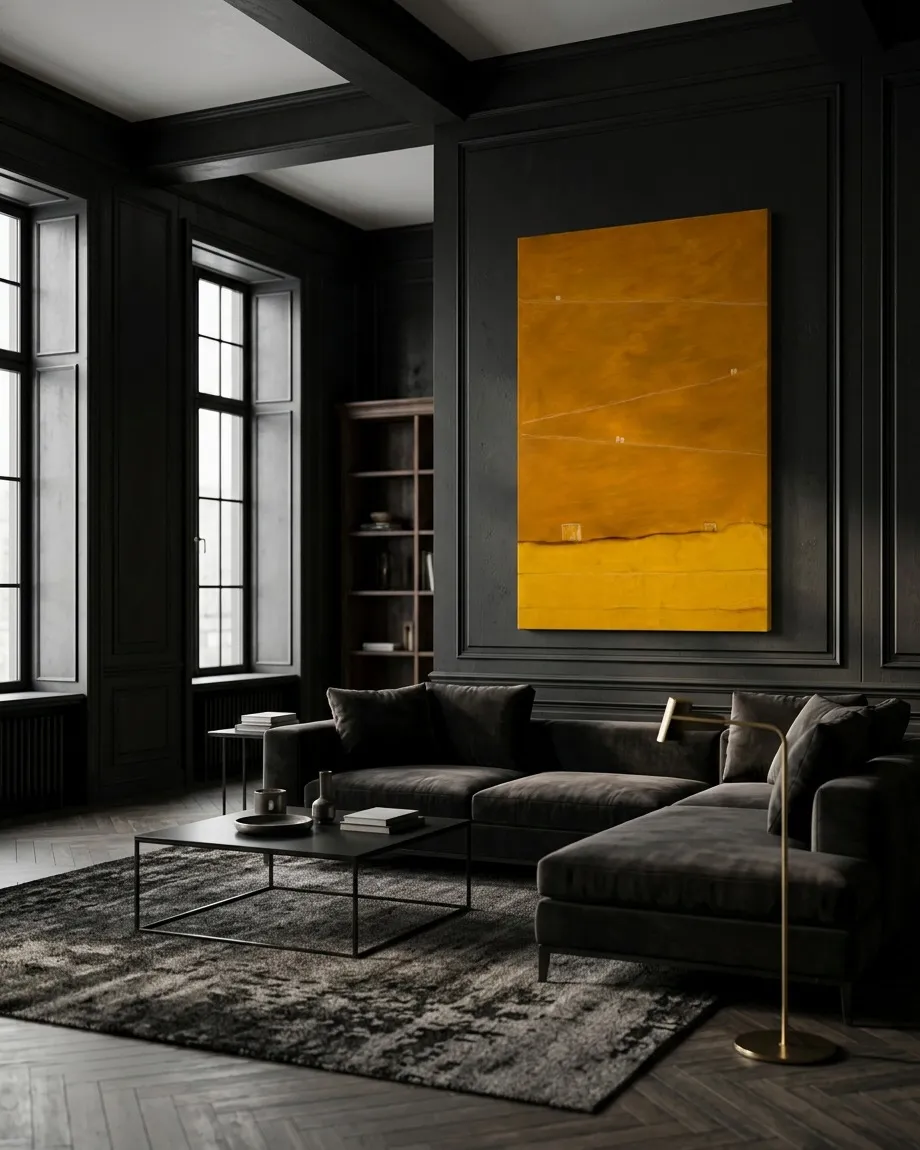
QUINQUE Abstract Painting in Dark-Walled Living Room
Hanging against the understated shadow of a dark-moulded wall, the ochre and yellow vibration of "QUINQUE" does not merely decorate the space; it interrupts it with the gravity of a contained temperature. The contrast between the austere architecture and the incandescence of the canvas reveals that colour here neither illustrates an external landscape nor describes a transient state of mind. Instead, it functions as a mass of silent pressure, a block of static warmth that condenses a dense psychological atmosphere without relying on anecdote. Anyone observing the artwork from the grey velvet sofa is not witnessing a drama, but rather the presence of a limit: a chromatic boundary that halts the noise of the surroundings and obliges the body to measure its own distance from the matter.
When I worked on the two large regions of this canvas, I was not looking for a pleasing chromatic balance, nor did I intend to paint a metaphor about light. I wanted the ochre and the yellow to meet with the raw force of two tectonic plates colliding in silence. In sinking the spatula and scraping the oil paint to trace that dark dividing line, I was not drawing a navigable horizon; I was recording a wound on the surface, a physical mark that stops the dispersion of colour. For me, painting is this effort to fix a dense vibration, a melancholy that weighs upon the matter and needs no words to make itself real in space.
The affinity with Rothko's painting becomes evident in the immersion of colour, but here the chromatic atmosphere is broken by a material demand closer to Antoni Tàpies. The two blocks resting upon the central scar act as anchors for a structure that resists dissolution; they are not symbols of a refuge, but physical presences that hold the gaze at the exact point of friction. By renouncing any narrative thread or psychological explanation, the composition allows emotion to condense into its pure elements: the compression of the upper stratum, the resistance of the relief, and the unstable expansion of the lower yellow. The painting does not recount a loss or a search, but offers itself as the sediment of a long process, a weathered skin that preserves the marks of its own duration.
I often wonder whether those three small blocks resting upon the incisions of the upper area are attempting to hold themselves in the void or if they have already accepted the inevitability of their decline. Opening those thin white channels over the ochre, removing paint instead of adding it, I felt the need to create a space of minimal trust, a groove where lightness could find provisional support. There is no hidden message behind this order, nor a key to be deciphered beneath the Latin title of the work; there is only the trace of my fingers on the canvas, the number five as a measure of touch, and the suspicion that any theory attempting to explain this silence will end up burying the fact of the painting.
In the stillness of this minimalist interior, the painting ultimately behaves like a tactile shore where the viewer can lay down the urgency to interpret. The artwork does not ask to be understood, but rather to be inhabited from the somatic vibration of its relief and its contained voids. By avoiding narration, "QUINQUE" preserves the integrity of its emotional state, transforming the dark wall into a threshold where waiting or simply remaining no longer requires a narrative to justify itself. The strength of the image lies in that stubborn resistance to translation: a territory of colour and cut that remains open, offering a silent refuge for those who accept looking without the constant need to explain.
- Original artwork
- QUINQUE
- Actual dimensions
- 31.5 × 47.2 in / 80 × 120 cm
- Presentation
- Digital contextual visualization
Context references
paintings for elegant living rooms · dark grey wall decor · ochre and yellow abstract art · classic contemporary interior design · Maurizio Valch QUINQUE
About this visualization
This visualization places the artwork within an architectural context to help collectors and viewers imagine its presence in a real space. It is an interpretive reference, not an exact reproduction: the original work remains the sole authority for scale, color, surface and material presence.