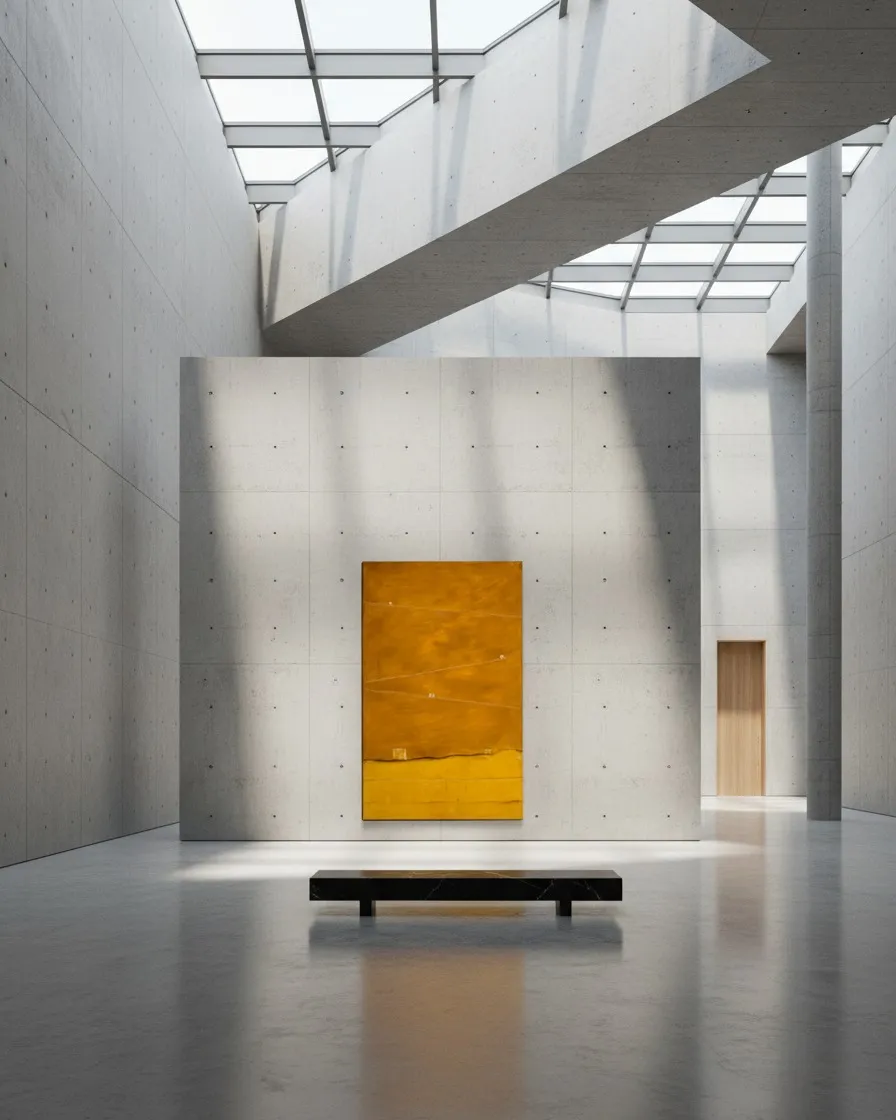
Context study / QUINQUE
Ochre Vertical Painting QUINQUE in Gallery - Maurizio Valch
The surface of the artwork unfolds before the gaze as a rigorous exercise in restraint and balance, where a chromatic field of subtle ochre and golden tones is interrupted by a stark horizontal division defining a lower stratum of greater visual density. Upon the upper section, a series of fine horizontal incisions furrow the canvas with the precision of tensioned cables or imperceptible tectonic faults, serving as an unstable support for three small, pale blocks that seem to slide or suspend themselves along these pathways, while another two sit firmly on the border of the lower plane. This almost geometric arrangement immediately evokes the ideas of the mystic philosopher George Gurdjieff regarding the automatism of human existence, suggesting that our lives frequently unfold in a sleepwalking mechanical state. Contemplating the rigidity of these lines, the inevitable question arises whether these fine incisions and their small blocks do not represent a cartography of daily limits: fixed and pre-established routes where presences move under the illusion of autonomous progress, when in reality they only repeat, over and over, a line previously traced upon the territory of experience.
When I sink the palette knife into the wet medium, I do not seek to trace a decorative design, but to open a real rift that exposes the layers hidden beneath the density of oil and acrylic. I feel the physical resistance of the paste as it is torn—a gesture where the strength of the arm translates into a scar that divides the golden plane and alters its apparent calm. In executing these lines, I am struck by the doubt of whether I am establishing a constructive and habitable order, or if I am simply recording in a visceral way the limits and borders we impose on ourselves in daily transit. The two blocks resting on the lower band sink with the weight of terrestrial gravity, while the three upper ones seem to defy inertia, seeking an elusive balance between the heaviness of matter and the lightness of thought that attempts to rise above its own conditioning.
This apparent rigidity of the mechanical path enters into a fertile theoretical friction when confronted with the archetypal psychology of Carl Gustav Jung. If for Gurdjieff the linear marks of the painting denounce the prison of habit, for Jung the precise organization of the five elements that shape the title of the work—"QUINQUE"—responds to an unconscious impulse for psychic ordering and stabilization, a linear mandala where the number five acts as the axis of transformation and self-understanding. The ochre background, which refers both to the alchemical gold of transmutation and to the warmth of dry earth, thus becomes a crucible where Shadow and Light engage in a silent dialogue, seeking their own center of gravity through the exact distance and measured interval that separates each block from its opposite.
However, in the face of these complex psychological or mystical readings, I must reclaim the absolute sovereignty of matter and the pictorial plane. Before becoming a map of the psyche or a symbol of human mechanicalness, that ochre and golden background is the material translation of a very specific Mediterranean light that I keep in my memory, evoking the dryness of the landscape surrounding the coast of Nerja and the honesty of the earth exposed to the sun. The blocks are not metaphors of being, but elemental presences with their own volume that demanded a physical place to sustain themselves and exist within the painting. The true mystery of the composition does not lie in deciphering the hidden meaning of its number, but in sustaining the vibrant silence and the distance that separates each element; it is the void between them that truly holds the structure of the painting.
In the end, it is possible to destabilize the apparent fixity of this geography by introducing Osho's perspective on the dissolution of rigid structures and the reclamation of absolute spontaneity. Looking closely at the vibration of the pigment, one might ask what would happen if the blocks decided to abandon the safety of the incision and leap into the void of the canvas, breaking the truce of the established order to allow the medium to regain its free and wild flow. The work does not close itself in a single answer, but remains on the threshold of that instant prior to transformation, inviting the viewer to return their gaze to the warmth of its ochre surface, where the severity of the limit and the freedom of empty space coexist in a suspended silence that does not ask to be deciphered, but to be inhabited.
- Original artwork
- QUINQUE
- Actual dimensions
- 31.5 × 47.2 in / 80 × 120 cm
- Presentation
- Digital contextual visualization
Context references
abstract painting in exhibition room · large format contemporary painting · minimalist art exhibition · ochre paintings for gallery · Maurizio Valch QUINQUE
About this visualization
This visualization places the artwork within an architectural context to help collectors and viewers imagine its presence in a real space. It is an interpretive reference, not an exact reproduction: the original work remains the sole authority for scale, color, surface and material presence.