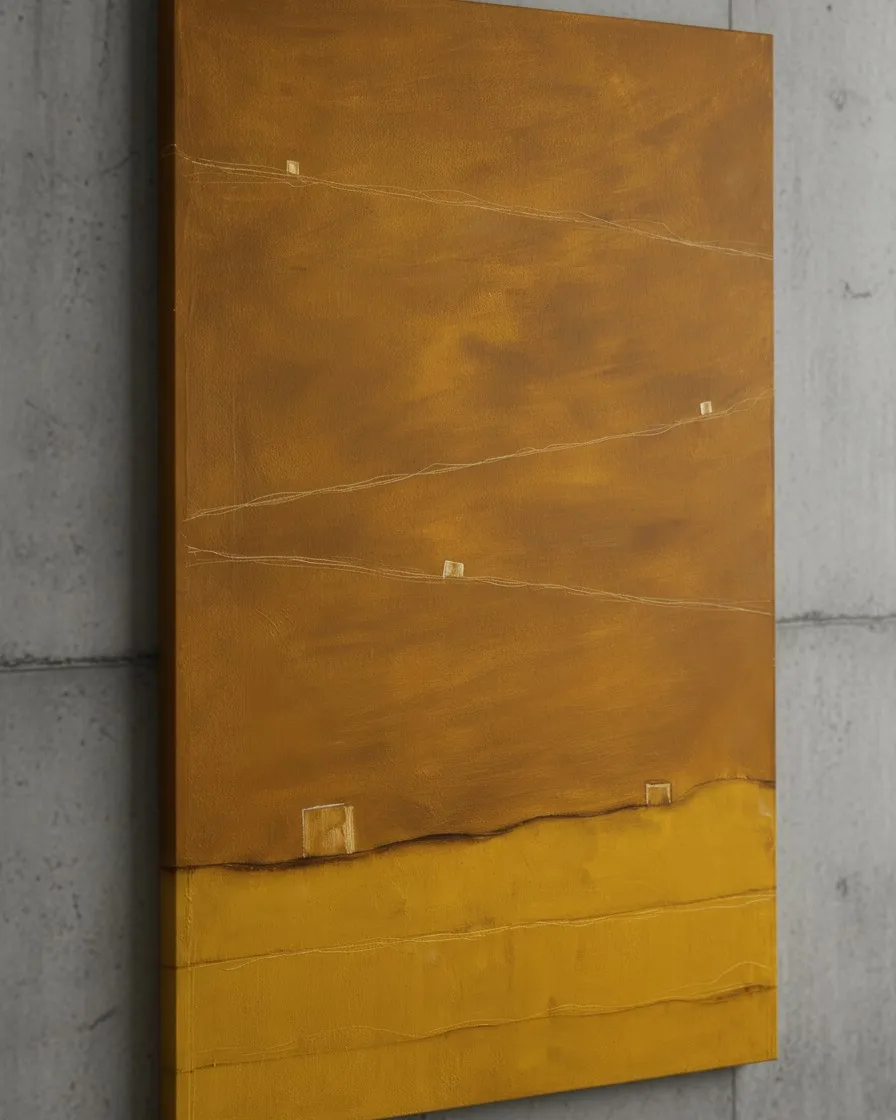
Context study / QUINQUE
Detail of Abstract Painting QUINQUE - Maurizio Valch
Five-signal Protocol for QUINQUE
Entry distance: do not bring your face close yet.
From afar, QUINQUE does not declare what kind of extension it offers. The ochre might be a wall retaining heat, an excessively low atmosphere, land viewed from insufficient height, or a surface that has learned to resemble a landscape. There are earthy yellows in the lower zone, an amber twilight up high, areas where the color seems breathed rather than deposited. The eye searches for a horizon line and does not find it: instead, it finds a dark division it does not yet know how to use.
First signal: up towards the left, a tiny clarity holds itself near an almost invisible thread. From this distance, it seems less like a figure than an interruption: a small white error in an extension that needs no explanation. If looked at too soon, it could become a house. If looked at with less haste, it might be merely the persistence of something that refuses to disappear.
**Rigoberta Menchú** recalls that no territory is empty when someone must live, name, or defend what occurs within it. Faced with this first mark, the gaze can no longer rest on the general beauty of the ochre like one contemplating an abstraction without consequences. Who can call a ground "surface"? Who decides that a line is just a line and not the memory of a separation, a blocked passage, an orientation transmitted in a whisper?
The white shape does not answer. It barely persists. Its smallness does not make it docile: it forces the entire field to justify its immensity.
Lateral instruction: follow one of the threads until you forget where it began.
The extremely fine lines cross the plane with an electric fragility. They do not quite become paths; neither do they allow themselves to be fixed as cracks, cables, veins, or threads. In certain sections, they seem to approach one another, converse, deviate, lose their own course. The eye follows them with the childish hope that they will lead somewhere and discovers that orientation can be a form of wandering.
Second signal: towards the right, suspended over another almost imperceptible weave, appears a pale presence smaller than a fingernail. It has something of a signal placed in a spot far too large for it. Something slightly comical as well: it seems to have arrived with a solemn task and suddenly forgotten the manual.
A child might ask: why does the field seem to be waiting for those small things to do something?
The question changes the size of the painting. There is no longer background and figures. There are five small possibilities of measure, five minimal bodies—or almost-bodies—capable of altering the weight of an extension. The immense ceases to be important just for being immense. Perhaps it is only that which has not yet learned to listen.
**Epicurus** thought that a shared life could find in the small a sober pleasure and a defense against fear. Look at those two high signals and see neither emblems of conquest nor promises of exit: see possible companions, beings reduced to what is necessary so as not to be left alone. A community without monuments might begin this way: not with a square, not with a flag, but with five pale spots that recognize each other at a distance without dominating the terrain.
But the first voice does not grant that calm so easily. If the five marks accompany one another, on what ground does this accompaniment occur? Serenity cannot erase who owns the map, who traces the border, who remains on the side where the line turns darker. The landscape of QUINQUE shows no proof of belonging to anyone, and precisely for that reason it is unsettling: perhaps it has been emptied by a gaze that prefers not to ask whom its breadth expels.
I look at the ochre and do not know if it still obeys me. I pause on the lines and feel my first intention drift away from me. I look for five presences, but I find five questions that change when I look at them. I cannot decide if I am holding a territory, a distance, or a breath, and I remain within that indecision.
Descent: go down to the dark cut without trusting it to be a horizon.
In the lower third, the painting modifies its posture. The more luminous band extends like a ground, but the border separating it from the upper field is neither clean nor stable. It undulates, darkens, seems to accumulate shadow instead of drawing a frontier. The viewer's body seeks support there and discovers that even this support trembles.
Third signal: slightly above that band, almost in the center, a small pale form seems to perch on a line. It could be a cube, an opening, an abandoned die, a fragment of architecture reduced to its skeleton. It is, for an instant, the most vulnerable of the five: it is too close to the break, too exposed to the ground becoming something else.
Here the disagreement becomes harsher. Rigoberta's voice distrusts a friendship that declares itself sufficient while beneath it the ground is split. No care between minimal bodies is enough if the common space is distributed unequally; no rest is entirely serene if someone must sustain, alone, the precariousness of all. Naming the violence of a ground is not equivalent to turning it into a slogan: it is equivalent to not decorating it.
Epicurus does not withdraw his gesture, but neither does he remain untouched. The calm he proposed was not anesthesia; yet, faced with the dark line, he understands that resting cannot mean disengaging. Fear diminishes when shared, yes, but sharing requires knowing where each body rests and what part of the ground has been denied to it. Friendship, here, ceases to be a protected little room: it becomes an uncomfortable task of common space.
The child returns, but now her question has changed: if those five things came together, could they make the line stop cutting?
There is no quick answer. The upper threads do not descend to repair the break. The yellow band does not open like a solution. The painting does not offer a mechanism to unite what is separated. It only forces one to notice that the minimal forms have managed to ensure that the division is no longer a visual accident.
Low register: the fourth presence enlarges as it approaches.
Below, towards the left, a pale figure seems larger than the previous ones. It is close to the dark edge, perhaps touched by it, perhaps emerging from the luminous band. This time it is difficult not to imagine a threshold; but as soon as the word appears, the painting undoes it. We do not know if it invites entry, if it prevents passage, if it measures a distance, or if it has simply been caught in the place where the yellow changes in density.
There is tenderness in that disproportion. The form is minimal against the field, but seems to carry an excessive responsibility, like a small animal that has decided to watch over a mountain. There is also something obstinate: it does not adapt to the solemnity of the landscape. It remains white, almost ridiculous in its frankness, as if it had not received the news that everything around prefers to speak in ochres.
Rigoberta then recognizes a zone that does not allow itself to be reduced to a demand or a map. The temperature of the color, the soft resistance of the surface, the trembling of the lines: all of that touches an intimacy that is neither private property nor a collective slogan. There is a bodily memory in the act of searching for ground, a memory that does not need to be immediately translated into a program.
And Epicurus, looking at that same small form, can no longer imagine an innocent pleasure. The right measure of a life does not consist only in needing little; it also requires asking why some bodies receive less ground, less shadow, less possibility to stop. The tiny community he had glimpsed begins to pain him in a different way: it is not enough for its five members to accompany each other; they must learn not to call peace a stability that others do not reach.
I return to the dark line and cannot manage to see it as a simple separation. I approach the low mark and feel that I do not fully know it. I ask myself what part of my own gaze turns it into a border and what part of me needs it to remain illegible. I cannot bridge that distance.
Last interference: do not identify the fifth too quickly.
Towards the right, near the break, remains the last white signal. Or perhaps it is not the last: the eye, after traversing the painting, has learned that spatial order is a habit, not a law. This form seems situated on the boundary between the ochre field and the yellow band, but it also seems to have shifted slightly, as if it could abandon its place when we stop looking at it.
The five do not form a line or a clear constellation. They do not obey a reassuring geometry. Each alters the others: the ones above make the one below more tense; the largest makes the minimal ones seem more distant; the central one transforms the threads into possible links and, immediately, into possible separations. A community, the painting suggests without asserting it, is perhaps not a set of likes, but a shared difficulty in measuring the world.
Look for a few seconds at the small white signal next to the right edge of the dark band; then return to a single thread passing above it.
- Original artwork
- QUINQUE
- Actual dimensions
- 31.5 × 47.2 in / 80 × 120 cm
- Presentation
- Digital contextual visualization
Context references
close up abstract painting · oil texture detail · contemporary abstract art · incised marks canvas · Maurizio Valch STRATA
About this visualization
This visualization places the artwork within an architectural context to help collectors and viewers imagine its presence in a real space. It is an interpretive reference, not an exact reproduction: the original work remains the sole authority for scale, color, surface and material presence.