Context study / LUX REMOTA
LUX REMOTA — Context Study
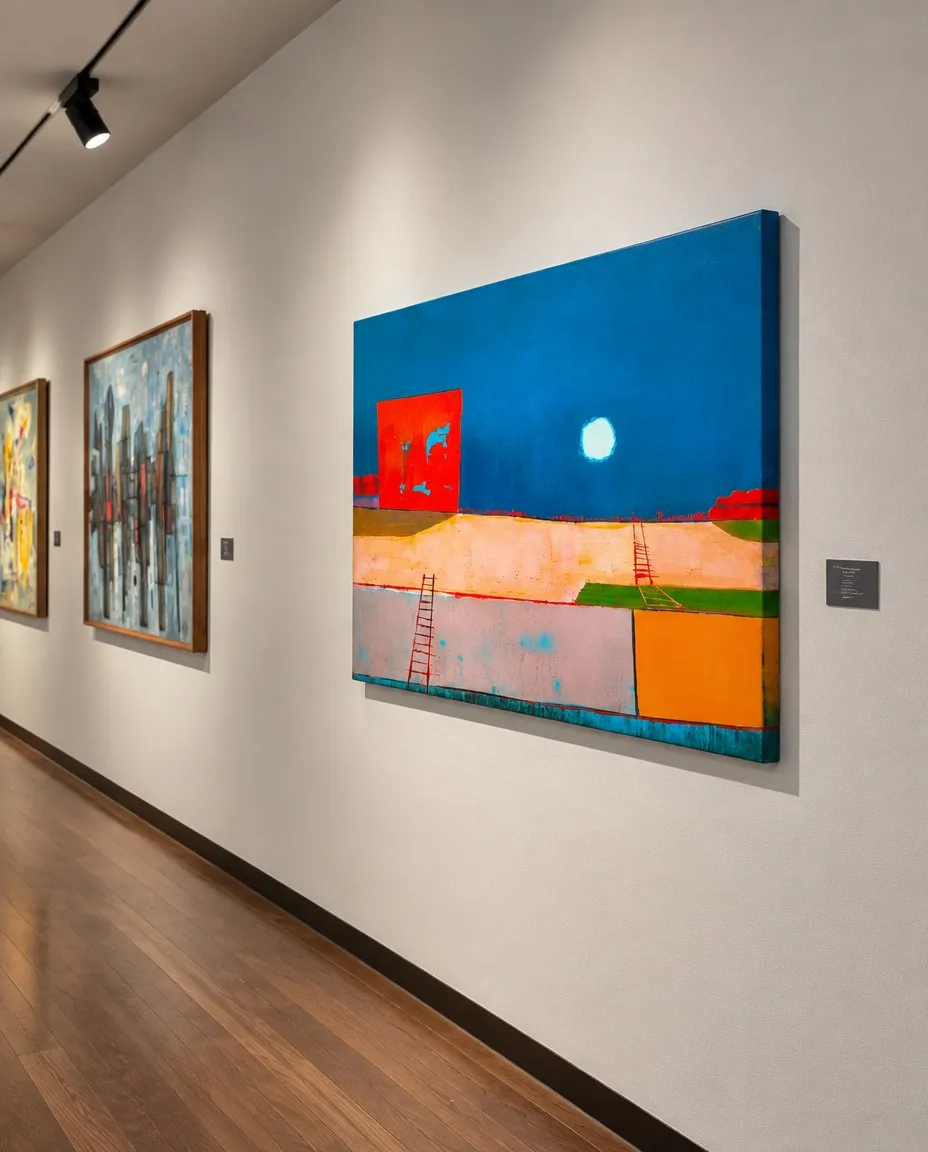
Nothing around the red yields to its authority. Although it concentrates the eye with almost immediate intensity, it remains held at the left margin, separate from both the white circle and the bands that organise the ground. Its position neither establishes a façade nor sets an axis: it occupies an area of the painting with the obstinacy of something already there, a found piece whose presence compels attention to be redistributed without ever governing it.
Up close, this condition becomes less geometric than it first seemed. The contour does not retain the impersonal clarity of a constructed plane; the paint gives at its edges, allowing small incursions of blue to appear and revealing a surface that never fully closes upon its own red. It may evoke a structure, a sign planted in a field, or a mass that has survived a displacement, but none of these possibilities settles. Even the two staircases, with their fragile directions, do not turn it into a destination. One rises from below; the other appears farther away, over the horizontal brightness. Both introduce passage into a territory the block, despite its weight, cannot close off.
The oblique gallery view sharpens this resistance. The canvas retains its depth and the red remains set apart, without moving towards the centre even as the painting takes on a precise physical presence on the wall. From the right, the eye first travels across the blue, the suspended light and the bands of ground before returning to this lateral form. It then ceases to be an emblem to decipher. It remains as an obstacle or a remnant: compact enough to weigh upon the territory, yet too eroded and displaced to turn it into a definitively recognisable place.
Artistic affinities
The affinity with certain chromatic masses in Nicolas de Staël helps identify this ambiguity between landscape and architecture. There, too, a compact colour can acquire the density of a volume without entirely relinquishing its pictorial condition. In LUX REMOTA, however, Maurizio Valch shifts this possibility towards a more pronounced solitude: the red does not integrate into a continuity of planes that might support it, but is exposed to the breadth of the blue and the material instability of the lower fields. Its force derives less from a dominant position than from the resistance it offers to what surrounds it.
- Original artwork
- LUX REMOTA
- Actual dimensions
- 47.2 × 31.5 in / 120 × 80 cm
- Presentation
- Digital contextual visualization
Context references
blue and red painting in exhibition space · horizontal abstract painting on white wall · contemporary art for gallery · LUX REMOTA Maurizio Valch exhibition
About this visualization
This visualization places the artwork within an architectural context to help collectors and viewers imagine its presence in a real space. It is an interpretive reference, not an exact reproduction: the original work remains the sole authority for scale, color, surface and material presence.