Context study / LUX REMOTA
LUX REMOTA — Context Study
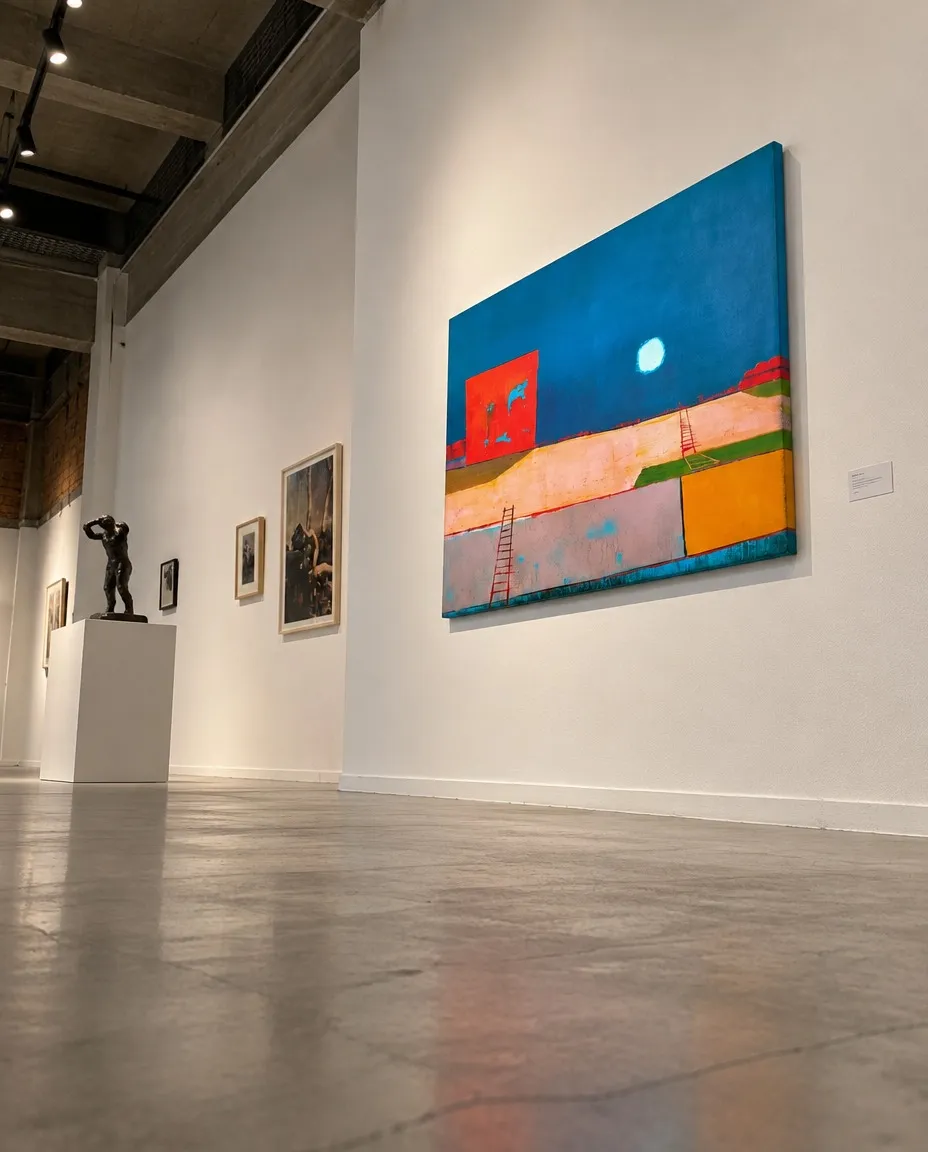
A barely perceptible staircase is enough to make a band cease to be merely a band. From the moment it appears, the pink, grey and green no longer present themselves only as surfaces distributed across the canvas: they take on an expanse to be crossed, an incline, even a duration of passage. The other staircase, set farther back, repeats this operation on a diminished scale. Between them there is no narrative or assured destination; there is a precarious measure that makes what surrounds them seem immense.
The large red form at left participates in this disproportion differently. It occupies a limited area, but weighs like a structure set at a distance, capable of altering the reading of the whole field. By contrast, the white sphere does not dominate the blue through size: it makes it vaster precisely because it fits within it with such solitude. LUX REMOTA thus organises a familiar experience of looking across open territories: a minimal signal can make visible a distance that previously had no measure. The eye calculates without intending to; it imagines heights, separations and possible routes.
The low, oblique view of this presentation makes that operation especially tangible. The canvas retains its 120 centimetres of width within a larger architecture, yet its reduced signs do not weaken before the actual scale of the room. On the contrary, the painted staircases establish an alternative scale within the image, more uncertain than that of the building but sufficient to make its bands seem to extend mentally. The painting does not represent a panorama; it makes the viewer complete one from signs too small to contain it.
Nothing compels us to decide whether this territory lies outside or forms in the perception of the viewer. What matters is that the flat fields cease to end where the canvas ends. A thin staircase, a circular light and a set-apart block are enough for the eye to move away from them, cross an unmapped distance and continue beyond the edge.
Artistic affinities
Paul Klee offers a particular affinity for understanding the efficacy of these smaller forms: in his work, a geometric sign or elemental architecture can activate relations of scale and ambiguity far greater than its own size. Valch departs from Klee’s rhythmic mobility. His elements do not form a script that expands across the entire surface; they remain isolated, exposed to large reserves of colour and silence. They therefore do not animate a populated world, but allow the immensity of an almost empty one to emerge.
- Original artwork
- LUX REMOTA
- Actual dimensions
- 47.2 × 31.5 in / 120 × 80 cm
- Presentation
- Digital contextual visualization
Context references
blue red pink and ochre abstract painting · horizontal painting in contemporary gallery · abstract wall art for gallery · LUX REMOTA Maurizio Valch
About this visualization
This visualization places the artwork within an architectural context to help collectors and viewers imagine its presence in a real space. It is an interpretive reference, not an exact reproduction: the original work remains the sole authority for scale, color, surface and material presence.