Context study / LIMEN
LIMEN by Maurizio Valch | Abstract Painting in a Museum
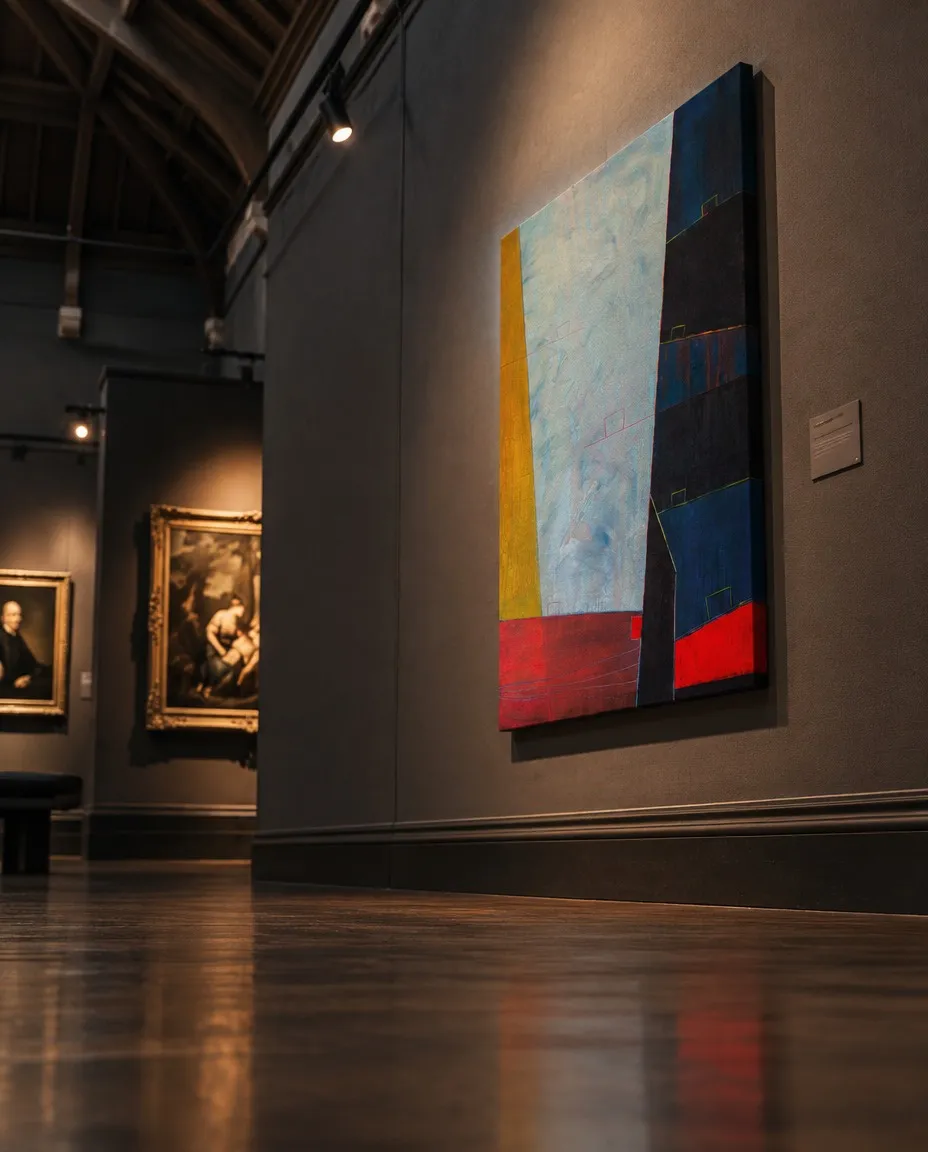
Among the gilded frames in the background, where bodies and episodes seem to call for identification, LIMEN withdraws that narrative support. Its 120-centimetre vertical format offers no figure to which a story might be assigned: instead, it sets out a veiled light-blue field, a red base pressing upward, an ochre edge, and a lateral band of almost-black blue. Within this expanse, green rectangles and magenta lines barely attain the status of signs. The low, side-on view also makes the canvas’s three-centimetre depth perceptible; the painting asserts itself as a situated plane before it becomes a window. This reserve accords with Maurizio Valch’s documented language: fields of colour, divisions, horizons, and incisions organise territories without fixing them within recognisable geography. What matters is not deciphering the signs, but registering how a presence begins to take up a position within a field that still exceeds it.
This demand for attention finds a precise echo in one of the questions running through his thought: what remains of an event when the mind hastens to cover it with interpretations? It would not be appropriate to translate every mark in LIMEN into psychology; nor does the painting permit this. Yet its formal economy allows, for a moment, the need to decide who or what is represented to be suspended. The eye measures distances, notices a line that breaks off, senses that the red does not become stable ground, and perceives that the lateral darkness concentrates a limit. In this pause, appearance does not amount to a resolved identity. It may be read more modestly as the experience of something distinguishing itself without having left behind the conditions that contain it.
The essays “When the Ground Appeared” and “From Dream to Territory” make it possible to place this suspension within a broader trajectory. There, Valch writes that in EMERSIO forms begin to occupy a position and separate from the ground, although emergence also entails exposure. LIMEN condenses this situation without turning it into a narrative: the small outlines describe neither doors, figures, nor architecture, yet they shift the field’s scale and make visible that an organisation is underway. In contrast to the narrative paintings in the adjoining room, this condition becomes especially clear. Those works seem to offer an already constituted scene; this one asks us to attend to the preceding instant, when the territory has not yet fully decided what it can sustain. The absence of anecdote is thus active: the event takes place in the uncertain formation of the visible.
A specific affinity with Paul Klee helps clarify the function of these minimal forms. In both cases, certain geometries can act as signs and as internal measures of scale without being reduced to a decipherable message. In LIMEN, however, the marks do not animate a world of imagined architectures: they remain sparse, almost absorbed by the large fields of colour and the density of the dark edge. Valch places them in a more exposed territory, where each indication must negotiate its place with the expanses that press upon it. Thus, on leaving the surrounding portraits, what remains is not an absence to be completed through fiction, but a surface that teaches us to look at the moment when something has only just begun to become present.
- Original artwork
- LIMEN
- Actual dimensions
- 31.5 × 47.2 in / 80 × 120 cm
- Presentation
- Digital contextual visualization
Context references
LIMEN Maurizio Valch · EMERSIO abstract painting · vertical blue and red abstract painting · abstract painting in a museum · contemporary art with fields of colour · contemporary geometric abstract painting · wall art for a gallery or museum · abstract painting with minimal geometric forms
About this visualization
This visualization places the artwork within an architectural context to help collectors and viewers imagine its presence in a real space. It is an interpretive reference, not an exact reproduction: the original work remains the sole authority for scale, color, surface and material presence.