Context study / LIMEN
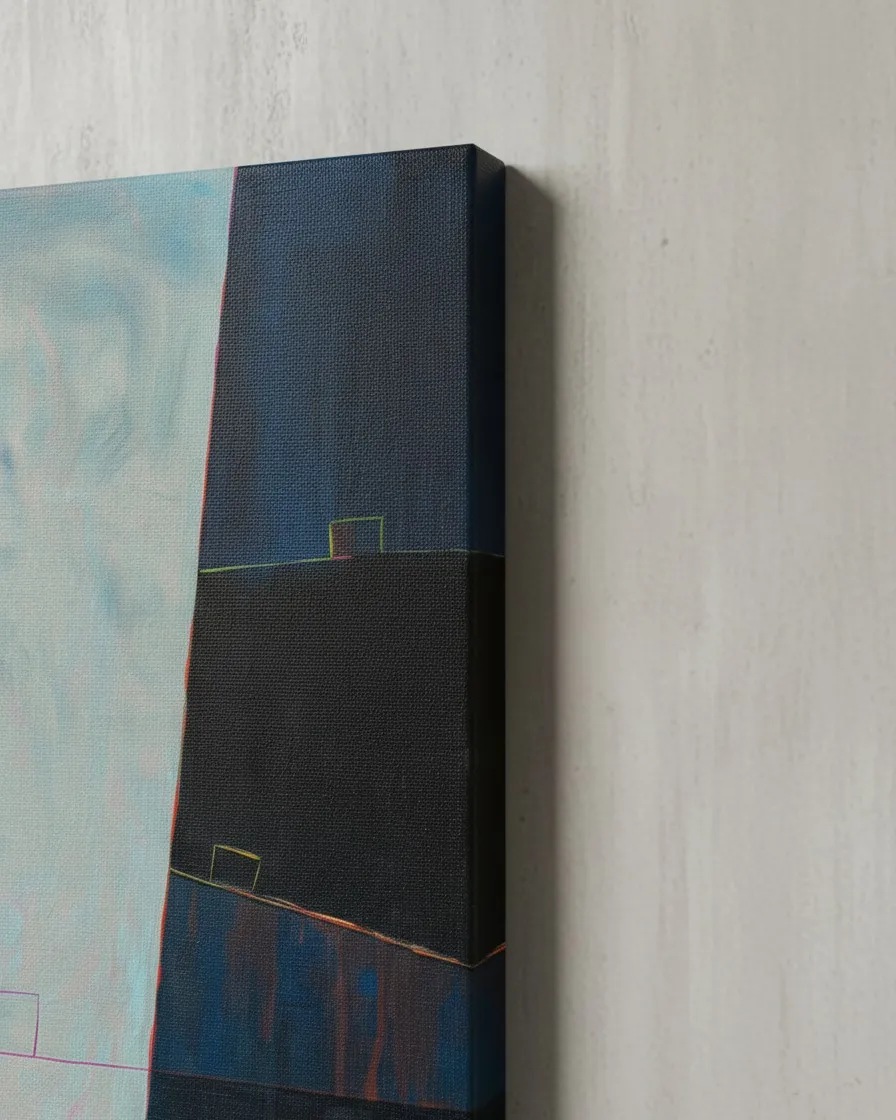
LIMEN by Maurizio Valch: side detail of abstract painting
Order slips out of alignment precisely where it seemed most secure. Near the edge of LIMEN, the deep blue band does not retain a straight boundary: it narrows, tilts against the light blue, and changes in pressure as it reaches the lower dark area. The exposed weave of the canvas and variations in application prevent these fields from being read as industrial surfaces. In Maurizio Valch’s language, divisions and incised lines are not drawing superimposed on a neutral ground, but interventions capable of passing through the material and turning it into boundary, trace, or route. This side view makes it possible to see that the 80 × 120 cm structure does not resolve itself into clean geometry: its stability depends on small shifts that keep it active.
Such precariousness may recall an experience that runs through the artist’s thinking: the distance between an outward direction and an inward movement that offers no reliable map. His life journeys have sustained an attention to passages, places of provisional belonging, and what remains between departure and arrival; they do not provide a biographical key for deciphering the painting, but they do make its resistance to definitive solutions pertinent. The two small green rectangles, the yellow and magenta lines, and the barely suggested verticals introduce local measures within an expanse that cannot be fully measured. They give the impression of orienting, though no axis succeeds in mastering the field. Form, therefore, does not appear as a conquest of territory, but as a position that must be continually readjusted.
The essay “When the Ground Appeared” places EMERSIO at the moment when something leaves the undifferentiated and becomes exposed to having a position. LIMEN brings that condition into its most concrete grammar: the visual ground does not provide a grid that secures what emerges, but inclinations, bands of unequal density, and separations that shift as they are followed. The essay states that emerging does not mean attaining a definitive figure; it means accepting the risk of becoming visible. Seen from the edge, this idea ceases to be merely conceptual. The slight relief of the fabric and the continuation of the fields over the canvas edge recall that the surface is not an abstract boundary either: it has thickness and, with it, material vulnerability. The promise of organisation persists, but never fully closes.
An affinity with Barnett Newman illuminates a specific question: how a minimal intervention can reorganise an extensive field and turn division into a spatial fact. Yet the lines in LIMEN do not possess the vertical firmness or separating precision associated with the zip. They tremble, deviate, and submit to the slope of the masses they cross; even the small rectangular signs are affected by this general instability. Where a separation might declare a clear autonomy, Valch retains a negotiated boundary. The closely viewed canvas edge confirms the difference: the painting does not erect order against its material, but allows its irregularity to sustain, provisionally, every possibility of form.
- Original artwork
- LIMEN
- Actual dimensions
- 31.5 × 47.2 in / 80 × 120 cm
- Presentation
- Digital contextual visualization
Context references
LIMEN Maurizio Valch · side detail of abstract painting · blue and light blue abstract painting · abstract art with fine geometric lines · canvas with painted edges · contemporary territorial painting · vertical deep blue abstract painting
About this visualization
This visualization places the artwork within an architectural context to help collectors and viewers imagine its presence in a real space. It is an interpretive reference, not an exact reproduction: the original work remains the sole authority for scale, color, surface and material presence.