Context study / LIMEN
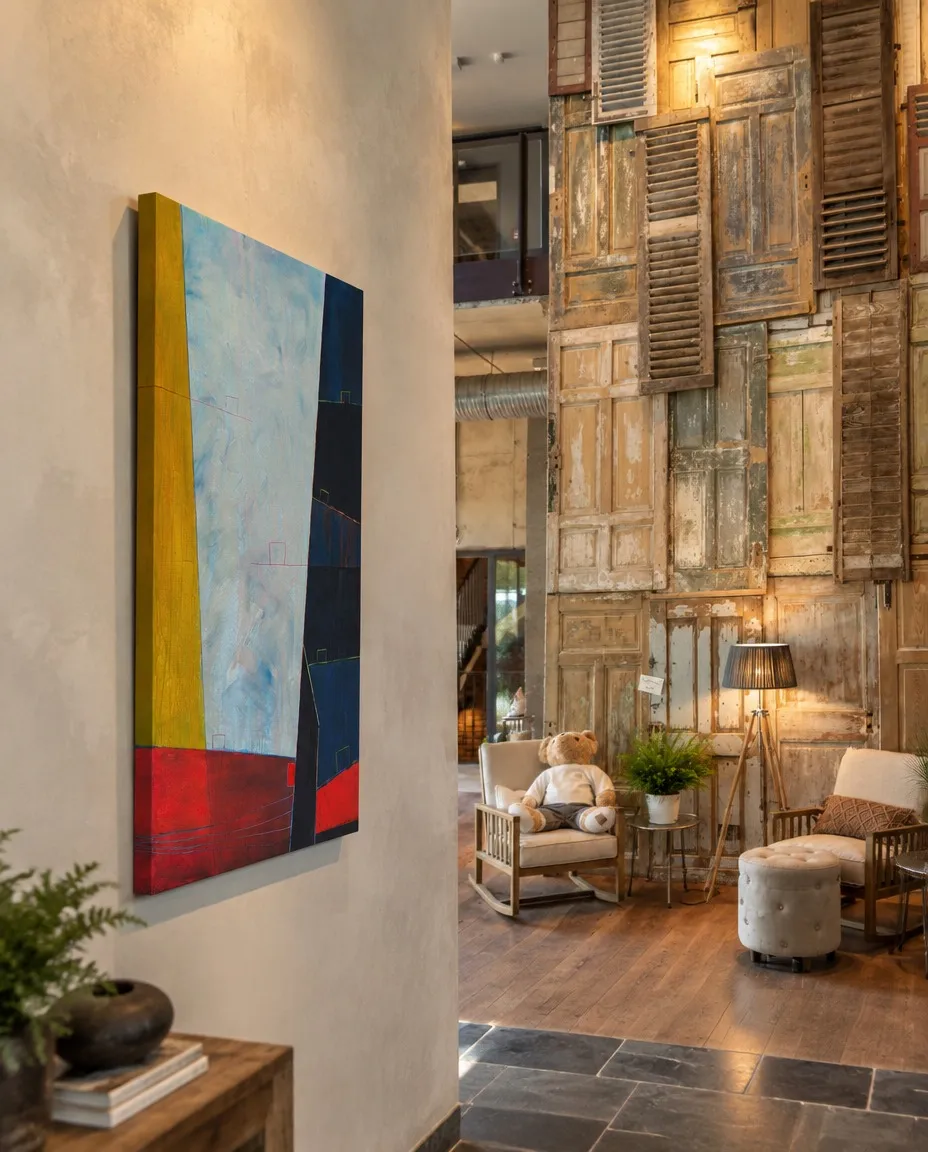
LIMEN by Maurizio Valch in an interior with reclaimed doors
Before becoming a wall, a division may be no more than a tentative gesture. In LIMEN, the magenta lines and small open outlines have that fragility: they intersect the veiled pale blue and dark bands without imposing a final grid upon them. Maurizio Valch’s practice draws on chromatic fields, divisions, and incisions to make the surface into territory as well; in this work, what is certain is the visual pressure between the large central plane, the slanted ochre edge, the red base, and the lateral blue-black mass. The minimal signs do not stabilise the whole: they measure out a possible scale and expose its inadequacy. Seen in profile in the corridor, the three-centimetre depth makes this provisional quality physical: the canvas stands apart from the wall without thereby becoming a resolved partition.
The experience of movement has a persistent place in the artist’s thinking: an external route can be traced, while inner direction remains uncertain. Without turning that biographical experience into a fixed key, it helps explain why these rectangles are not read as usable doors. They indicate a distance but offer no itinerary. In the space shown, the painting faces an accumulation of used doors and shutters, whose layers of paint, fastenings, and wear reveal how much time a separation can hold before hardening into architecture. LIMEN preserves the preceding instant: an inside and an outside are beginning to emerge, though the field around them still prevails.
The essays “From Dream to Territory” and “When the Ground Appeared” place EMERSIO at the point when a form begins to take up a position without fully detaching from its origin. This idea makes it possible to attend to the painting’s asymmetry: the central pale blue does not function as an available background, but as the expanse from which the signs attempt to differentiate themselves; the lateral bands and red base deny them any easy equilibrium. The artist has written that appearance entails losing the protection of the undifferentiated. In LIMEN, this exposure does not take the form of an isolated figure, but of marks that cannot yet guarantee the boundary they propose. Order is born here with reservations: within itself, it retains the breadth it is beginning to cut through.
A specific affinity with Barnett Newman helps identify the spatial power that can be concentrated in a minimal intervention across a broad field. Yet Valch’s lines do not possess the conclusive verticality of a zip that organises the plane once and for all. They break into incomplete frames, shift in height, and coexist with planes that seem to erode all geometric certainty. Against the aged panels in the scene, which bring together openings already fixed by use, LIMEN asserts another temporality: delimitation is not yet a law or a defence, but a material question of where an edge might begin.
- Original artwork
- LIMEN
- Actual dimensions
- 31.5 × 47.2 in / 80 × 120 cm
- Presentation
- Digital contextual visualization
Context references
LIMEN Maurizio Valch · vertical abstract painting for living room · abstract wall art with red blue and ochre · contemporary painting in a warm interior · abstract painting beside antique doors · abstract art for eclectic decor · contemporary territorial painting
About this visualization
This visualization places the artwork within an architectural context to help collectors and viewers imagine its presence in a real space. It is an interpretive reference, not an exact reproduction: the original work remains the sole authority for scale, color, surface and material presence.