Context study / LIMEN
LIMEN by Maurizio Valch in a Contemporary Interior
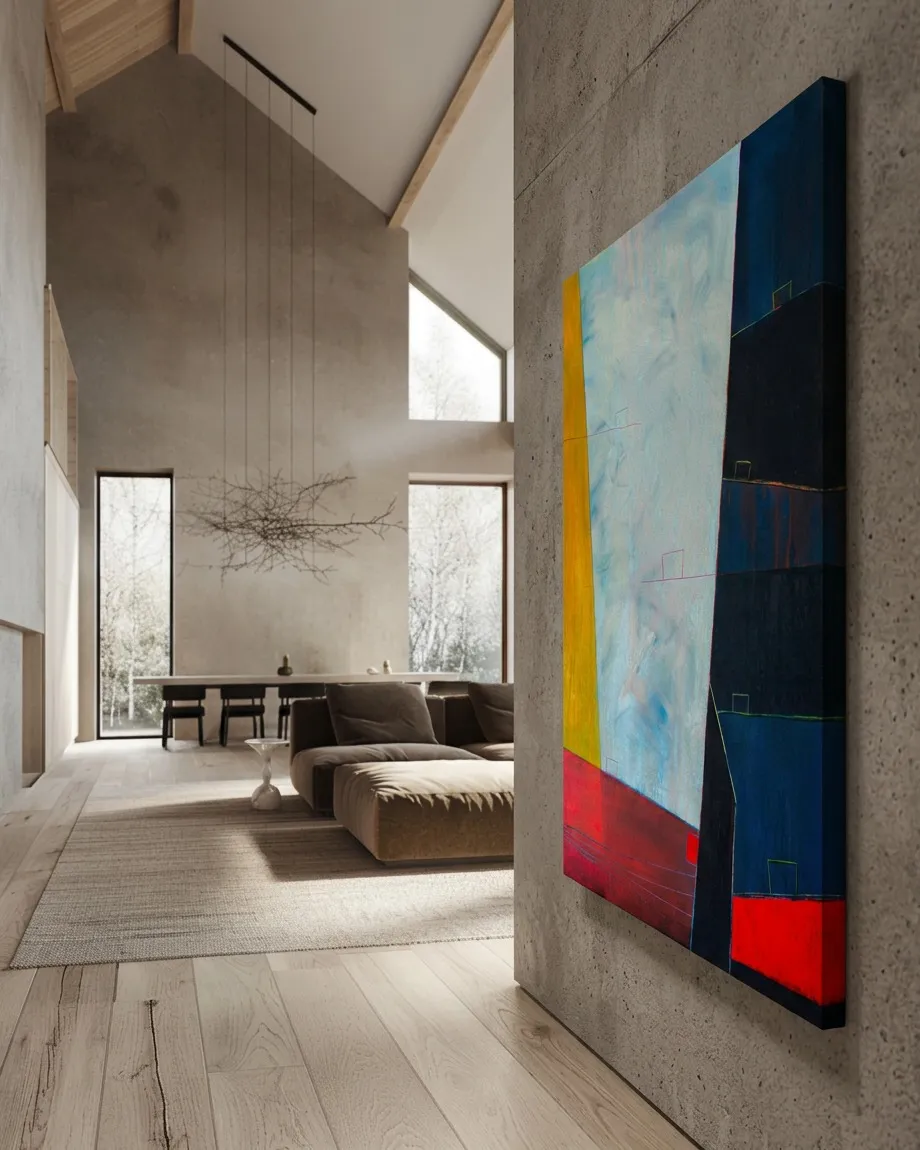
The dark edge of LIMEN appears before any frontal reading: viewed from the side, the 3 cm canvas does not disappear against the wall, but projects forward as a partition. The band of blues and blacks concentrated along the right edge thus finds a physical extension in the depth of the support, while the central pale-blue field remains on the other side of an actual distance. This condition intensifies procedures characteristic of Maurizio Valch’s language—colour fields, divisions, and small marks that regulate scale—without attributing unverified processes to this work. The minimal rectangles and fine lines do not seal off the territory; they make it more perceptible that every demarcation depends on a positional relation. Against the concrete, the painting’s vertical format does not decorate the wall: it introduces a precise interruption into its continuity.
Looking from this angle also engages the viewer’s body. To reach the pale area, one must move around the lateral concentration, whose black seems to gather and retain the surrounding space; the lower red, rather than offering stable ground, heightens this upward pressure. The experience comes close to an intuition persistent in Valch’s thinking: a separation does not necessarily amount to an achievement. His reflections on passage and provisional belonging make it possible to understand this boundary as a zone where proximity and distance are negotiated, rather than as a definitive frontier. The painting keeps open its associations with landscape, architecture, or inner experience; it does not turn them into emblems of a biography. What it makes tangible is the fertile discomfort of having to position oneself before an edge without being able to fix it entirely.
In “From Dream to Territory,” Valch describes the move towards more structured spaces without reducing it to a triumphant evolution: dream and memory remain sedimented when the ground acquires weight. LIMEN condenses this condition. Its veiled centre retains an atmospheric, almost suspended quality, yet the lateral bands and tiny signs compel us to consider the field as a place already organised by differences. The side presentation makes another consequence of this writing visible: what begins to distinguish itself from the ground gains presence, but also becomes exposed. The edge is not the end of the image, but the point at which the image assumes its condition as an object and enters into relation with the space that contains it.
The affinity with Barnett Newman may clarify the spatial role of division, though only to a point. In both cases, a minimal or concentrated separation can alter the entire expanse of the field; it does not function as a secondary detail. Yet LIMEN departs from the affirmative clarity of the zip: its boundaries are traversed by variations, fragile lines, and small frames that prevent a sovereign partition. The painting does not impose two perfectly isolated worlds. As it projects from the wall and carries the weight of its edge, it makes a real separation felt that paradoxically remains porous: a threshold before which being on one side or the other never fully resolves the distance.
- Original artwork
- LIMEN
- Actual dimensions
- 31.5 × 47.2 in / 80 × 120 cm
- Presentation
- Digital contextual visualization
Context references
vertical abstract painting for contemporary living room · wall art for minimalist interior · abstract painting on concrete wall · contemporary painting for modern home · vertical blue and red abstract art · canvas with 3 cm depth
About this visualization
This visualization places the artwork within an architectural context to help collectors and viewers imagine its presence in a real space. It is an interpretive reference, not an exact reproduction: the original work remains the sole authority for scale, color, surface and material presence.