Context study / LIMEN
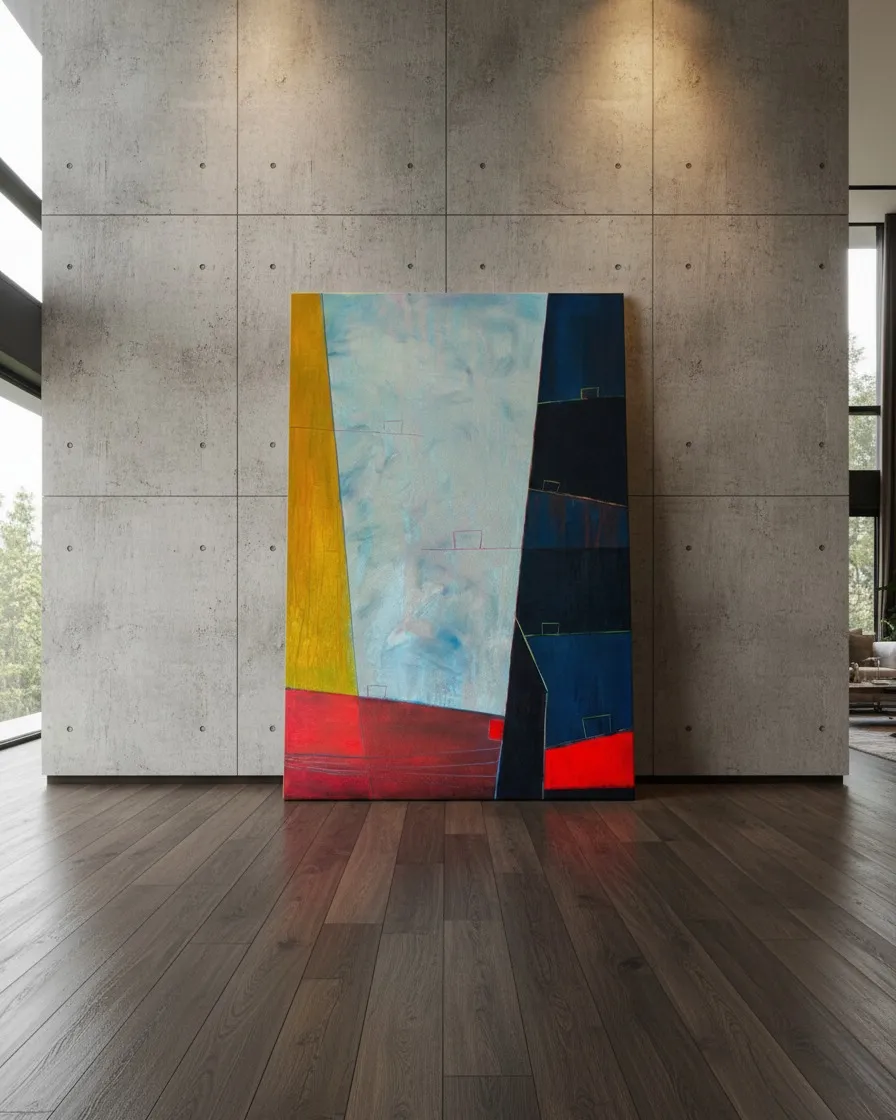
LIMEN by Maurizio Valch in a concrete interior
From the low vantage point of this presentation, height is not offered as a promise of arrival: it becomes a distance the body must register. LIMEN’s 120 vertical centimetres assert themselves against the double-height wall without dissolving into its scale; by contrast, the minimal contours distributed across the light blue and dark side acquire a precise fragility. The red band at the base presses the whole upward, but does not establish a continuous direction. The slanted ochre, the veiled central field, and the column of almost-black blues hold as zones of differing density, separated by edges that never quite agree on a common order. This economy of fields, divisions, and small presences belongs to Maurizio Valch’s territorial language, although the work does not illustrate an identifiable landscape. What matters is that its signs barely provide measure against expanses that exceed them.
This disproportion may touch on an experience that accompanies the artist’s thinking: the difference between a journey that can be drawn and a movement whose inner direction remains uncertain. Valch has distinguished these two registers when recalling walking, where physical continuity does not guarantee an intimate sense of orientation. LIMEN retains something of this condition without translating it into personal narrative. The small rectangles and lines might invite an itinerary-like reading, but their dispersal prevents them from becoming instructions. They remain suspended between a light field that seems to open and a dark edge that concentrates interruptions. Height, then, does not amount to overcoming: it makes palpable the demand to remain visible when no common ground yet exists between the parts.
The essays From Dream to Territory and “When the Ground Appeared” help situate this difficulty within the movement toward EMERSIO. There, Valch describes a territory that ceases to be mere suspension and begins to support, separate, and condition what appears; he also warns that emerging does not mean attaining a definitive form, but losing the protection of the undifferentiated. LIMEN turns this idea into a concrete organisation: the lower red does not stabilise the plane, the vertical sectors do not form a closed architecture, and the signs do not complete an ascending scale. The work retains the ground as pressure and limit. Seen from below, the canvas seems to rise without fully detaching from what holds it back; between one zone and another remains an amount of space that cannot be resolved by the simple advance of the eye.
Paul Klee offers a specific affinity for understanding the function of these small signs: in certain of his compositions, minimal geometric forms activate an uncertain scale and lend intensity to the surrounding void. In LIMEN, however, these units do not generate a playful architecture or a rhythm of construction. Their precariousness is set against colour masses of unequal weight, close to the spatial gravity that may also recall Nicolas de Staël. Valch departs from such condensation into blocks by leaving the limits open, vulnerable to the milky breathing of the centre and the pressure of the dark side. What remains to be measured is not a route upward, but the persistence of a separation that the painting chooses to keep in view.
- Original artwork
- LIMEN
- Actual dimensions
- 31.5 × 47.2 in / 80 × 120 cm
- Presentation
- Digital contextual visualization
Context references
LIMEN Maurizio Valch · large vertical abstract painting · abstract art for a concrete wall · red blue and ochre abstract painting · contemporary painting in a brutalist interior · minimalist vertical wall art · contemporary territorial abstraction
About this visualization
This visualization places the artwork within an architectural context to help collectors and viewers imagine its presence in a real space. It is an interpretive reference, not an exact reproduction: the original work remains the sole authority for scale, color, surface and material presence.