Context study / LIMEN
LIMEN by Maurizio Valch — Abstract Painting Detail
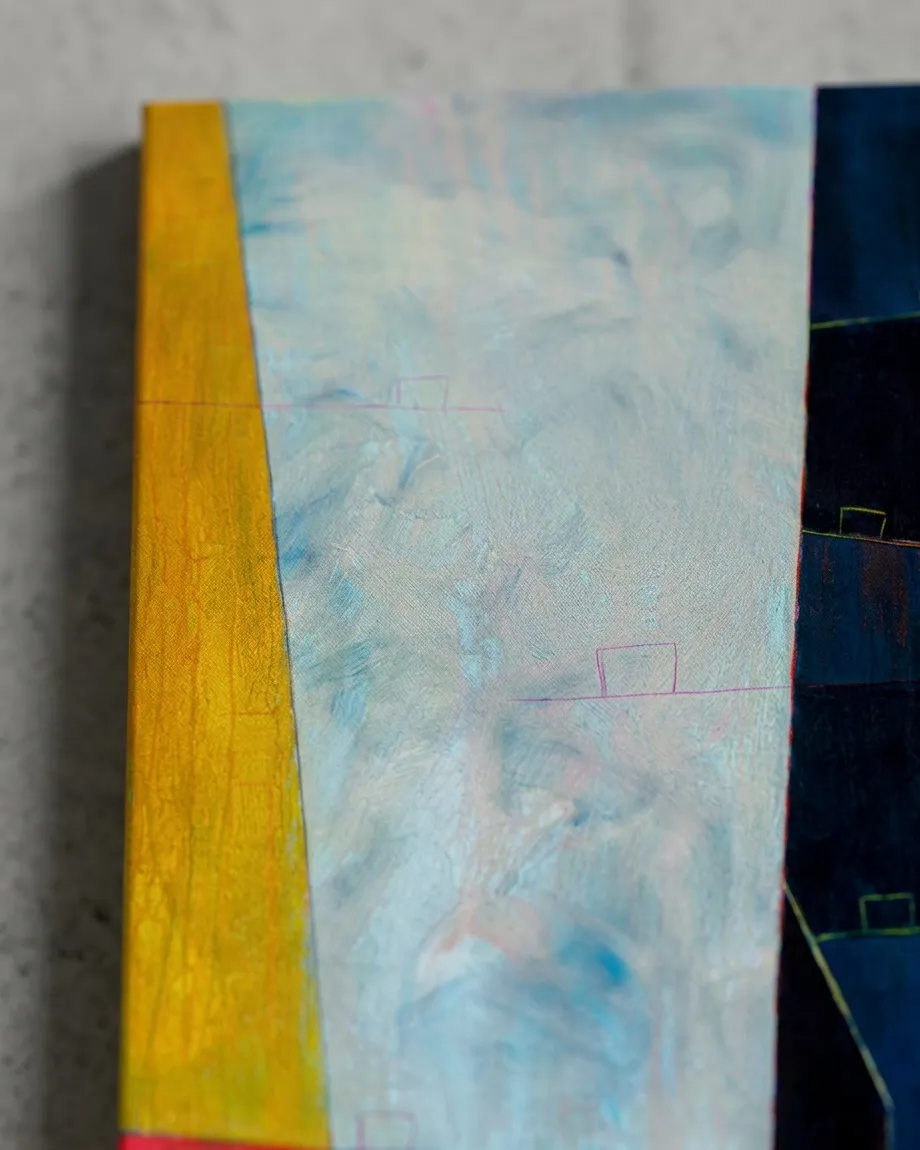
The pale-blue field of LIMEN retains an openness that resists any role as background. Seen up close, it reveals whitish glazes, pink and blue passages, and brushwork that does not dissolve into a smooth atmosphere: the surface records a formation still in progress. On either side, the inclined ochre and the dark band concentrate the weight of the edges; between them, the lines and small magenta enclosures barely attempt a measure. This economy belongs to Maurizio Valch’s visual language, grounded in colour fields and divisions capable of situating a presence without enclosing it. The proximity of this presentation even makes the canvas weave and the uneven density of the pigment perceptible: the centre does not open onto an illusionistic depth, but sustains its own material condition as a place in the making.
Keeping something unresolved seems to be a form of attention rather than a lack of decision. In the artist’s thinking, territory does not refer only to an external landscape: it can be memory, pressure, time, or a space of appearance, without these dimensions needing to be translated into fixed symbols. The outlines in LIMEN allow for this openness because they do not impose meaning on what they circumscribe. They might organise a minimal construction, yet remain too light and porous to stabilise it. The painting thus offers an experience close to an observation Valch has formulated in other contexts: attending to what appears before the mind turns it into a total explanation. The pale blue does not provide an identity; it delays the moment at which an identity might be asserted.
In “When the Ground Appeared,” Valch writes that emerging does not mean attaining a definitive form, but leaving a previous condition behind and becoming exposed. LIMEN shifts this idea into an especially tenuous scene: we do not witness the emergence of a recognisable figure, but the minimal conditions that would make its outline possible. The ochre band and the almost-black blue side act as boundaries that make the central breadth perceptible, though they do not dominate it. The ground, as that essay understands it, is not neutral: it supports, separates, and conditions. Here, however, the pale expanse retains a reserve that resists being fully transformed into architecture. The threshold named by the title becomes temporal: the slow interval in which something begins to take measure without yet knowing what it will be.
A particular affinity with Paul Klee helps clarify the role of these small rectangles and lines: they neither describe buildings nor function as emblems, but as signs of scale that activate distance within the field. In LIMEN, their fragility matters more than their shape. Against geometry’s tendency to order and conclude, Valch leaves them suspended over a veiled and changing material; they are indications of a possible organisation, not the plans for a structure. The painting therefore retains a singular spatial unease: the more discreet these delimitations become, the vaster the area they fail to possess.
- Original artwork
- LIMEN
- Actual dimensions
- 31.5 × 47.2 in / 80 × 120 cm
- Presentation
- Digital contextual visualization
Context references
contemporary abstract painting detail · canvas texture with glazes · pale-blue and ochre abstract painting · abstract art with fine geometric lines · colour field painting detail · light blue textured painting
About this visualization
This visualization places the artwork within an architectural context to help collectors and viewers imagine its presence in a real space. It is an interpretive reference, not an exact reproduction: the original work remains the sole authority for scale, color, surface and material presence.