Context study / LIMEN
LIMEN by Maurizio Valch | Abstract threshold painting
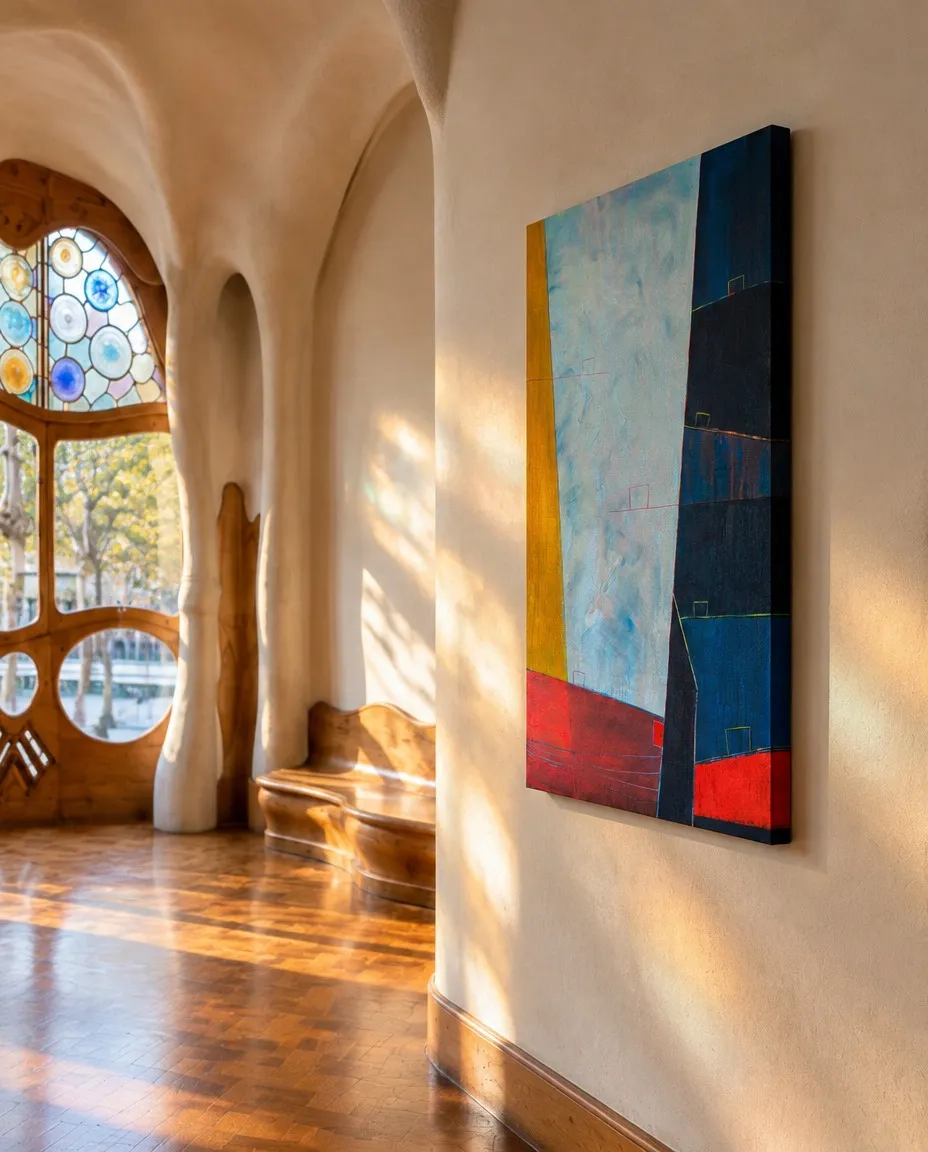
The pause within LIMEN becomes clearer when it appears at an angle, without occupying the corridor frontally. Its eighty by twenty centimetres sustain a precise vertical: an ochre band opens along the left flank, veiled pale blue holds the centre, and an accumulation of near-black blues compresses the right; below, red shifts the distribution of weight. Yet none of these fields behaves as a static parcel. The edges slant, the paint changes in density, and the small linear rectangles introduce fragile measures, barely sufficient for the eye to register distances. This economy belongs to Maurizio Valch’s territorial language, made of divisions, horizons, and worked surfaces; in this work, boundaries order the field without closing it.
Such an arrangement may be related to an experience of passage that runs through the artist’s thought: that of being between a place left behind and another not yet assumed. There is no need to identify the planes with biographical episodes to sense that LIMEN resists the security of a definitive border. The dark area does not cancel the milky air of the centre, nor does the lower red settle into a stable ground. Each zone retains its condition, yet remains affected by its proximity to the others. The painting thus leaves an open question: does distinguishing oneself, taking up a position, truly require isolation? Rather than answering through symbols, it proposes an experience of attention in which passage becomes perceptible because differences exist, not because movement has ceased.
The essays “From Dream to Territory” and “When the Ground Appeared” help situate this reserve. Valch has described the movement between his series not as an evolution that cancels previous stages, but as a sedimentation: dream persists as ground gains weight, and the appearance of a form retains the pressure of what contained it. EMERSIO is concerned precisely with that vulnerable moment in which something begins to take place without attaining a closed autonomy. LIMEN condenses the question with restraint. Its minimal outlines do not explain what has emerged; they make visible that every incipient form requires a relation to an edge. The threshold ceases to be a dividing line between two domains and becomes the very thickness of their contact.
The modernist architecture intensifies this reading without replacing it. Against the soft curves of the ceiling, undulating wood, and fragmented reflections in the stained glass, the canvas’s vertical bands do not compete by reproducing the dynamism of their surroundings. They introduce a delay. From the side, the dark depth of the edge and the slanted cut between the fields make the painting read as a quiet measure within a flowing space. With caution, one might recall an affinity with Barnett Newman in the capacity of a minimal division to turn a broad field into a spatial event. But where Newman tended towards a forceful assertion, Valch maintains variable edges, small signals, and a veiled materiality that prevent any final statement. The boundary remains firm only as much as is needed for shifting continuity to be felt.
- Original artwork
- LIMEN
- Actual dimensions
- 31.5 × 47.2 in / 80 × 120 cm
- Presentation
- Digital contextual visualization
Context references
LIMEN Maurizio Valch · vertical blue and red abstract painting · contemporary abstract art with colour fields · threshold and territory painting · vertical abstract wall art · contemporary territorial abstraction · dark blue and ochre abstract painting · minimalist painting for corridor
About this visualization
This visualization places the artwork within an architectural context to help collectors and viewers imagine its presence in a real space. It is an interpretive reference, not an exact reproduction: the original work remains the sole authority for scale, color, surface and material presence.