Context study / LIMEN
LIMEN by Maurizio Valch | Abstract painting in a gallery
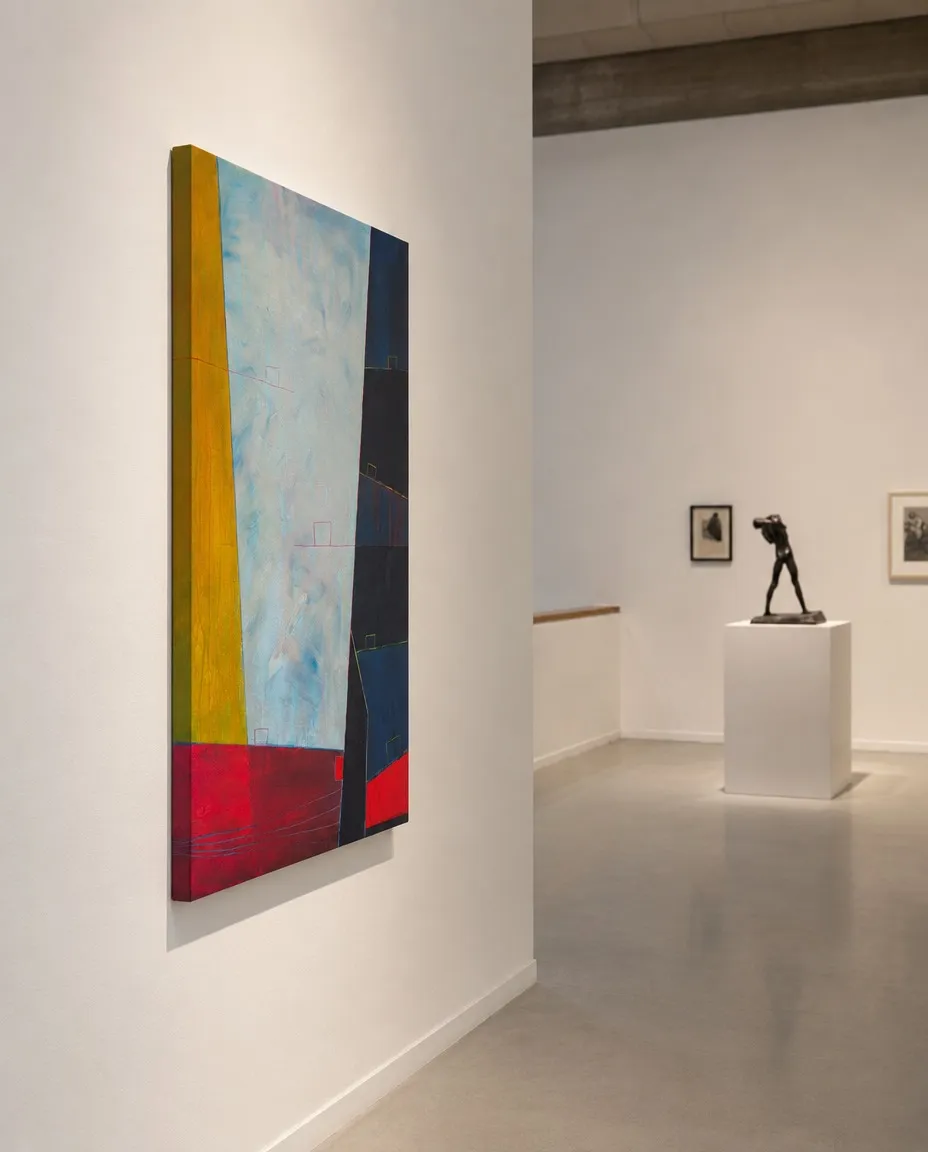
The passage is interrupted before the image can be taken as complete. From the side of the wall, LIMEN first appears as a three-centimetre edge and a narrow ochre strip; the pale blue field, dark bands, and lower red arrive later, when the body corrects its position. This sequence makes tangible a central feature of Maurizio Valch’s language: spatial divisions and chromatic fields do not describe a recognisable place, but organise a territory of boundaries, weights, and distances. Only on approaching do the minimal rectangles and fine lines crossing the zones of colour become apparent. They do not function as decorative details: they alter the scale of the whole and prevent the surface from settling into a conclusive architecture. The adjoining room, visible in the background, extends the delay; the painting does not close off the passage, but accompanies a movement between spaces.
This need to approach finds a cautious echo in an experience that runs through the artist’s thought: the difference between a route that can be traced and an inner movement whose direction is not known in advance. His journeys and walks have left him with a sustained attentiveness to places of passage, fatigue, and intervals in which apparently nothing happens. LIMEN does not illustrate those experiences, but its partial appearance allows the threshold to be read less as a fixed frontier than as a temporal situation: one does not yet possess an overall view and yet has already entered into relation with what lies ahead. The form does not offer itself as an answer; it requires the gaze to abandon the security of having understood too soon.
In “When the Ground Appeared,” Valch writes that emerging entails leaving a previous condition and becoming exposed: taking up a place does not mean attaining a definitive figure. LIMEN makes this vulnerability perceptible through its vertical organisation, in which veiled pale blue remains pressed between the slanted ochre and the bluish density on the right. The delayed view reinforces this condition: the small coloured enclosures do not appear all at once, but take shape as the viewer shifts position. “The Missing Beat” helps specify the effect. There, silence or rhythmic interruption is not a passive void, since it calls on the body to supply the missing pulse. In the same way, the initially hidden portion of the painting activates anticipation: physical movement completes, without entirely resolving, the experience of the visible.
The affinity with Paul Klee is pertinent not because of any general formal resemblance, but because of the role of these small linear units as uncertain measures within a larger expanse. In Klee, certain signs and elementary architectures can make a distance inhabitable without mastering it; in LIMEN, the magenta, green, and yellow rectangles introduce a fragile scale amid fields that exceed them. Valch departs from the graphic lightness associated with that reference: his signs are absorbed into a denser surface, divided between chromatic weight and material edge. For this reason, the threshold is not reduced to a line within the painting. It extends into the time needed to pass alongside it, pause, and discover that looking also entails crossing.
- Original artwork
- LIMEN
- Actual dimensions
- 31.5 × 47.2 in / 80 × 120 cm
- Presentation
- Digital contextual visualization
Context references
LIMEN Maurizio Valch · abstract painting in a gallery · contemporary vertical abstract art · abstract painting with fine lines and minimal rectangles · territorial colour field painting · abstract wall art for gallery · pale blue ochre and red painting · contemporary vertical abstract artwork
About this visualization
This visualization places the artwork within an architectural context to help collectors and viewers imagine its presence in a real space. It is an interpretive reference, not an exact reproduction: the original work remains the sole authority for scale, color, surface and material presence.