Context study / LIMEN
LIMEN by Maurizio Valch | Vertical Abstract Composition
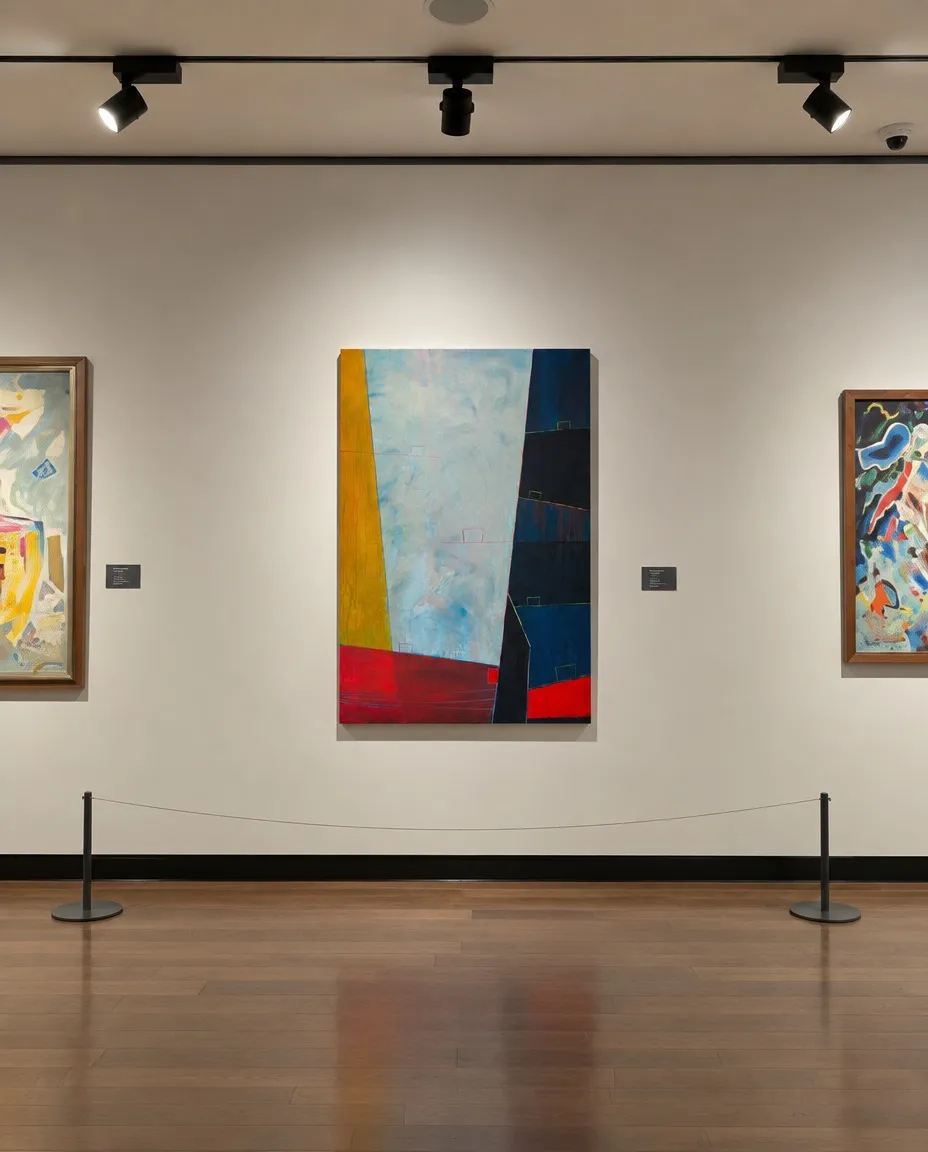
From a distance, LIMEN becomes an almost immediate assertion: the low red, the pale field, and the lateral blue-black band stand out with a force reinforced by the gallery’s frontal wall. Yet this reading of large masses slows down once the tiny magenta and green profiles come into view, barely held within the light blue or beside the dark edge. In Maurizio Valch’s language, divisions and marks do not establish a recognisable geography; they introduce limits and relations of scale within a territory in transformation. The 80 × 120 cm painting thus sustains two speeds: an organisation visible from afar and a more precarious web that demands closer attention.
That delay may be related to an attentiveness the artist has distinguished from the need to explain everything. His thinking distrusts the ease with which a perception or event becomes covered over by interpretations; in LIMEN, the minor signs resist precisely this rapid conversion into narrative. They offer neither figures, doors, nor an itinerary to decode. Rather, they make the proportions of the planes containing them uncertain and prevent the large central field from functioning as a calm surface. The experience approaches a threshold: something begins to separate from its surroundings, yet still depends on them to gauge its position.
In “When the Ground Appeared,” Valch writes that emerging entails losing the protection of the undifferentiated and becoming exposed to occupying a place. LIMEN makes this exposure material without theatricalising it: the small open figures barely manage to remain within a chromatic distribution of considerable weight. “The Missing Beat” helps to clarify the perceptual effect of this reserve. There, the artist considers rhythmic interruption as an absence that compels the body to sustain inwardly what it does not receive in full. The painting’s signs work in a similar way: they do not resolve the order of the fields, but interrupt it just enough for the gaze to prolong its attention and complete—without closing—the relationship between the zones.
The affinity with Paul Klee is relevant not because of a similarity of style, but because of the role minimal units can assume before a larger expanse. In Klee, a reduced sign can activate an architecture or alter the scale of an entire space; in LIMEN, the small chromatic contours perform a comparable task, though stripped of any narrative or playful impulse. Against the territorial compactness of Valch’s work, they act as uncertain measures: they make it perceptible that red is not simply ground, blue-black not merely an edge, and the pale plane not self-sufficient. The gallery’s public frontal view allows the whole to be grasped first; the painting reserves its instability for those who choose to stay.
- Original artwork
- LIMEN
- Actual dimensions
- 31.5 × 47.2 in / 80 × 120 cm
- Presentation
- Digital contextual visualization
Context references
LIMEN Maurizio Valch · vertical abstract composition · light blue red and blue-black abstract painting · contemporary art with minimal geometric forms · colour-field abstract painting · abstract painting for a gallery wall · territorial abstraction with spatial divisions · minimalist vertical wall art
About this visualization
This visualization places the artwork within an architectural context to help collectors and viewers imagine its presence in a real space. It is an interpretive reference, not an exact reproduction: the original work remains the sole authority for scale, color, surface and material presence.