Context study / LIMEN
LIMEN by Maurizio Valch | Abstract Painting in a Contemporary Corridor
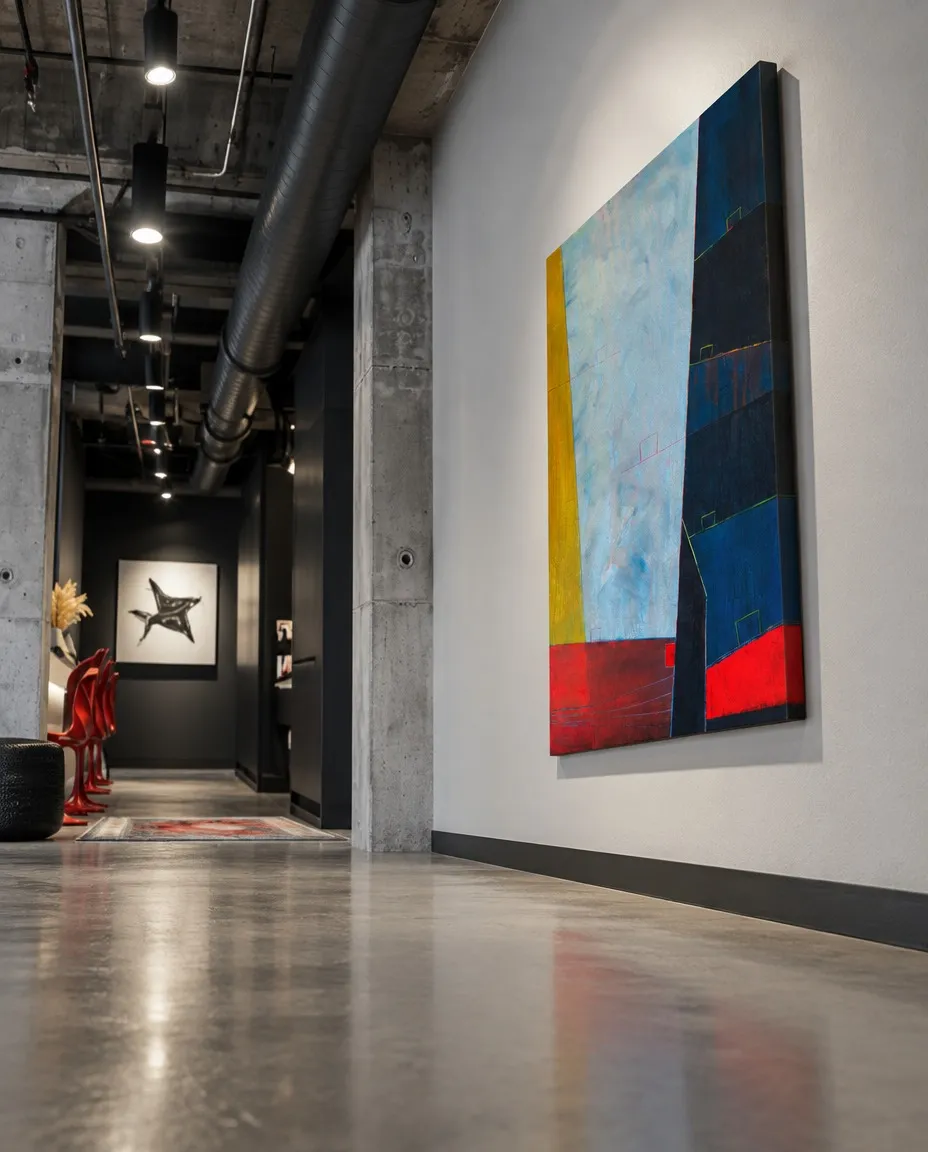
The corridor imposes a rhythm of transit—polished floor, pillars, ducts, and repeated light fixtures—but LIMEN introduces a delay that cannot be absorbed by it. The 80 × 120 cm canvas, set slightly apart from the wall and seen at an angle, retains even the physical presence of its 3 cm depth. Within it, the veiled light blue does not yield to decorative transparency: it sustains a surface of milky variations and traces of work; the lower red rises with contained energy, while the nearly black blues concentrate along the right edge. This arrangement extends Maurizio Valch’s austere territorial language, based on fields, divisions, and tensions of scale, without turning geometry into a conclusive order. The small colour profiles do not stabilise the whole: they provisionally measure an expanse that continues to change in density.
The slowness activated by the painting may be related to a persistent concern of the artist: attending to an event before thought covers it over with explanations. There is no reason to turn the colours of LIMEN into a psychological narrative; yet their resistance to being resolved at a glance makes that attentive disposition perceptible. The oblique bands and minimal rectangles require the gaze to linger without promising a final key. Against an architecture designed to direct bodies and organise movement, the work sustains an interval in which observing does not amount to classifying. Territory, in Valch’s research, may be both external and mental; in this scene, that double condition appears as a tangible pause within a passage that remains open.
The essay “The Missing Beat” helps clarify the scope of that pause. There, the artist examines how a regular pulse makes the absence of an expected beat active: the body continues to anticipate it and participates in the structure from the void. The sequence of lamps and ducts in the corridor offers a comparable regularity, but LIMEN neither illustrates nor theatrically contradicts it. It introduces a visual syncopation: the large light-blue field suspends the inertia of the greys, the lower red disrupts the continuity of the floor, and the fine lines shift the gaze’s point of support towards weak and uncertain areas. The painting does not isolate the viewer from the corridor; it returns that corridor to them with a less automatic attention, aware of the intervals its habitual rhythm leaves unseen.
A specific affinity with Nicolas de Staël helps to recognise the weight of its large chromatic masses, capable of oscillating between construction, landscape, and block. In LIMEN, too, the dark blue and pale field possess a gravity that prevents them from being treated as simple backgrounds. But Valch departs from any stable condensation: the light blue retains an eroded, breathing quality, the lateral bands incline, and the tiny green, magenta, and yellow contours introduce scales that unsettle the solidity of the whole. Rather than closing off a chromatic architecture, the painting maintains a threshold: a silent concentration that, even surrounded by concrete and circulation, leaves the eye suspended in the time of its own delay.
- Original artwork
- LIMEN
- Actual dimensions
- 31.5 × 47.2 in / 80 × 120 cm
- Presentation
- Digital contextual visualization
Context references
LIMEN Maurizio Valch · EMERSIO abstract painting · blue and red abstract painting · contemporary vertical abstract art · colour-field painting · wall art for a contemporary corridor · abstract painting for an industrial interior · minimalist art with geometry and colour
About this visualization
This visualization places the artwork within an architectural context to help collectors and viewers imagine its presence in a real space. It is an interpretive reference, not an exact reproduction: the original work remains the sole authority for scale, color, surface and material presence.