Context study / LIMEN
LIMEN by Maurizio Valch | Abstract Territory in Transit
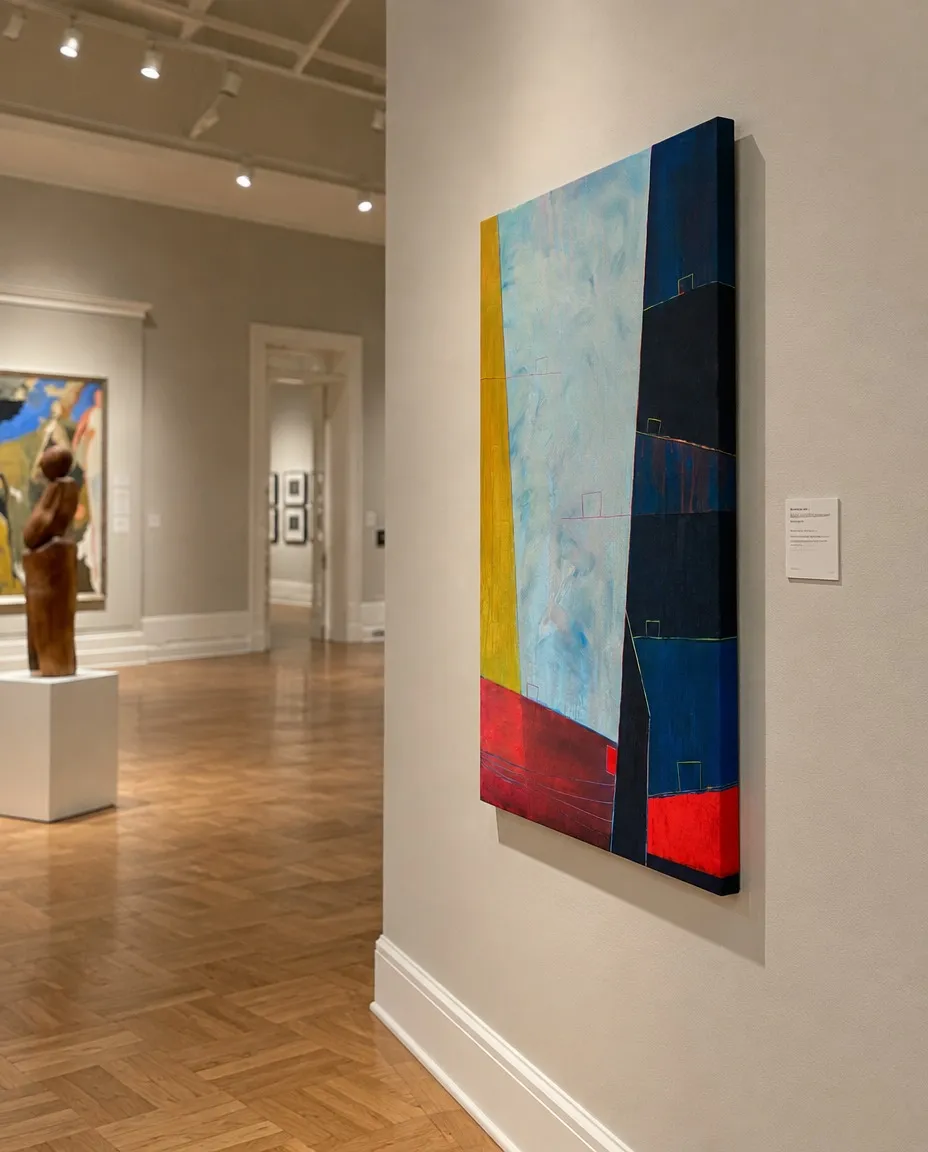
As one turns towards the next galleries, the painting does not close off the passage; it sets its pace. Its vertical 80 × 120 cm format appears in profile on the wall, allowing the corridor to retain its continuity to the left. Within LIMEN, the central light-blue field remains open and permeable, while the right-hand side concentrates successive dark planes, separated by fine lines that do not hold to a fixed height. The red base and narrow ochre band introduce further points of support, yet none settles into ground or arrival. This distribution belongs to Maurizio Valch’s territorial language: fields, divisions, and incisions do not illustrate a recognisable geography, but make relations of weight, distance, and edge visible. In this presentation, these relations create lateral pauses within a movement uninterrupted by the architecture.
An outward direction may be clear without resolving the movement of the person travelling through it. In Valch’s thinking, the experience of travel has left a persistent distinction between a traceable path and an inner orientation that offers no reliable map. LIMEN gathers this difference without turning it into a personal narrative: the small rectangular forms and the strokes crossing the fields seem to register temporary positions rather than indicate a route that must be followed. The blue and black density on the right may be felt as a sequence of retentions, but not as a final obstacle. Each band briefly arrests the gaze and yet allows it to return to the light area or continue towards the lower red. The painting thus sustains an experience of passage in which stopping does not mean retreating, nor having found a destination.
This suspension enters into dialogue with two strands of his writing. In “From Dream to Territory,” Valch insists that the transition between his series should not be understood as linear progress: what came before remains active in the new organisation, and choosing one’s own movement does not guarantee a conclusive destination. LIMEN belongs to EMERSIO, precisely the moment when a form separates from the territory without yet attaining secure autonomy. Meanwhile, “The Missing Beat” considers rhythmic interruption as an absence that activates attention rather than emptying it. The lateral bands function similarly: their changes in colour, level, and thickness introduce visual syncopations. The gaze anticipates regularity and encounters slight mismatches; it must complete the cadence for itself, without the painting offering a narrative solution.
An affinity with Richard Diebenkorn helps clarify this condition of movement through space. In both cases, oblique planes and abstract divisions retain a memory of landscape: they suggest expanse, slope, or distance without describing a particular place. But where Diebenkorn can unfold space as a broad, airy network, Valch compresses that possibility into an edge under greater pressure. The dark band does not organise a perspective receding into depth; it stands beside the light field as a succession of partial thresholds. Seen beside the museum’s actual opening, this difference becomes physical: the visitor may continue walking, even as the painting makes them feel that every continuity contains intervals that do not yet know where they lead.
- Original artwork
- LIMEN
- Actual dimensions
- 31.5 × 47.2 in / 80 × 120 cm
- Presentation
- Digital contextual visualization
Context references
LIMEN Maurizio Valch · abstract painting about territory and transit · vertical dark blue and red abstract art · contemporary painting with spatial divisions · abstract painting with light-blue and ochre fields · minimalist territorial abstraction · vertical wall art for contemporary interiors · threshold abstract painting
About this visualization
This visualization places the artwork within an architectural context to help collectors and viewers imagine its presence in a real space. It is an interpretive reference, not an exact reproduction: the original work remains the sole authority for scale, color, surface and material presence.