Context study / GRADUS
GRADUS — Context Study
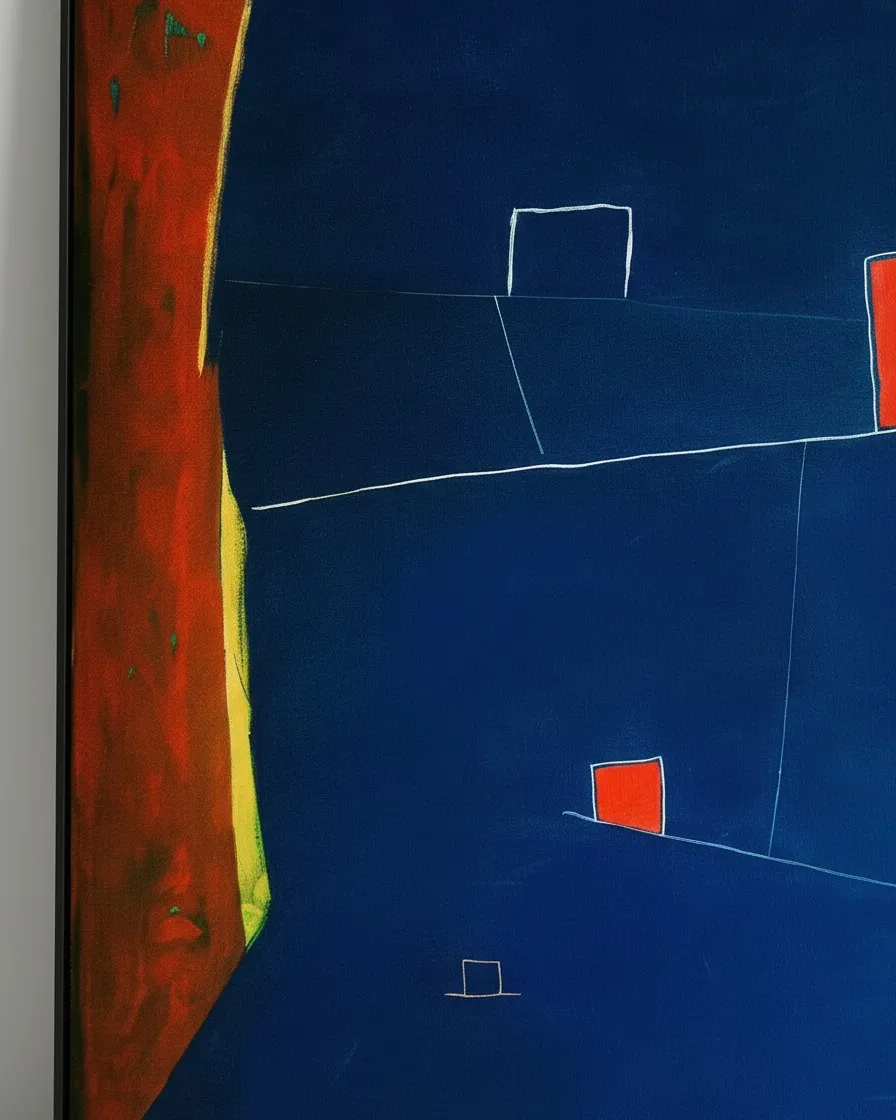
Depth and spatial tension in this canvas fragment are established through the sharp encounter of two adjacent color fields. On the left, a textured rust-orange band stands out, bounded by a thin, luminous yellow line that vibrates against the deep cobalt blue ground. The visual focus shifts toward the center, where thin, intersecting white lines and open geometric forms support a small red quadrant suspended in the space. Viewed closely, the painted surface reveals the canvas weave beneath layers of acrylic and oil glazes, showing discrete traces of the brush and palette knife. This physical proximity invites a quiet, direct engagement with the painting, presenting the materials without embellishment. The composition rests in a state of quiet containment, where soft light emphasizes the subtle tactile variations of the suspended forms.
- Original artwork
- GRADUS
- Actual dimensions
- 47.2 × 63 in / 120 × 160 cm
- Presentation
- Digital contextual visualization
Context references
original cobalt blue abstract painting · contemporary vertical abstract artwork · original oil and acrylic on canvas · minimalist red and blue geometric art · textured blue and rust color field painting · contemporary painting from SITUS series · original painting by Maurizio Valch · modern brutalist abstract art · fine art for contemporary collections · minimalist vertical oil painting · cobalt blue and rust orange painting · abstract canvas painting with geometric lines
About this visualization
This visualization places the artwork within an architectural context to help collectors and viewers imagine its presence in a real space. It is an interpretive reference, not an exact reproduction: the original work remains the sole authority for scale, color, surface and material presence.