Context study / FISSURA
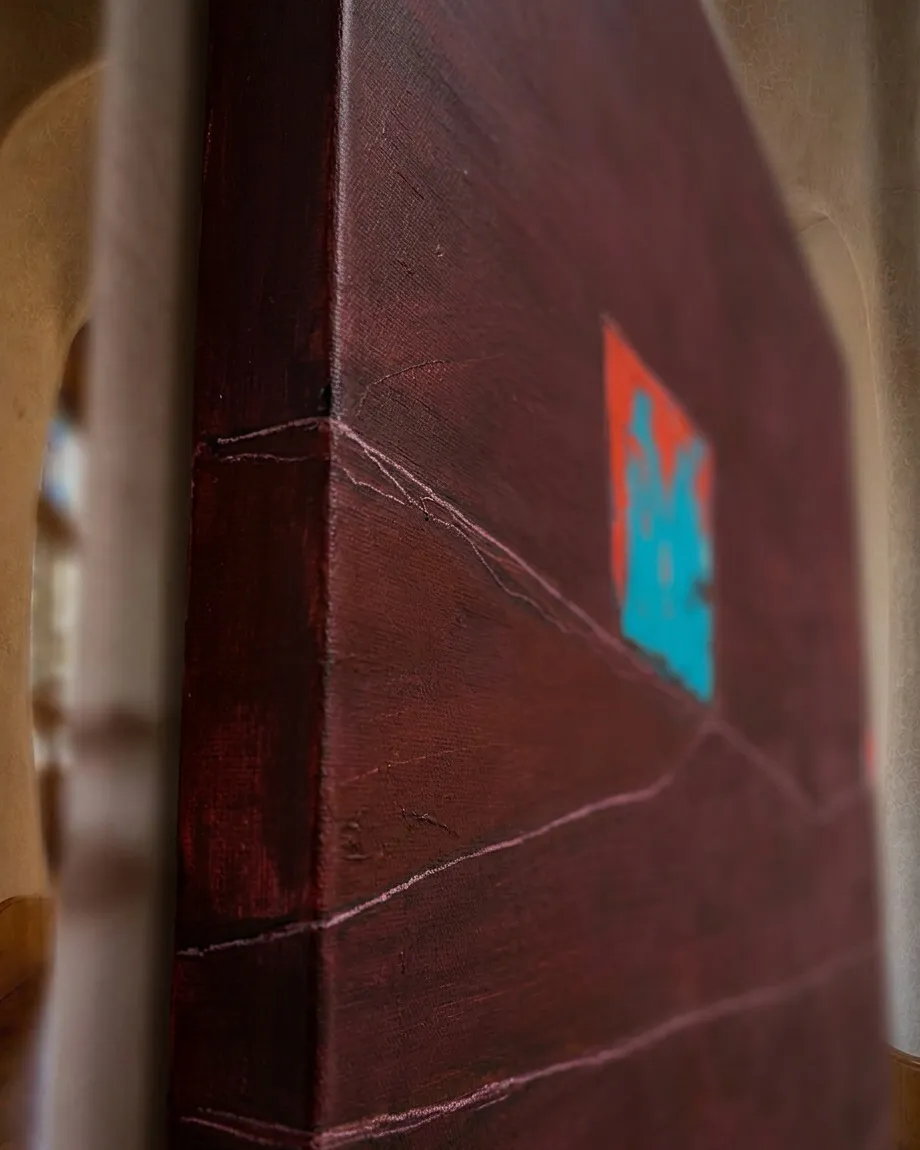
Stretcher Detail and Texture of the Painting FISSURA
The gaze first stumbles upon the edge of the stretcher, a thickness of three centimeters where the canvas folds, revealing the material accumulation of pigment—a crust of wine and burnt earth that anticipates the topography of the frontal plane. Venturing into the surface, space unfolds not as a representation, but as a geological territory subjected to shearing forces. A thin line, incised directly onto the plane, tears the continuity of the dark crimson, dividing the canvas into strata that seem to slide in opposite directions. Upon this crevice rests a small quadrangular block, a volume of bright red topped by a discharge of turquoise blue that breaks the chromatic silence of the background with the urgency of an alarm signal. This small structure, far from integrating peacefully, is held in a precarious balance over the fissure, raising a silent question about its own nature: is it an archaeological vestige resisting erosion, or a redoubt of concentrated matter refusing to be devoured by the density of the surrounding void?
When I sink the spatula and the stylus into the fresh matter, I do not seek to draw a trajectory, but to tear away the excess to find the skeleton of the painting. The line in FISSURA is a physical cut, an incised line that resists my hand as it cuts through the overlapping layers of acrylic and oil that I have patiently accumulated over weeks. Time does not dissolve in color; it remains trapped in the groove, fossilized in the roughness of the frayed edges left by the tool as it drags the pigment. There is no room here for the complacency of ornament nor for the gentle brushstroke that seeks to seduce the eye. The painting is built through a dialectic of subtraction and loss, where the surface must be wounded to reveal its true structural density, its condition as an exposed body that bears gravity and the wear of the gesture.
This wound in the pictorial surface acts as a threshold where psychic and intellectual tensions converge, tensions that resonate with the mental cartography designed by Carl Gustav Jung, the Swiss psychiatrist who analyzed the thin boundary between the mask of consciousness and the abysses of the collective unconscious. From this perspective, the fissure segmenting the canvas represents the inevitable breakdown of the Persona, the cracking of the socialized order that exposes the Shadow or the spark of the Self, embodied here in that anomaly of turquoise blue emerging above the block. In parallel, the chromatic inertia of the reddish plain evokes the existential automatism pointed out by George Gurdjieff, the mystic who described the state of hypnotic sleep in which ordinary human life takes place. The isolated block, suspended over the scar, thus takes on the character of a nucleus of "self-remembering," a desperate effort to fix attention and awaken in the midst of a plain governed by mechanistic repetition. The painting does not resolve this conflict; it exposes it as a latent tectonic fault, suggesting that civilization itself is nothing but a fragile crust suspended over underground currents ready to fracture it.
I view with suspicion the insistence on searching for mystical keys or grandiose psychological readings in what is, fundamentally, a physical fact of weight, proportion, and color. For me, that red and turquoise block is not a symbol of the awakening of consciousness, but a material presence, a concentrated mass struggling to sustain itself on the edge of a fault line that I myself have dug. My gaze was educated under the light of a harsh Mediterranean, a geography that has nothing idyllic or postcard-like about it, but is defined by hard horizons, silent distances, and strata of ruins superimposed on the same dry clay ground. That color does not imitate the sea; it is the residue of an relentless light that burns the earth and exposes the skeletal structure of the landscape, a reality where things simply are, heavy and silent, resisting their own disappearance on a crumbling plain.
In the end, the work refuses to submit to the fixity of a single interpretation, remaining in a state of silent vibration that challenges the viewer. The three centimeters of depth of its profile constantly remind us that we are not looking at an illusory window, but at an object that shares our own three-dimensional space and our own time of wear. The formal tension between the vast field of color and the small geometric accident remains unresolved, suspended over the void of the crevice. It is a painting that does not seek to comfort, but to bear witness to the resistance of the limit, a structure held together by internal pressures and controlled ruptures. In its rough silence, the work remains as a fragment of wounded earth, a testimony that every form of order, whether on canvas or in the mind, is always defined by the depth and permanence of its own crack.
- Original artwork
- FISSURA
- Actual dimensions
- 47.2 × 31.5 in / 120 × 80 cm
- Presentation
- Digital contextual visualization
Context references
abstract oil painting texture · canvas stretcher thickness 3 cm · incised lines in abstract painting · foreground painting stretcher · Maurizio Valch FISSURA artwork detail
About this visualization
This visualization places the artwork within an architectural context to help collectors and viewers imagine its presence in a real space. It is an interpretive reference, not an exact reproduction: the original work remains the sole authority for scale, color, surface and material presence.