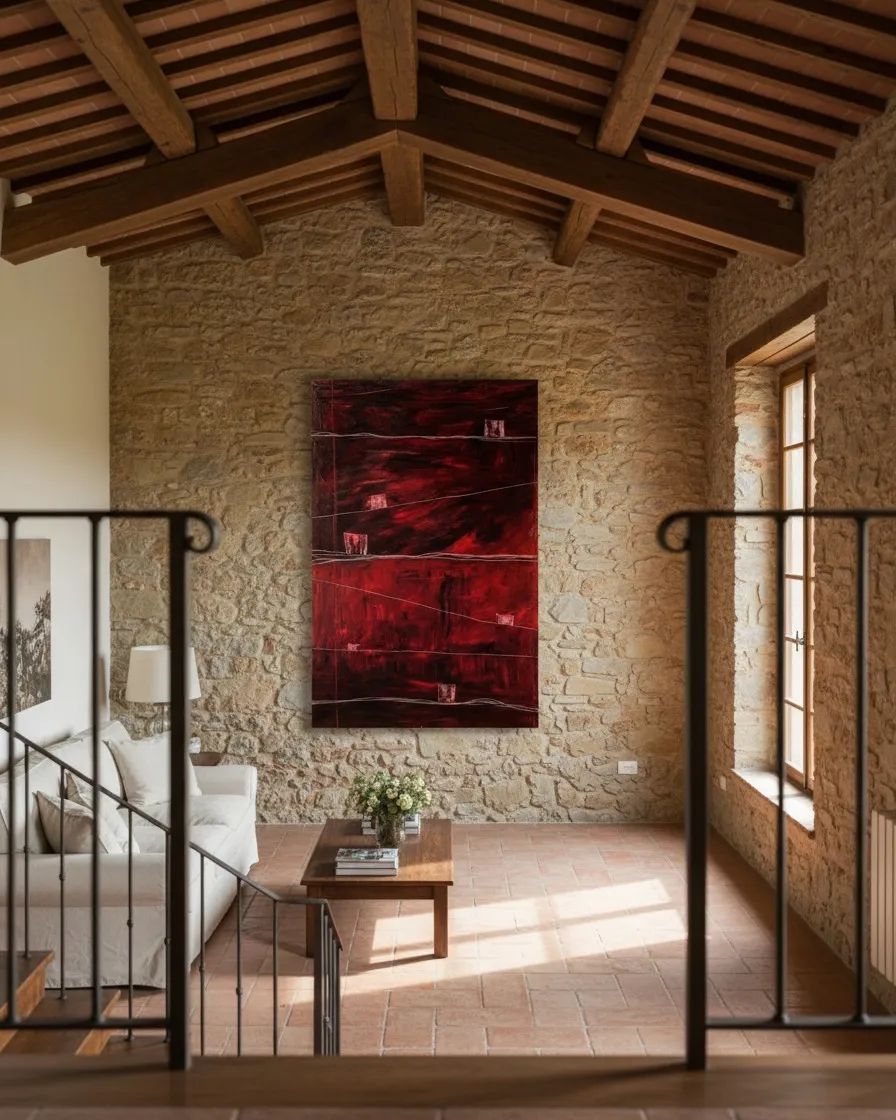
Context study / DISPERSA
Abstract Painting DISPERSA by Maurizio Valch in Rustic Living Room
The surface of "DISPERSA" presents itself as a dense stratigraphy where the crimson red, mixed with shades of rust and asphalt, acquires an almost geological quality, referring to primitive mineral pigments like red ochre (almagre) or iron clay used in prehistoric cave paintings such as Altamira or the Nerja caves. Far from being a flat background, this chromatic support functions as an earth crust under constant pressure, upon which small quadrangular pink-toned blocks are arranged, seeming to float or run aground in space. These minimal monoliths suggest archaic settlements or isolated awarenesses trying to resist dissolution within hostile territory. This fragmentary arrangement evokes the thought of Carl Gustav Jung, the Swiss psychologist and psychiatrist key to the analysis of the human psyche, whose concept of the fragmentation of the Self and the search for cohesion within the collective unconscious resonates in the way these forms search for a physical hold. There is no intention of illusory representation here, but rather a cold ordering of elements that strictly depend on the rugged geography of the canvas to find their place in the composition.
When facing the wet material of this canvas, my interest does not lie in the addition of color, but in the physical gesture of subtraction and incision. The horizontal lines crossing the composition are not strokes superimposed on the background, but wounds inflicted directly into the skin of the painting; they are incised marks executed with force using the palette knife and stylus, revealing the underlying luminous layers of acrylic and oil that lay hidden under the density of the crimson. I feel the resistance of the material as I drag the tool, a physical effort that turns the act of painting into a labor almost of stone-cutting or land-surveying. For me, this red background does not constitute an ornamental space or a passive void, but a dense body, a living and archaic matter that I decide to violate to trace a cartography of distance, where each indentation functions as a relief or a real coordinate sustaining the weight of the forms I paint on top.
The distance mediating between the small blocks distributed along the incisions generates a metric tension that defines the internal structure of the work. The philosopher and mystic of Armenian origin George Gurdjieff, known for his theories on the awakening of consciousness and human mechanicalness, proposed that individuals habitually operate under automatic laws that keep them asleep; in this sense, one might wonder if these horizontal marks function like the threads of a deterministic gear that drags the structures along, or if each monolith represents a nucleus of conscious resistance trying to maintain balance. This spatial tension is closely linked to the sonorous architecture of composers like Arvo Pärt, the Estonian pioneer of minimalism and creator of the tintinnabuli style, where the interval of silence between notes possesses the same vibratory and structural weight as the sound itself. In "DISPERSA", the apparent void between the geometric masses is not an absence of meaning, but an active space measuring the exact distance necessary so that the blocks do not collide or dissolve in the immensity of the crimson.
The title "DISPERSA" connects inevitably with my own experience of transit and exile, with that constant memory of the Mediterranean as a territory of interrupted steps and walking without a predictable destination. In tracing the red vertical line cutting the canvas at its far-left edge, I sought to delimit an absolute threshold, a tectonic axis acting as a physical border and impassable barrier defining the limit of the habitable. While meticulously placing each block on the horizontal scored marks, I was invaded by the uncertainty of not knowing if these small structures are searching for a safe refuge along the path or if, on the contrary, they have been definitively abandoned to their fate, subject only to the precarious gravity of the line sustaining them in the midst of the chromatic storm. Each block is a presence I place in space with a held pulse, measuring its vulnerability against the visual weight of an environment threatening to absorb them.
Returning the gaze to the concrete materiality of the surface, "DISPERSA" consolidates itself as a visual battlefield between the geometric rigor of its six blocks and the eroded, almost brutalist quality of the red-black background. The faded edges of the quadrangular forms contrast with the sharpness of the incised lines, laying bare the coexistence of formal planning and the accident of the pictorial material. There is no comforting resolution or promise of definitive order in this composition; the elements remain suspended in a tense immobility appealing to the raw perception of the observer. Ultimately, the painting places us before an undecipherable topography where the blocks persist clinging to their thin lines of containment, forcing us to inhabit the uncertainty of a space where distance is the only real measure of existence.
- Original artwork
- DISPERSA
- Actual dimensions
- 31.5 × 47.2 in / 80 × 120 cm
- Presentation
- Digital contextual visualization
Context references
crimson red abstract painting · decorating rustic living room with contemporary art · abstract painting by Maurizio Valch · 80x120 cm paintings for living room
About this visualization
This visualization places the artwork within an architectural context to help collectors and viewers imagine its presence in a real space. It is an interpretive reference, not an exact reproduction: the original work remains the sole authority for scale, color, surface and material presence.