Context study / DISPERSA
DISPERSA — Context Study
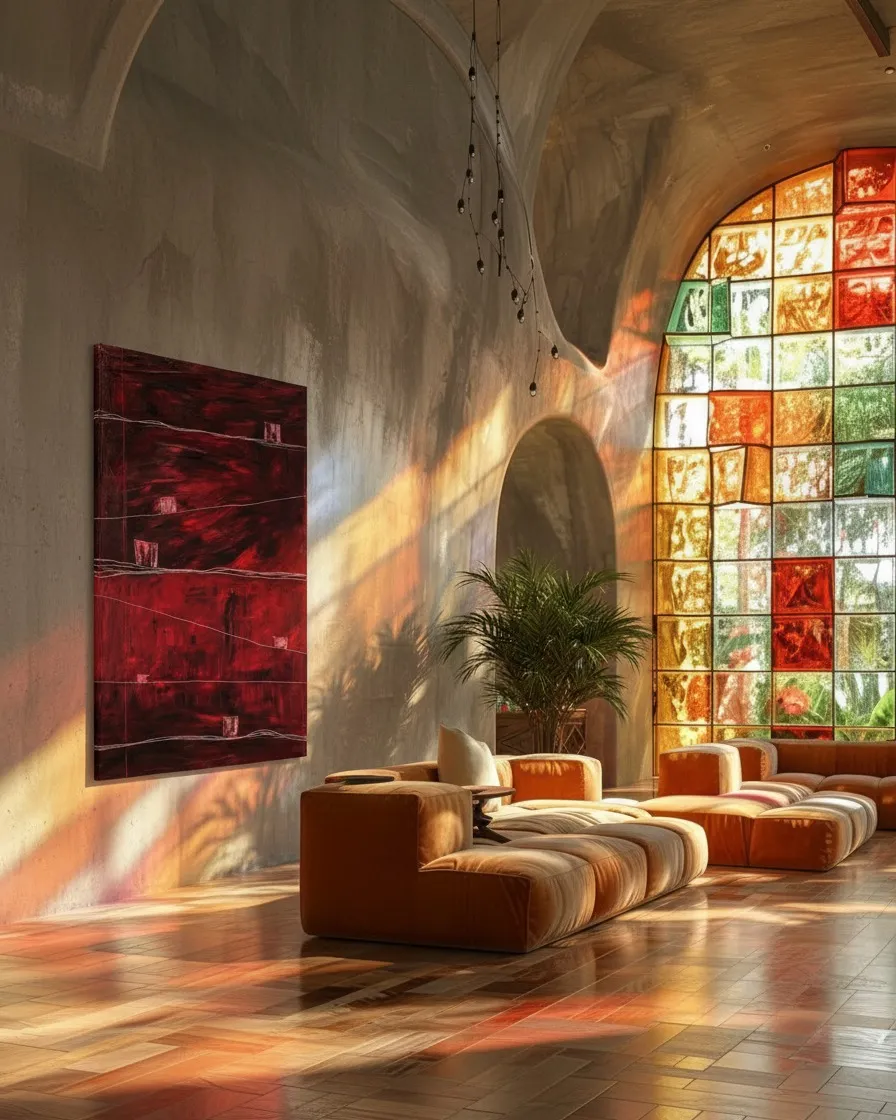
A silent temple does not need speeches to support its gravity; the slant of its vaults and the filtered light brushing its walls are enough. Observing DISPERSA installed in this architecture of high ceilings and windows casting bursts of color, it immediately becomes clear that the painting was not conceived to narrate an event, but to occupy space with the fixity of an interior climate. Against the transitory dynamism of the sunlight bathing the room, the large crimson canvas remains immutable, condensing a dense, almost geological emotional temperature. There is no anecdote, no characters, no temporal coordinates; the work acts as a block of concentrated silence that halts the dispersion of the environment and demands of the viewer a purely physical confrontation with the vibration and weight of color.
When I sink the palette knife to scrape the wet red matter, I am not drawing a path on the canvas, but opening a channel for an accumulated, nameless pressure to breathe. The crimson is not a decorative background; it is the thick stratum where I decide to deposit a state of suspicion and isolation, a contained vibration that refuses to be translated into words. Those incised lines, from which tiny blocks hang like suspended weights, are the record of a physical limit: the need to empty the surface so that the invisible acquires its own gravity. I know very well that thought immediately tries to invent an explanation to justify the stillness, but my painting seeks precisely to stop that defense mechanism and force us to remain before the bare fact of the wound on the fabric.
This refusal to narrate links Maurizio Valch to the emotional sobriety of Mark Rothko's color fields, where color ceases to describe and becomes a state of absolute absorption. However, while in the color field tradition the surface tends toward an atmospheric weightlessness, in DISPERSA the matter defends itself with a tactile stubbornness that dialogues closely with the legacy of Antoni Tàpies. The incision is not a floating line, but a physical cut that penetrates the strata of oil and acrylic, revealing the hidden support and turning the surface into a skin marked by the wear of time. By combining this subtractive wound with the appearance of contained geometric blocks, the artist avoids both informalist disorder and pure geometry, keeping emotion under a tight, asymmetrical iron structure that does not seek to comfort but to resist.
Many times I have been tempted to turn my life and my practice into a grand heroic gest, a journey of continuous battles where each painting must be justified as a trophy or a definitive change in my own identity. But before this canvas hanging in the shadows of this great space, I understand that true maturity consists in laying down arms and accepting that a mental state does not need a theory to be real. Resting the stretcher directly against the rustic floor of the studio or seeing it interact here with the changing light, I confirm that the incisions lead to no safe harbor; they are only transit marks, the proof that consciousness can sustain itself in its own decline without needing to invent a future justification.
In the end, the strength of DISPERSA lies in its ability to operate by subtraction, very close to the spare composition of Arvo Pärt, where the empty interval sustains the tension of the played note. The painting does not explain what has been lost or what is being sought; it limits itself to presenting the wound and the block, the fall and the resistance, in a suspended balance that resonates in the viewer's body before reaching their intellect. There is no mystery to be deciphered through a catalog of symbols, but rather a marked territory offered as a tactile shore. By renouncing narration, the image preserves the purity of condensed emotion, allowing silence to appear only when the mind has understood its own interpretative noise.
- Original artwork
- DISPERSA
- Actual dimensions
- 31.5 × 47.2 in / 80 × 120 cm
- Presentation
- Digital contextual visualization
Context references
buy red abstract painting · decorate living room with original art · large format painting designer living room · contemporary art spacious interiors · warm minimalist interior design
About this visualization
This visualization places the artwork within an architectural context to help collectors and viewers imagine its presence in a real space. It is an interpretive reference, not an exact reproduction: the original work remains the sole authority for scale, color, surface and material presence.