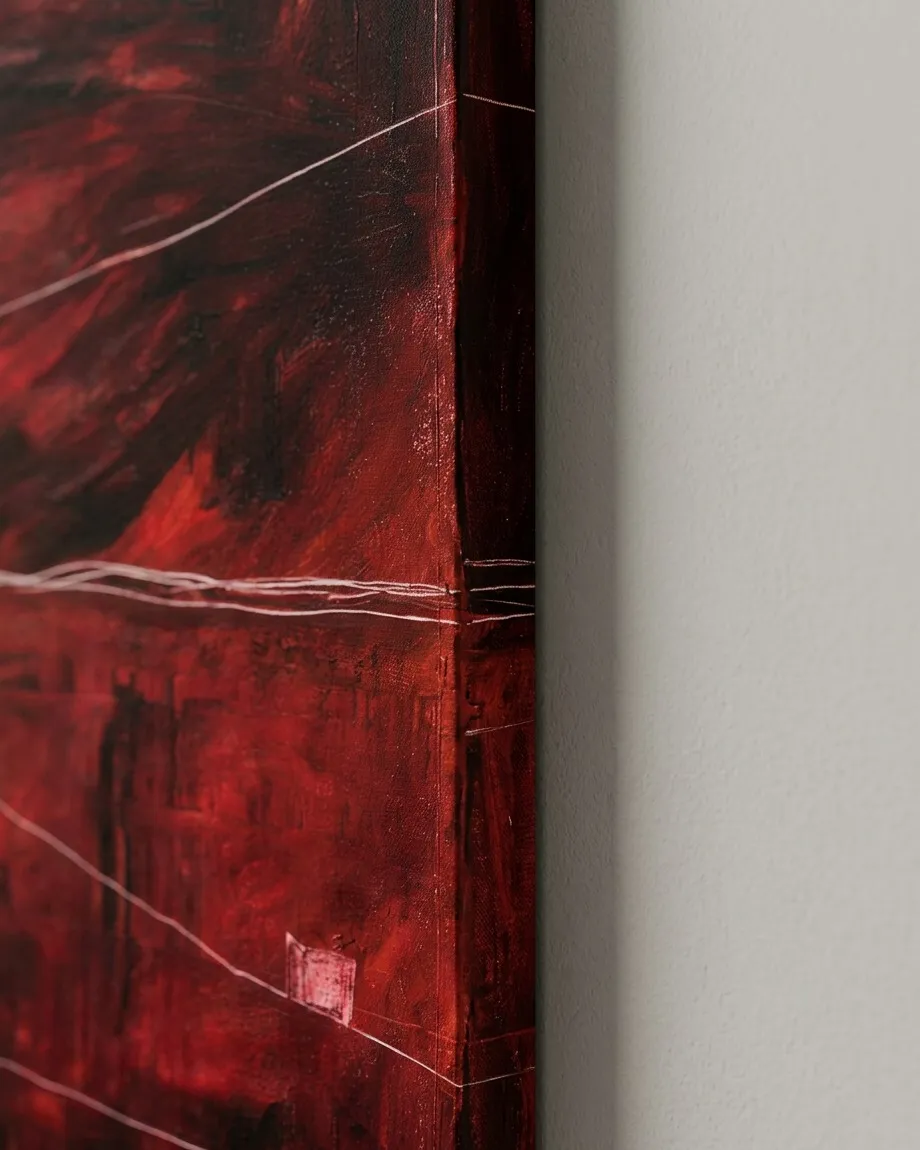
Context study / DISPERSA
Detail of the Edge of DISPERSA | Maurizio Valch
In the upper third, where a light thread moves diagonally. The surface resembles a power station lit up in the dark: it does not offer a complete flat plane, but rather fragments of activity, areas that receive pressure and others that absorb it. The eye follows the oblique thread from the left, believing it will find an exit; upon nearing the edge, the trajectory is interrupted or becomes too faint to guarantee its continuation. Then the question changes: perhaps it is not about crossing space, but about knowing which part of space is authorized to respond.
The dark red does not behave like a background. It thickens, recedes, and reappears with a density that forces one to look slowly. There are almost black areas that seem to retain an old signal, as if something had been said there many times and compressed until it lost its words. The thread, however, does not clarify: it barely insists. Its clarity is not a triumph over darkness; it is a fragile attempt to find direction within it.
On the left vertical edge, where a line seems to sew and wound at the same time. This vertical divides without fully separating. It could be the limit of a room, the seam of a screen, the place where a wall refuses to be completely a wall. Each thread that reaches this point modifies the previous one: the one that seemed like a route becomes an order; the one that seemed like a wound becomes a measure; the one that seemed like an escape returns as surveillance.
James Baldwin. He is a writer capable of listening to how intimacy, social violence, desire, and difficult truths pierce through a voice. Here he would quickly detect that these lines do not communicate innocently. They also distribute positions: on this side someone emits, on the other someone waits, and between the two, something records who may cross and who remains suspended. But the network does not allow itself to be fixed as a transparent denunciation. A thread can delimit, yes, and at the same time tremble as if it needed to be held by that which it limits. The surveillance also seems vulnerable; the border has an irregular breath.
The gaze goes down searching for a stable point and finds, instead of rest, a denser red band. There the viewer's body can change its rhythm: breathing becomes a little shorter, like standing before a zone that holds heat without offering shelter. The eye wants to check if one line actually touches the other, if they cross or only pass so close that they produce the illusion of contact.
In the medium-low band, where the red concentrates and the threads multiply. The damaged station seems to have accumulated messages at this point. They do not arrive in order. Some overlap, others deviate, and others are reduced to a light vibration over the dark density. The question is no longer just who speaks, but what happens to a voice when it finds too many voices stopped before it.
From that interference, a voice filters through, closer to the edge of the surface than to any explanation.
I look at that line and cannot decide whether it is obeying a direction or searching for a way to escape it. When the painting stands before me, the red zone seems to keep more than I recognize, and a small mark can alter the entire balance without asking permission.
This doubt does not soften the tension; it makes it more precise. The small pale rectangle near the bottom does not necessarily look like a window, a label, or a rescued fragment of a message. It could be a station that has lost its frequency. It could be a piece of light that arrived late. It could also be something the network failed to classify.
Then a child's question appears, exact and difficult to dismiss: why does the small light square at the bottom remain stuck to the red if the threads above seem to push it in another direction? The question alters the scale of everything. There is no longer a huge architecture of signals and cuts, but a minimal thing trying not to let go. The viewer approaches mentally, almost with the impulse to hold it with a finger, and discovers that the painting has made that simple gesture strange: would holding it mean protecting it, preventing its fall, or preventing its escape?
At the lower intersection, where several light lines brush past without quite coinciding. Charlie Chaplin. He is a filmmaker and actor capable of turning bodily imbalance, silence, and stumbling into thought. His entry modifies the gravity of the threads: they stop looking like mere cables stretched between hostile zones. They can also be a precarious choreography. One of them curves as if it had lost its step; another crosses with a slightly comic obstinacy; a third seems to arrive too late for a rendezvous with the edge.
There is a discreet tenderness in this uncoordination. Something could slip on the red band and, instead of disappearing, find an absurd way to stay upright. Viewed through this sensitivity, the pale lower form is no longer just retained: it essays a small maneuver. There is no need to turn it into a character to notice that it has a peculiar weight, an active clumsiness, a resistance that does not boast of heroism.
But Baldwin is not corrected by this lightness. The stumble does not erase the fact that some threads weigh more than others. The line that crosses the middle of the surface retains an almost administrative insistence: it passes, cuts, reappears, demands attention. Chaplin then discovers that grace can occur under a real load; the body does not always lose its balance as a game. Sometimes it stumbles because the ground was already tilted before it began to walk.
In the friction zone next to the right edge, where the red seems to compress against the shadow. There, the surface becomes especially ambiguous. There seem to be layers pulling apart and others pushing against each other. The vertical line does not finish ordering the scene: it could be a seam preventing a collapse, but also the place where the collapse has already begun. The gaze loses its orientation, returns to the upper thread, goes down to the small rectangle, and returns to the red band, as if each path activated a different frequency.
Baldwin, now traversed by the bodily fragility that Chaplin let in, might look at the small pale form differently. Perhaps it is not trapped inside the system of lines. Perhaps it tests, without grand gestures, an escape. Not a clean exit or a complete liberation, but the minimal displacement of one who learns to use an interruption as a breathing space. Chaplin, on the other hand, retains his newly acquired suspicion: even the slightest gesture may have to carry a force it did not choose.
The discrepancy remains alive between them. The need to state what weighs does not accept being turned into entertainment; the need to leave space for the stumble refuses to let every wound be fixed as a sentence. Between one and the other, the thread persists, light and almost hesitant, crossing a red that seems to listen without granting a complete answer.
In the interruption near the small pale rectangle, before the threads leave the field. The network disperses again. Nothing quite gathers into a readable sentence. There is control, but also loss; there is a will to order, but the order itself seems to generate deviations. The station is not simply broken: it continues to function in a way that forces one to distrust the very idea of functioning.
I want to order the paths, but each time one seems to settle, another appears to displace it. I do not know if the dispersion contradicts the control or if it is born within it. Sometimes I think I recognize an exit; immediately the surface hides something again that I cannot quite name.
A message remains active, not as a grandiose secret but as a concrete interference: the light line running through the medium-low zone seems to stop next to the edge, but perhaps it does not stop; perhaps it sinks into the red and continues where the eye can no longer follow it. Looking back at that intersection, the threads no longer seem to delimit the painting. They seem to be the only thing preventing the red band, accumulated behind them, from spilling out of the image.
- Original artwork
- DISPERSA
- Actual dimensions
- 31.5 × 47.2 in / 80 × 120 cm
- Presentation
- Digital contextual visualization
Context references
unframed painting edge · painted canvas side · 3 cm stretcher detail · abstract painting edge · profile artwork
About this visualization
This visualization places the artwork within an architectural context to help collectors and viewers imagine its presence in a real space. It is an interpretive reference, not an exact reproduction: the original work remains the sole authority for scale, color, surface and material presence.