Context study / DISPERSA
DISPERSA Abstract Painting in a Modern Wabi-Sabi Living Room
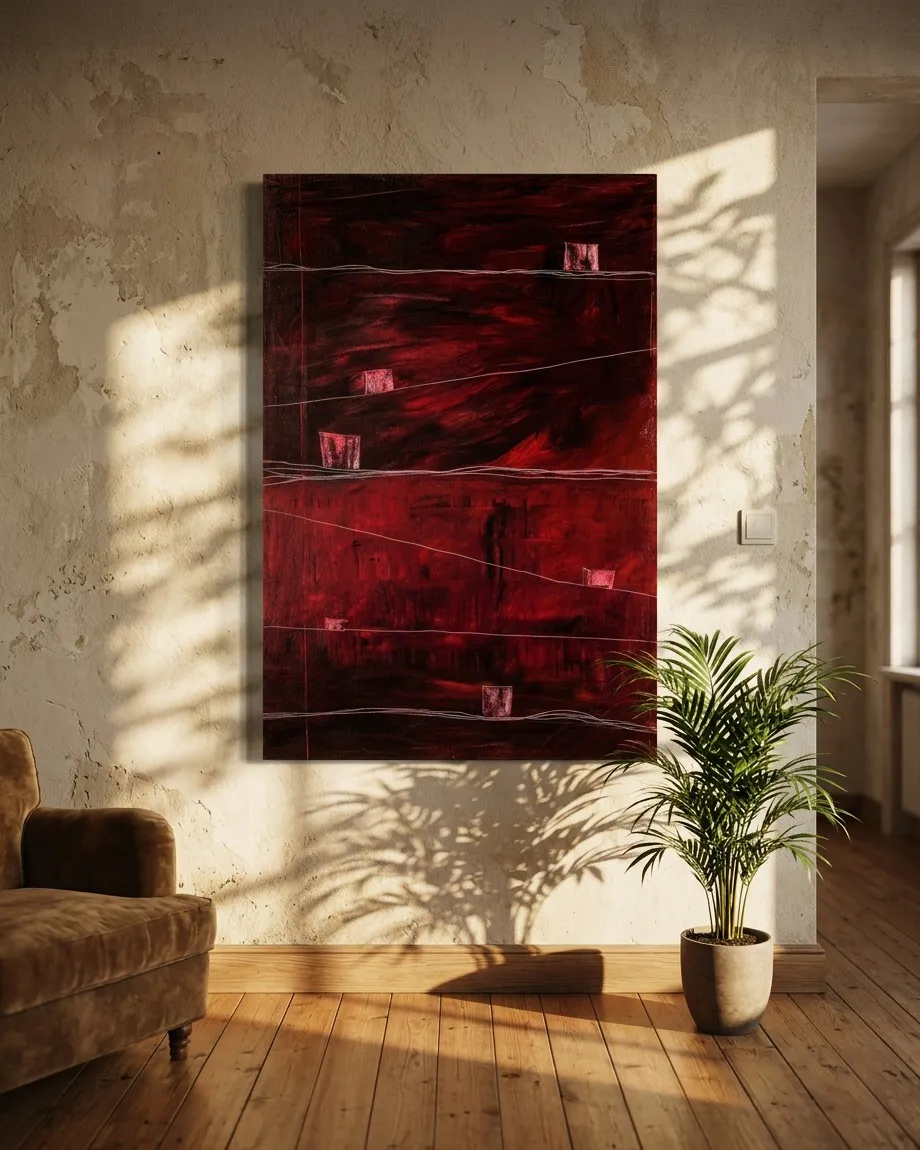
DISPERSA does not open like a landscape: it rises. First, it forces one to traverse its height, from the higher, more closed, almost nocturnal red, to the lower band, where the red seems to rehearse a ground without deciding to support anything. Between both extremes, the whitish lines cross the field as if someone had stretched nerves over an excessive distance. The question appears before finding its five small, light interruptions: what kind of gravity has been withdrawn from this place so that five small things remain suspended without becoming symbols?
The first is at the top, barely separated from the darkness that surrounds it. It could be a window too small for a face, a closed notebook, a fragment of wall that has detached without falling. Deciding it does not matter. What matters is noting that the nearby line does not fully support it: it passes close, brushes it, perhaps threatens it. Francisco Varela was a Chilean biologist and philosopher who thought of the mind as a living, bodily, and changing experience. With him, looking ceases to be a still operation: the eye follows the line and the body, without asking permission, looks for a posture so as not to slide with it. The line is not just a line; it organizes a precarious orientation for the viewer.
The second clarity appears lower down, towards the left, between layers of red that seem to move in different directions. Isadora Duncan was a dancer who made breath, weight, and movement a free way of thinking. She is suspicious that this form is floating. She sees it testing a minimal resistance: not the elevation of something light, but the effort of something heavy that has found, for an instant, a ridiculous and heroic way of not falling. A child might ask: "Why don't those little squares fall if there's nothing underneath?" The question remains between the two lines, more difficult to sustain than the small form.
I find myself before this surface as if before a distance that neither fully opens nor closes. I feel that the red offers me strata, but each stratum retreats when I try to measure it; I feel that the lines orient me, but also make me lose my balance. I cannot be sure where a depth begins or where a tension becomes a horizon. My gaze wants to rest, and the surface shifts.
The third form, located towards the center-left, seems to have reached an area of greater friction. The red no longer behaves as a background: it has visual thickness, interruptions, areas that absorb and areas that return a minimal light. The small, light piece does not dominate that density; it almost merges with it. If it were a door, it would be too narrow for a body. If it were a stone, it would be afraid of touching the ground. If it were a letter, it would have forgotten the language it was meant to deliver. No single possibility explains the figure, but each forces us to look at it more carefully: it is not on the red, but within a pressure that does not cease to expel it.
Varela would want to know what the viewer does with that pressure: how the eye invents top and bottom, distance and support, before naming them. Duncan interrupts that inquiry with a physical suspicion: perhaps the body does not look at the painting from the outside, perhaps it breathes trapped between two white tensions. Then the third form no longer seems like an isolated thing. It seems like the point where a breath has stopped. Varela discovers that the bodily gesture does not illustrate perception: it modifies it. And Duncan, by standing still before that small clarity, finds an immobility that does not fully fit in dance.
Further to the right, a fourth pale figure settles near a line that descends with a distrustful calm. There the space is disturbed. The line can be a wire, a cut, a horizon, or a wrinkle on an immense surface; it can support and divide at the same time. It is too thin to carry all the drama entrusted to it, yet it carries it anyway. The small form seems to have stopped just before obeying it. It is no longer enough to ask why it does not fall. The child's question changes: "What if it falls upwards?" Nothing in the painting answers, but the lower red begins to lose its authority as ground.
Between that fourth form and the last one, the painting acquires a kind of geography without maps. Above, the dark red retreats into bands of night. In the center, something rubs, crosses, insists. Below, the bands do not quite settle: they seem like surfaces that remember having been horizontal but have stopped trusting that condition. The whitish lines do not stabilize the place; they produce the sensation that a possible stability exists and withdraw it in the same gesture. Five small things do not remain here by miracle or obedience. They remain because the landscape has stopped deciding what it means to fall.
I believed I recognized a direction in these tensions, a sufficient relationship between the dark areas, the red bands, and the small light presences. Now I see that one of them escapes me: the one near the bottom edge confirms nothing of the above. It forces me to accept that the surface can keep a distance that does not depend on me, and that another gaze can find a connection there that I had not foreseen.
The fifth form waits below, near a low line that seems to vibrate without moving forward. It is the smallest and yet it alters the entire landscape. It could be a remnant of light that learned to reflect night; it could be a minuscule object looking at the ground before deciding if it exists. The surrounding red layers are no longer just layers: they are an enormous expanse whose gravity has been called into question by something almost insignificant. The line beneath that form does not fully support it or cut it. It remains slightly displaced, as if it had chosen a place where no fall could prove it wrong.
- Original artwork
- DISPERSA
- Actual dimensions
- 31.5 × 47.2 in / 80 × 120 cm
- Presentation
- Digital contextual visualization
Context references
red painting decorating ideas · warm minimalist living room with art · large format vertical abstract painting · textured painting on plaster wall
About this visualization
This visualization places the artwork within an architectural context to help collectors and viewers imagine its presence in a real space. It is an interpretive reference, not an exact reproduction: the original work remains the sole authority for scale, color, surface and material presence.