Context study / CUSTODES
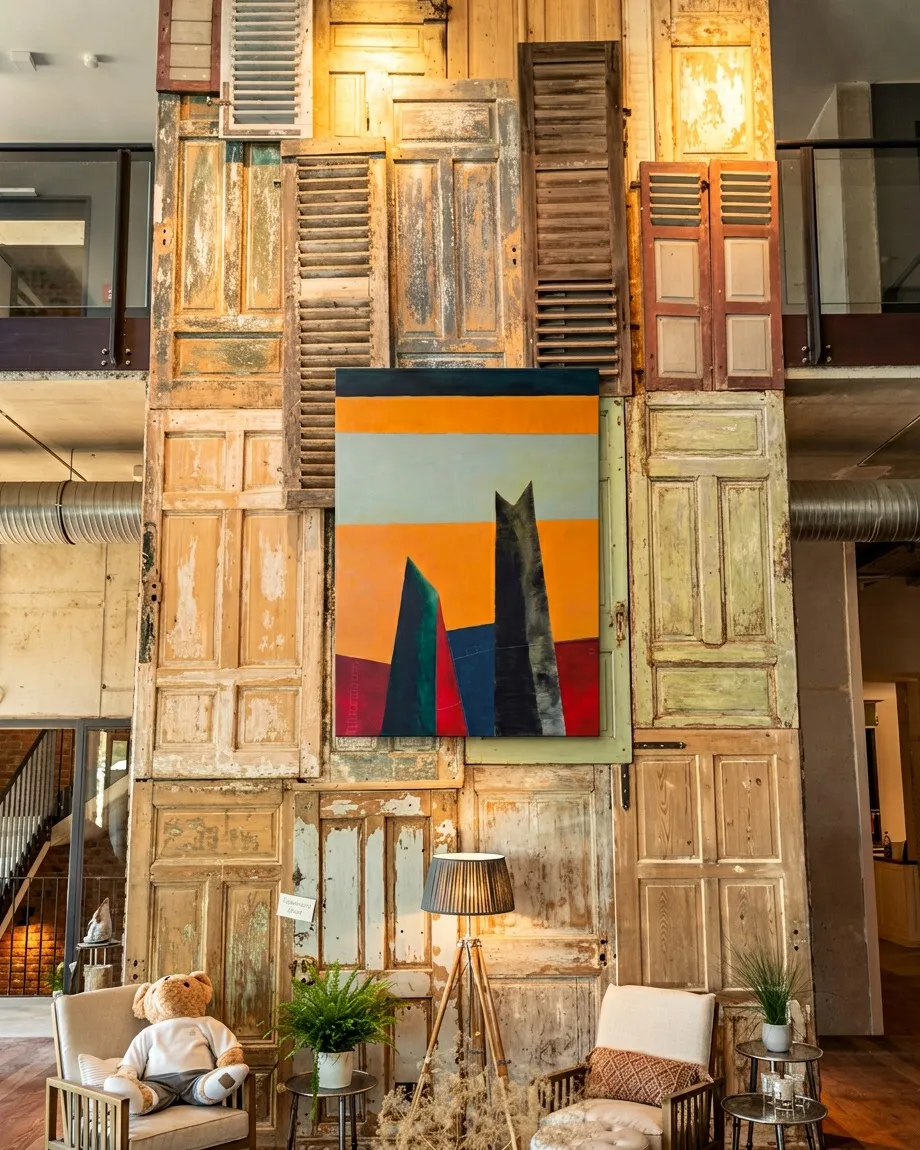
CUSTODES en un mockup de interior
None of the doors surrounding CUSTODES finds an equivalent within the canvas. The shutters, panels, and frames retain the evidence of an earlier function: to divide rooms, regulate light, allow or prevent passage. Before them, Maurizio Valch’s two vertical presences stand without hinges or openings. The taller one forks into two points beneath the dark band; the other, inclined and traced by a reddish edge, asserts itself against fields of orange, greenish grey, and crimson. Horizontal divisions and minute incised marks order the territory without making it traversable. This refusal is decisive: in a language that works with horizons, blocks, and marks capable of acting as boundaries or paths, CUSTODES makes the limit a material presence rather than an instruction.
Custody thus takes on an ambiguity that exceeds surveillance. The experience of displacement has left the artist with a sustained attentiveness to in-between places: the moment when one no longer fully belongs to the place left behind, nor has yet arrived at the next. There is no need to turn the figures into biography to recognise that their distance sustains a similar condition. Neither fully commands the field; both seem exposed to it and, at the same time, charged with maintaining it. The title does not determine whether they protect a territory, protect one another, or guard what cannot yet be shown. The painting preserves this uncertainty without turning it into decorative mystery: a boundary may offer shelter while simultaneously preventing something from taking form.
The essays From Dream to Territory and When the Ground Appeared help clarify this condition. Valch has written that the ground is not a neutral base: it supports, separates, and conditions what may rise upon it; in EMERSIO, to emerge means leaving the protection of the undifferentiated and becoming exposed. CUSTODES places that exposure in a relationship between two forms that have gained contour, though they still seem bound to the planes from which they arise. Surrounded by actual doors, the canvas intensifies a difference: the architectural threshold promises a concrete transition, while the painted figures keep open the question of what might lie on the other side. To guard, then, does not mean to close off; it means sustaining a frontier whose function has not yet been resolved.
The affinity with Nicolas de Staël helps clarify the weight of these chromatic masses suspended between block, architecture, and landscape. Yet where De Staël’s condensations may gather an impression of place under light, Valch retains a more reserved frontality: his forms do not lead the eye toward a recognisable scene, but hold it before two presences with no accessible interior. The weathered shutters heighten this reserve by contrast. Their worn layers speak of use and repeated passages; the bodies in CUSTODES, by contrast, seem newly separated from a territory that still lays claim to them. Between a door that remembers having been crossed and a form that grants no entry, the gaze remains before a threshold with no prescribed destination.
- Original artwork
- CUSTODES
- Actual dimensions
- 31.5 × 47.2 in / 80 × 120 cm
- Presentation
- Digital contextual visualization
Context references
CUSTODES Maurizio Valch old doors · abstract painting in an interior with reclaimed doors · contemporary art with monolithic forms · vertical orange and red abstract painting · wall art for an eclectic interior · abstract painting on a wall of old doors · territorial abstraction and architecture
About this visualization
This visualization places the artwork within an architectural context to help collectors and viewers imagine its presence in a real space. It is an interpretive reference, not an exact reproduction: the original work remains the sole authority for scale, color, surface and material presence.