Context study / CUSTODES
CUSTODES — Context Study
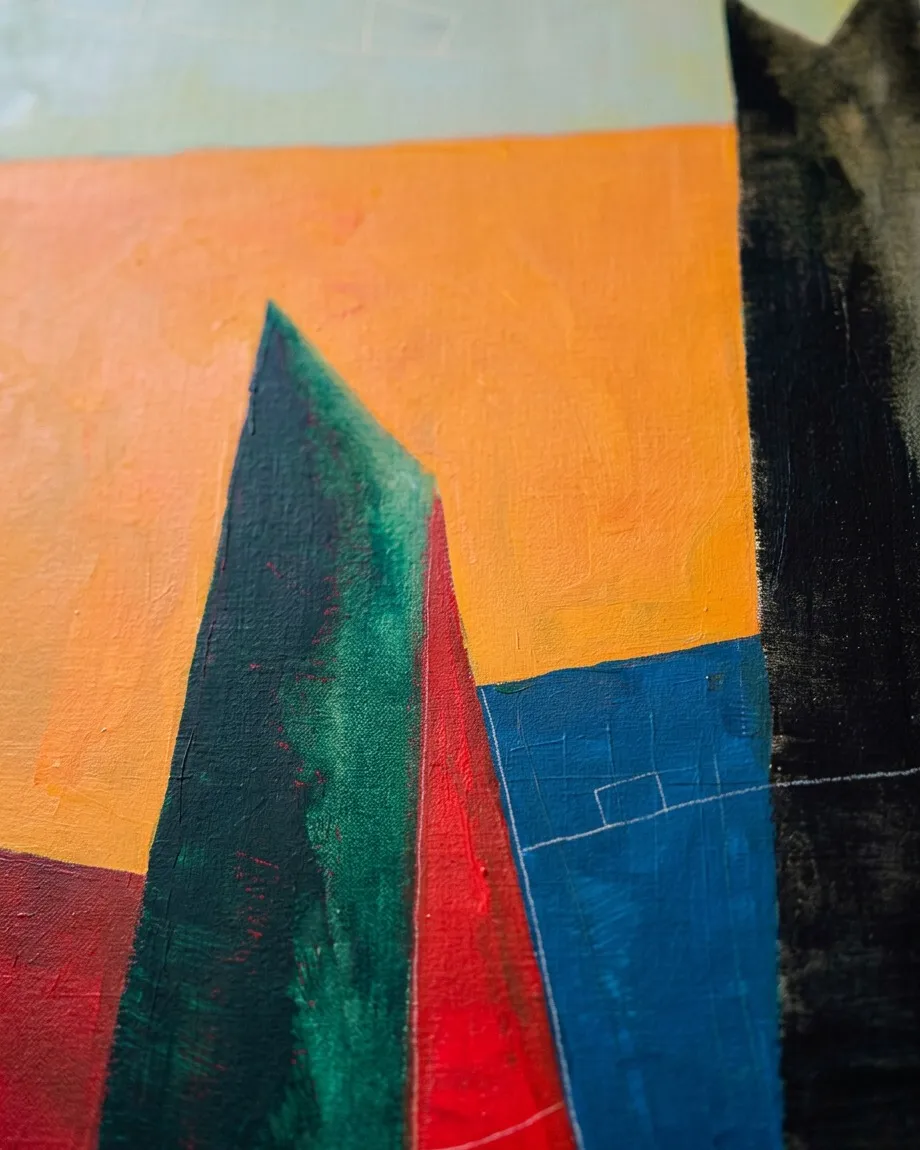
The distance between the two bodies in CUSTODES is not resolved by a sharp edge: it lingers in a dark green strip that shifts in density before meeting the neighbouring red, blue, and orange. This close view makes that delay legible. The smaller presence retains passages of brushwork, glazes, and reddish stippling; even the large orange field reveals irregularities, dragged passages, and subtle variations in paint load. The incisions and small linear figures, visible above all in the blue area, do not establish a coordinate capable of ordering the whole. Instead, they introduce a minimal resistance to the stability of the bands. In Valch’s language, chromatic fields, divisions, and incised traces tend to construct territories rather than backgrounds; here they suggest that the figures have not been cut out against a passive surface, but worked from within a material that still participates in them.
This material persistence gives concrete form to the ambiguity the artist associates with emerging. His presences do not seek to become immediately legible characters, buildings, or emblems: they occupy a place of their own without ceasing to register the pressure of what surrounds them. The visible friction between the green and the red edge of the narrower form makes this condition tangible without turning it into psychological allegory. It may recall an experience that runs through his thinking: identity never fully detaches itself from the journeys, memories, and explanations that have shaped it. But CUSTODES does not translate this intuition into a code. It holds before the eye the material fact of an incomplete separation, in which sustaining form also means remaining exposed to its strata.
In From Dream to Territory, Valch writes that the dream does not disappear when the ground gains weight: it remains sedimented in the organisation that follows. When the Ground Appeared extends this idea by describing EMERSIO as the moment when a form leaves the undifferentiated behind and, in becoming visible, loses an earlier protection. The enlarged detail of CUSTODES makes it possible to recognise this transition in painterly terms. The vertical presences already interrupt the horizontal bands with firmness, yet tonal shifts, barely transparent layers, and traces that never become a complete map prevent them from being read as finished entities. Territory is not the setting for their appearance; it remains the material condition that defines, limits, and makes them vulnerable.
The affinity with Antoni Tàpies particularly illuminates this refusal to fully separate image from surface. In both cases, a mark may operate as evidence of pressure or wear before it becomes descriptive drawing, and the painting may demand a close gaze attentive to its physical condition. Yet CUSTODES differs from the almost mural density often activated in Tàpies’s work. Valch preserves a more open territorial organisation: orange, blue, and the dark areas maintain distance, horizon, and scale around the figures. The faint marks do not turn the canvas into a self-contained wound; they allow matter to continue acting as the uncertain ground from which these two presences attempt to distinguish themselves.
- Original artwork
- CUSTODES
- Actual dimensions
- 31.5 × 47.2 in / 80 × 120 cm
- Presentation
- Digital contextual visualization
Context references
contemporary abstract painting detail · abstract painting with texture and incisions · green red and blue abstract art · close-up of material painting · painting with incised lines · canvas detail with layers of colour · CUSTODES Maurizio Valch detail
About this visualization
This visualization places the artwork within an architectural context to help collectors and viewers imagine its presence in a real space. It is an interpretive reference, not an exact reproduction: the original work remains the sole authority for scale, color, surface and material presence.