Context study / CUSTODES
CUSTODES — Context Study
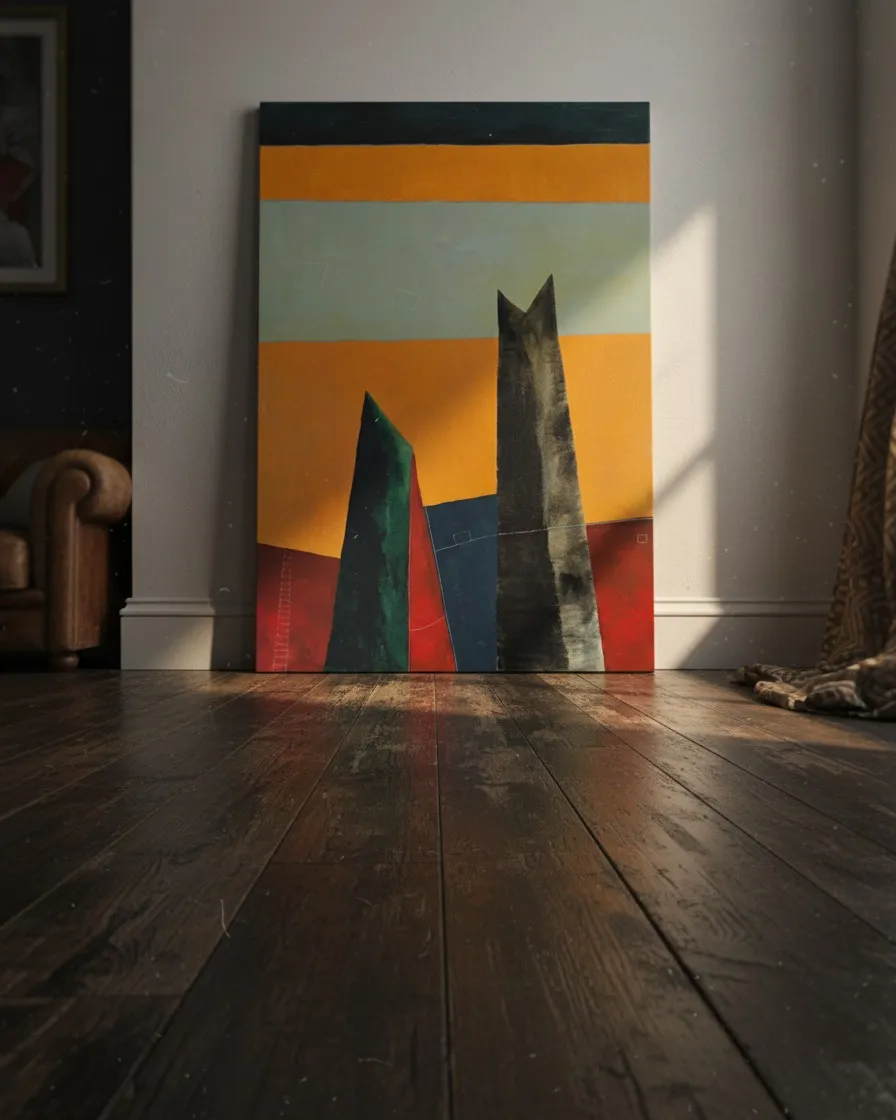
From floor level, separation ceases to be a compositional fact and takes on the scale of a suspended decision. In this presentation, the 80 × 120 cm format rises above the viewer’s gaze, while the converging floorboards extend towards the canvas a direction that the painting refuses to complete. Two vertical masses, unequal in height and profile, assert themselves against dark, orange, greenish-grey and red bands; between them, the lower blue remains held as a passageway without a route. This resistance to indicating a path belongs to Maurizio Valch’s territorial language: horizons, divisions and blocks do not describe a recognisable geography, but distribute weight, distance and possibility. The split crown of the larger form and the oblique edge of the smaller one make any promise of a calm ascent uncertain.
The experience of passage holds a sustained place in Valch’s thinking, though it offers no closed key for reading these forms. His journeys on foot have allowed him to distinguish between a route that can be traced on a map and an inner movement whose direction remains unknown. CUSTODES preserves that difference. The blue interval cannot be reduced to a symbol of psychological separation: above all, it is a visible expanse that compels us to gauge how much distance can be sustained without filling it with explanations. Under the extreme perspective, the two presences take on a particular vulnerability; they seem to protect a distance that also exposes them. To guard, then, does not necessarily mean to bring together or defend one’s own territory, but to admit that coexistence may depend on not closing too quickly the space between two positions.
In “When the Ground Appeared,” Valch places EMERSIO at the moment when a form leaves the undifferentiated and must take up a place within a territory that already conditions it. This formulation clarifies why the central void in CUSTODES is not neutral: the appearance of each mass alters the entire field and makes more evident the shared ground over which neither holds dominion. “From Dream to Territory” adds another decisive qualification: the passage between series is not a progression that eliminates what came before, since dream and memory remain sedimented when space acquires structure. In this painting, the blue band retains something of that unresolved reserve. It lies beneath the elevations, yet is not subordinate to them; it keeps open a region where distance can still be an experience rather than an argument or a destiny.
A specific affinity with Nicolas de Staël helps to recognise the ambiguous condition of these masses, suspended between block, landscape and architecture. Yet where de Staël’s chromatic condensations can direct the gaze towards a landscape light, Valch concentrates the question in the relation between isolated presences. The tall form does not organise a panorama; its upper cleft, seen from below, even seems to deny it a stable unity. Nor does the other function as a decorative counterpoint: its red edge and greenish volume place tension on the approach to the blue area. Thus, verticality does not lead the gaze towards a summit, but returns it again and again to the interval the two figures leave unresolved.
- Original artwork
- CUSTODES
- Actual dimensions
- 31.5 × 47.2 in / 80 × 120 cm
- Presentation
- Digital contextual visualization
Context references
CUSTODES Maurizio Valch · contemporary vertical abstract painting · orange red blue abstract painting · abstract art with architectural forms · colour-block painting · abstract artwork for a contemporary living room · original vertical wall art
About this visualization
This visualization places the artwork within an architectural context to help collectors and viewers imagine its presence in a real space. It is an interpretive reference, not an exact reproduction: the original work remains the sole authority for scale, color, surface and material presence.