Context study / CUSTODES
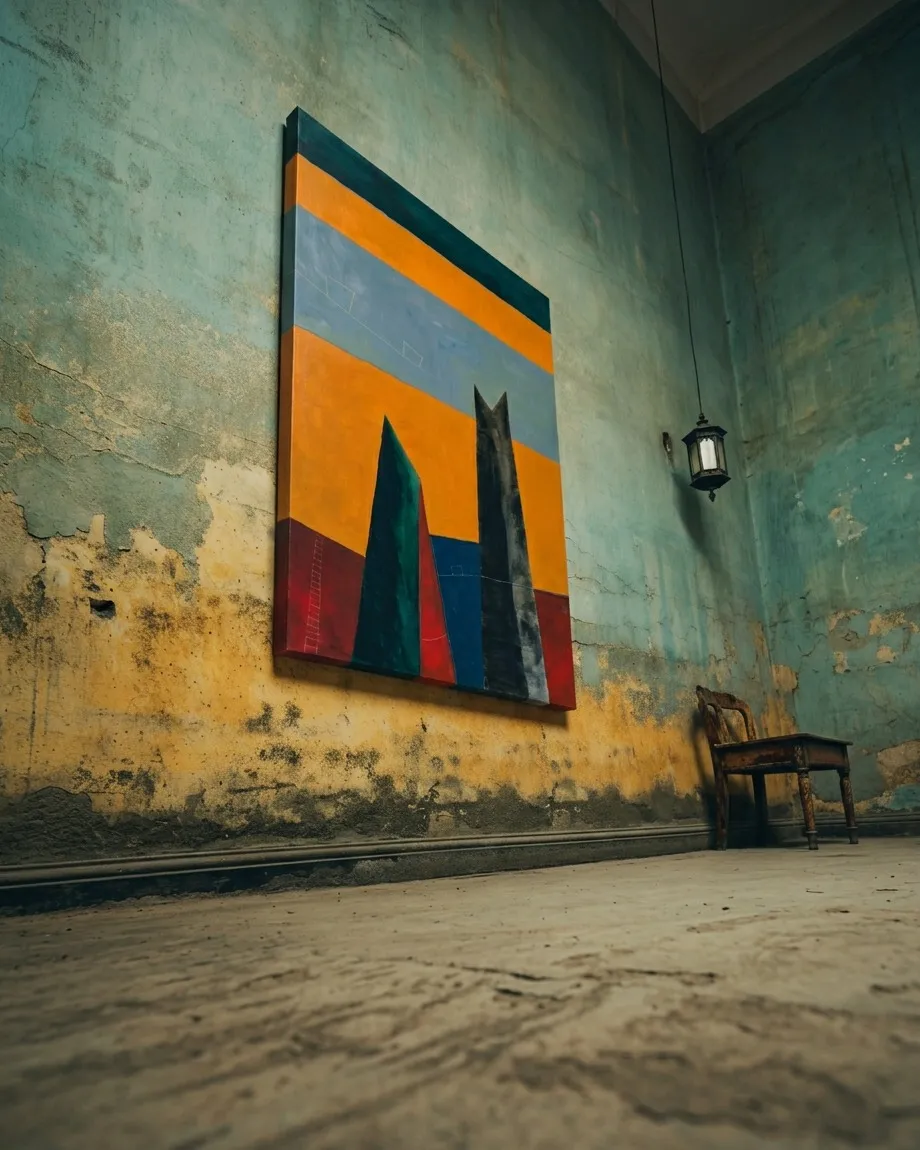
CUSTODES en un mockup de interior
The left edge, revealed by the oblique view, prevents CUSTODES from resolving into a flat image. The dark upper band and the fields descending along the side make the depth of an 80 × 120 cm canvas perceptible: territory continues where frontal vision would normally end. This concrete condition intensifies the presence of the two vertical forms. The larger one, split at its upper end, and the narrower triangular figure are not read solely through their silhouettes against the orange, greyish blue, and lower reds; they seem to assert themselves from a surface with body, weight, and a lateral reverse. In Valch’s language, chromatic fields, divisions, and monolithic forms do not describe a recognisable geography. In this work, moreover, glazes and irregular variations in density prevent the organisation into bands from becoming an inert order.
Appearance thus retains something of exposure. Valch has considered territory as memory, pressure, and transformation, and has been wary of identities that close too soon; this perspective helps explain why the presences in CUSTODES remain ambiguous, somewhere between architecture, body, and sign. There is no need to assign them a biography to recognise that they occupy a place without fully mastering it. Their height separates them from the horizontal fields, yet their bases remain tied to the fragmented ground. The aged wall of the setting heightens, by contrast, the physical resistance of the painting, although its wear belongs to the surroundings rather than to the canvas. What matters is that the canvas offers no escape into another world: it requires us to see how a form comes into existence through the very material that still contains it.
In “When the Ground Appeared,” Valch writes that to emerge is to leave behind the protection of the undifferentiated and become exposed to a territory that no longer functions as a neutral background. CUSTODES makes this idea almost tactile: by continuing around the edge, the painting shows that the support is not an invisible base, but an active part of what sustains the figures. “From Dream to Territory” adds another useful clarification: when the ground acquires structure, what came before does not disappear, but remains sedimented within the new organisation. Beneath the clear division of orange, greenish grey, blue, and carmine, this reserve of instability persists; the figures become distinct, yet do not emancipate themselves from the bands, glazes, and boundaries from which they arise.
The affinity with Nicolas de Staël illuminates the weight of these chromatic masses suspended between block, landscape, and architecture. Yet where de Staël may condense a luminous vibration of landscape, Valch maintains a more restrained frontality and a more explicit relation to the material edge. The three-quarter view makes this distinction visible: the presences are not merely set against a field of colour, but are sustained by a pictorial object that projects slightly into space. Their emergence does not culminate in triumphant autonomy; it remains vulnerable, bound to the depth that made it possible.
- Original artwork
- CUSTODES
- Actual dimensions
- 31.5 × 47.2 in / 80 × 120 cm
- Presentation
- Digital contextual visualization
Context references
CUSTODES Maurizio Valch side view · abstract painting with visible canvas edge · vertical abstract canvas on an old wall · contemporary art in orange blue and red · painting with abstract architectural forms · large vertical abstract painting · contemporary territorial painting
About this visualization
This visualization places the artwork within an architectural context to help collectors and viewers imagine its presence in a real space. It is an interpretive reference, not an exact reproduction: the original work remains the sole authority for scale, color, surface and material presence.