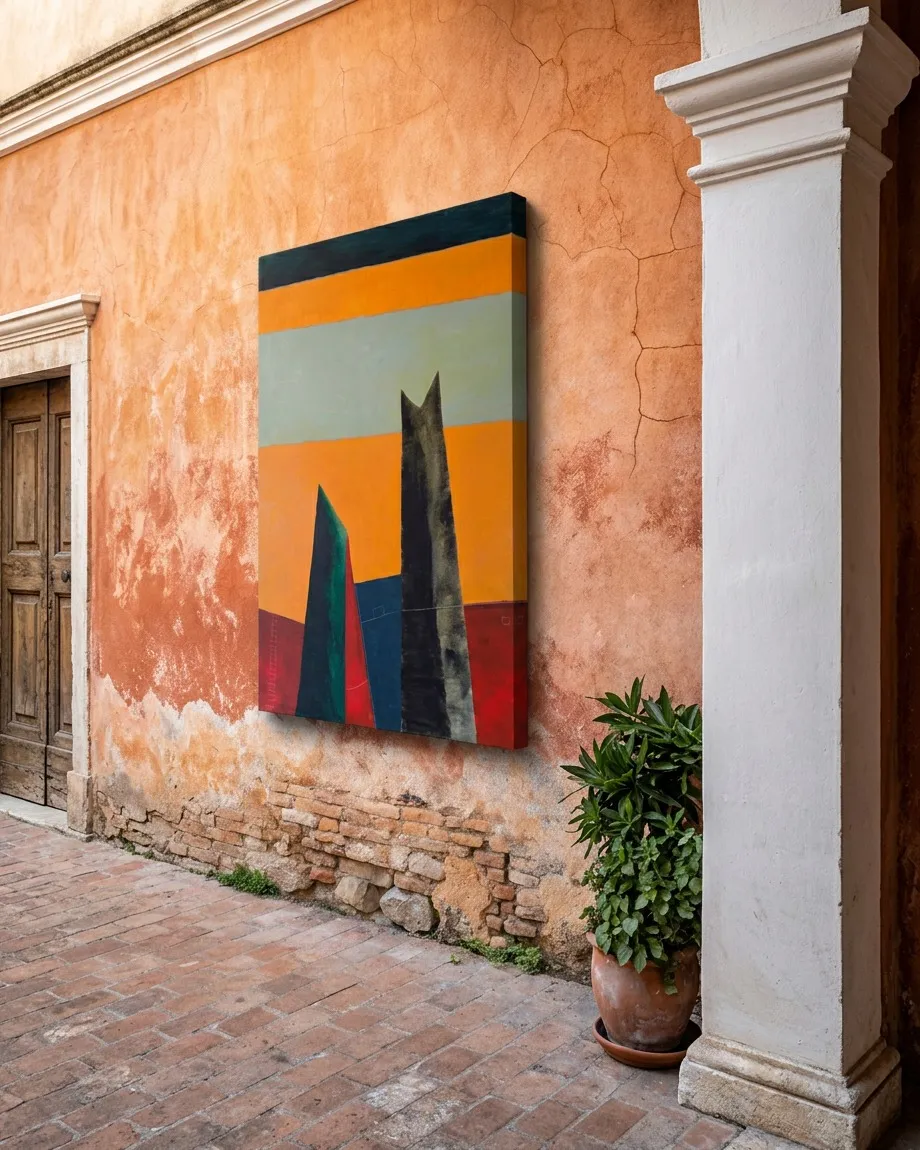
Context study / CUSTODES
CUSTODES en un mockup de interior
The cracked wall does not reduce CUSTODES to a decorative image: it makes visible the difficulty of sustaining a form when the support itself declares its wear. Against this irregular patina, bands of orange, greenish grey, blue, and carmine retain a restrained organisation, crossed by two vertical presences that take on the weight of precarious supports. The taller one, dark and split at its upper end, does not dominate the field with mechanical clarity; its glazes and shifts in density preserve the register of worked material. The slightly unstable edges of the fields, together with the discreet incisions in the lower area, also prevent the divisions from becoming closure. In Maurizio Valch’s painterly vocabulary, where cuts penetrate the surface rather than merely drawing upon it, order always appears exposed to what may pass through it.
This exposure finds a pertinent echo in his attention to territory as memory, pressure, and transformation, without requiring painting to be translated into a psychology of symbols. The artist has distinguished between an outer path, which can be mapped, and an inner movement whose direction remains uncertain; CUSTODES seems to sustain that difference. Its two bodies indicate no route and do not become characters: they measure a distance and remain within a divided ground that never fully assures their stability. The presentation wall intensifies this condition because it displays repairs, fissures, and a loss of uniformity while continuing to serve as a wall. The work may thus be felt as a provisional architecture: a form that does not deny the vulnerability of occupying a place, but learns to hold itself without promising absolute permanence.
In texts devoted to the passage from dream to territory and to the appearance of ground, Valch insists that origin is not a neutral background: it determines what can be raised upon it. EMERSIO shifts this question toward the moment when a form begins to separate from what contained it and, in becoming visible, loses part of its protection. CUSTODES gives form to this situation without narrating it. The horizontal bands offer a base, but the figures interrupt it; at the same time, their own contours still seem affected by the chromatic strata from which they emerge. The dark upper band compresses the height of the canvas, while the fragmented lower area introduces a ground that does not quite settle. Austerity does not resolve uncertainty: it makes it legible.
The affinity with Antoni Tàpies particularly illuminates the encounter between the painting and the aged wall surrounding it. In both cases, the surface may be perceived as a body that retains time in layers, erosion, and marks; Valch nonetheless departs from a conception of the wall as an almost autonomous field of traces. In CUSTODES, material wear is subordinated to a precise territorial distribution: the vertical masses, bands, and incisions establish relations of distance, guardianship, and resistance. The contrast with the external cracks does not turn the canvas into an intact surface. Rather, it makes clear that its calm depends on accepting the possibility of an alteration already at work along its limits.
- Original artwork
- CUSTODES
- Actual dimensions
- 31.5 × 47.2 in / 80 × 120 cm
- Presentation
- Digital contextual visualization
Context references
CUSTODES Maurizio Valch · vertical orange and blue abstract painting · abstract art on an aged wall · contemporary painting with monolithic forms · abstract artwork for a rustic wall · wall art in orange and carmine · contemporary territorial abstraction
About this visualization
This visualization places the artwork within an architectural context to help collectors and viewers imagine its presence in a real space. It is an interpretive reference, not an exact reproduction: the original work remains the sole authority for scale, color, surface and material presence.