Context study / CUSTODES
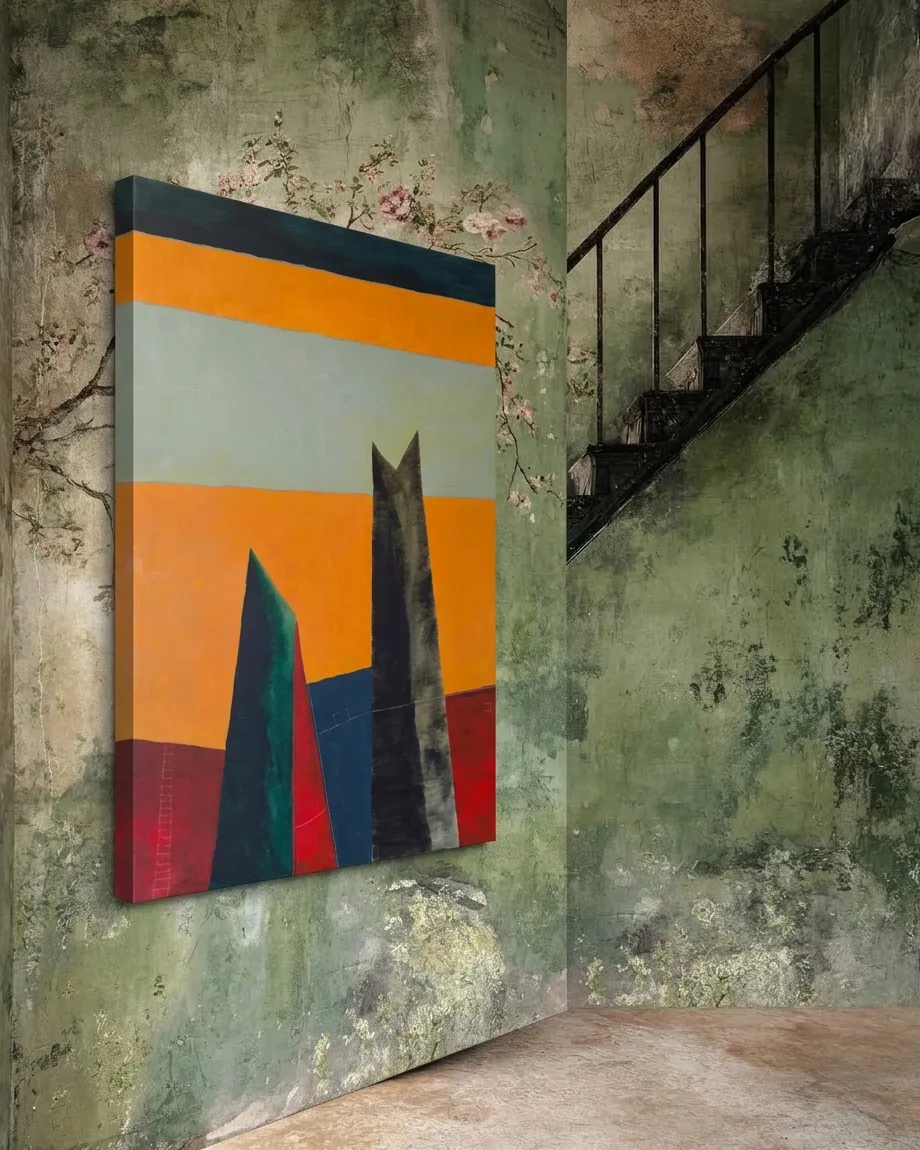
CUSTODES en un mockup de interior
The steps rising to the right make unequivocal a distinction that the canvas holds in suspension: the staircase distributes ascent across successive supports and disappears toward an upper level, while the two presences in CUSTODES rise without offering a path. Their dark tips interrupt the orange and greenish-grey bands, but do not function as arrows. This refusal is sustained within Maurizio Valch’s language: chromatic fields and monolithic masses construct a territory governed by limits and relations of scale, rather than a diagram designed to provide orientation. The faint incisions crossing the lower area suggest routes, though their physical condition as traces—closer to cuts in the material than to directional lines—prevents them from resolving the space. The vertical format, seen beside an actual staircase, heightens this distance between rising and leading.
The distinction touches on an experience that runs through the artist’s thought: an outer path can be traced on a map, but its inner equivalent guarantees neither direction nor arrival. Displacement, fatigue, and places of passage have given him particular attention to the interval in which one no longer fully belongs to the point of departure, yet has not reached a destination. CUSTODES does not translate this experience into allegory. It makes it perceptible through two forms that have acquired contour, weight, and distance from one another, even as they remain bound to the fields sustaining them. The guardianship of the title may therefore be read less as the watch over a goal than as an attentive remaining within a still-uncertain situation: occupying a place without immediately turning it into a conquest.
In “When the Ground Appeared,” Valch writes that to emerge is to lose the protection of the undifferentiated and become exposed to the conditions of territory. This idea helps explain why the height of these figures does not amount to triumph: separating from the ground already entails a new vulnerability. “The Ascent Without a Staircase” clarifies the problem by distinguishing the visible direction of the early series from a demand that later becomes distributed within the very structure of territory. CUSTODES retains a small incised staircase near its lower edge, but its fragility contrasts with the architectural staircase of the setting and with the forcefulness of the vertical bodies. The critique in “Fresh Earth for the Hero” of life conceived as heroic endeavour also resonates here: the painting suspends the expectation that every elevation must culminate in a crowning.
The affinity with Nicolas de Staël illuminates the capacity of these masses to remain between block, architecture, and landscape without settling into a single identity. But where de Staël’s chromatic masses may condense a sense of place, Valch keeps the two figures in a more isolated and guarded frontality. Before the real staircase, their verticality does not extend the movement of the ascending body: it questions it. The handrail promises continuity; the tips in the painting barely sustain a presence. Between the two, a more restrained measure of height appears: not that of someone moving upward, but of that which remains standing without yet knowing where it might go.
- Original artwork
- CUSTODES
- Actual dimensions
- 31.5 × 47.2 in / 80 × 120 cm
- Presentation
- Digital contextual visualization
Context references
CUSTODES Maurizio Valch staircase · abstract painting beside a staircase · contemporary art for a green wall · vertical abstract painting in an industrial interior · painting with monoliths and colour fields · orange blue and red abstract art · interior decor with vertical abstract painting
About this visualization
This visualization places the artwork within an architectural context to help collectors and viewers imagine its presence in a real space. It is an interpretive reference, not an exact reproduction: the original work remains the sole authority for scale, color, surface and material presence.