Context study / CUSTODES
CUSTODES — Context Study
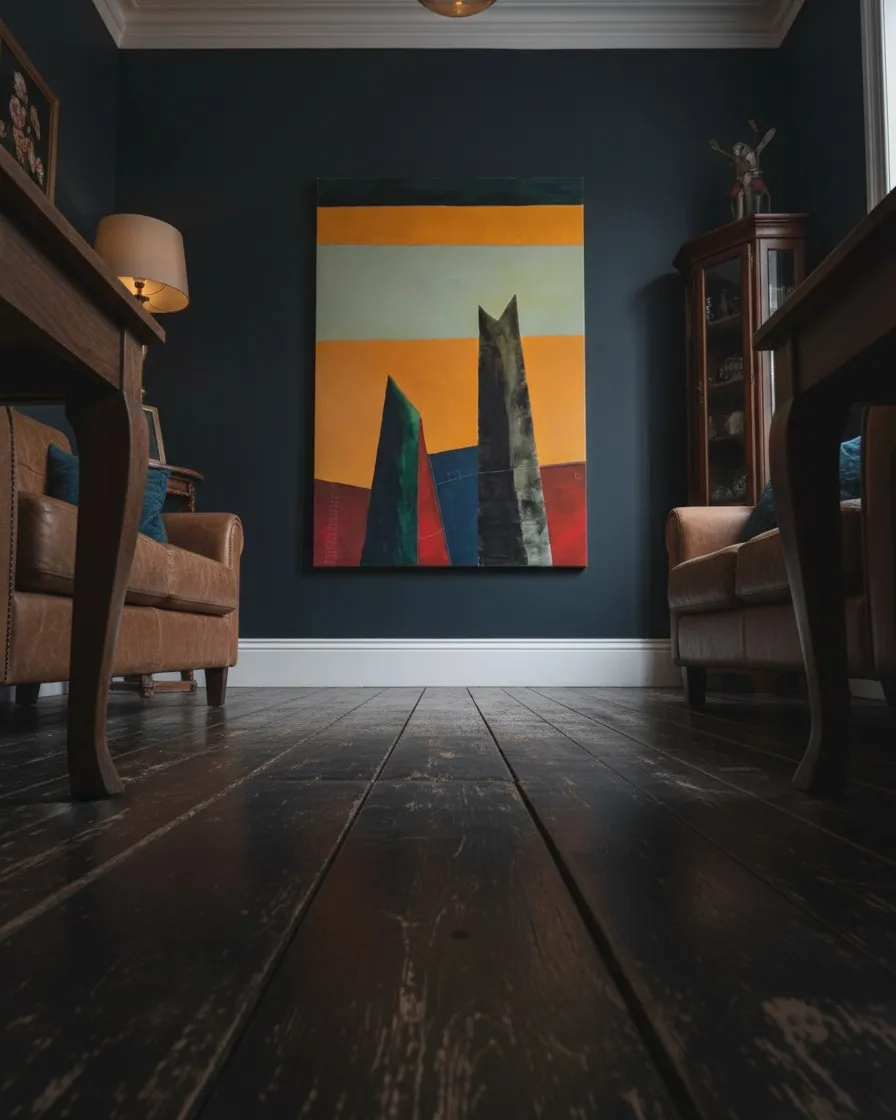
The dark seams of the floor turn distance into an arrow: from the low level of the gaze, they converge towards CUSTODES and make the vertical canvas the physical endpoint of the route. That promise of arrival breaks apart upon entering the painting. Orange, greenish-grey, red and blue bands establish strata and cuts, while the two vertical presences do not align along a shared path: one opens into an upper cleft; the other narrows and changes in density beside a red edge. Maurizio Valch’s language—fields of colour, territorial divisions and monolithic masses—is recognisable in these visible elements, but not as a system that definitively orders the territory. The room’s perspective concentrates; the painting disperses once more.
This difference between approaching and taking one’s place touches on an experience that accompanies the artist’s thinking: an outward journey may have direction, while inner orientation is not guaranteed by having arrived anywhere. His travels and displacements have left him especially attentive to temporary places, fatigue, and the condition of belonging neither fully to what has been left behind nor to what is yet to come. It would be excessive to turn the figures into autobiography; it is more precise to say that CUSTODES makes this condition felt without narrating it. The presences have already acquired contour, yet remain exposed to the fields around them and to the distance that separates them.
In “When the Ground Appeared,” Valch proposes that territory is not a neutral base: it supports, separates and orients before a form can assert itself upon it. This presentation intensifies that intuition by offering a real floor that seems to lead clearly to the painting; yet the painted ground fragments into areas that intersect and change direction. “From Dream to Territory” adds that the emergence of a form does not cancel previous layers: dream and memory remain sedimented within new organisations. For this reason, the two figures in CUSTODES cannot be read as assured guardians of a destiny. Perhaps they guard the uncertainty of occupying a position when the ground that makes it possible still acts from within.
The affinity with Nicolas de Staël illuminates the density with which the chromatic planes oscillate between landscape, block and architecture. In CUSTODES, orange does not function as a decorative background: it lends weight to the dark forms and makes their isolation palpable; the lower reds and blues prevent the ground from settling into a simple base. Valch nonetheless departs from the luminous condensation through which de Staël can gather a landscape. His masses remain more isolated and frontal, almost compelled to gauge their resistance within a divided field. At the end of the path proposed by the room, arrival does not provide a commanding view: it leaves the gaze before a territory in which one must still learn to orient oneself.
- Original artwork
- CUSTODES
- Actual dimensions
- 31.5 × 47.2 in / 80 × 120 cm
- Presentation
- Digital contextual visualization
Context references
CUSTODES Maurizio Valch · contemporary abstract art for a dark interior · orange red blue abstract painting · vertical painting with monolithic forms · contemporary territorial painting · wall art for a dining room · large vertical abstract artwork
About this visualization
This visualization places the artwork within an architectural context to help collectors and viewers imagine its presence in a real space. It is an interpretive reference, not an exact reproduction: the original work remains the sole authority for scale, color, surface and material presence.