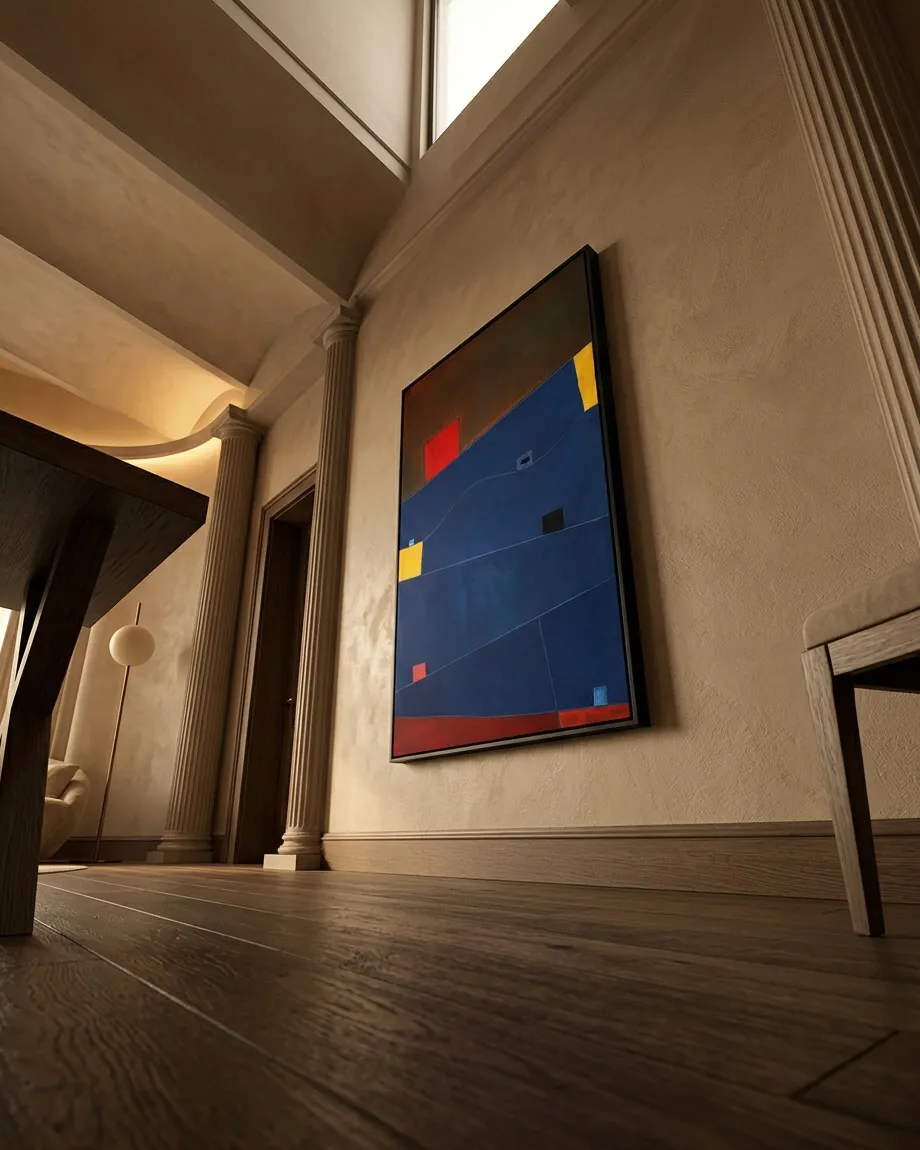
Context study / COACTUS
COACTUS Abstract Painting in Elegant Living Room with Columns
First Stratum: The Earth Sky
At the top of "COACTUS", the air turns mineral. There is no atmosphere in this upper horizon; what we contemplate is an earth sky, a dense ochre block pressing the rest of the composition downward with the dull force of sediments. In the midst of this teluric twilight, a red volume emerges or sinks, suspended in a gravitational ambiguity that challenges the eye.
For Louis Kahn, the architect of monumental ruins who understood that bricks have their own will and that light only exists in relation to the gravity of the wall, this upper stratum would not be a pictorial background, but a mental concrete slab. Kahn would see in that red block the key to an invisible vault: not an ornament, but the keystone that, by forcing itself against the ochre, sustains the quietness of the lower void.
"When I faced that upper boundary, I felt that the density of the ochre demanded a compensation, a vanishing point that was also an anchor. By placing that red block, I was not looking for a chromatic accent, but for physical resistance: the almost muscular sensation of holding a suspended mass that threatens to sink into the great plain below. Drawing the dividing lines on the canvas was not an exercise in geometry, but an act of containment, a way of fencing in the silence so that it would not overflow the sides."
Second Stratum: The Great Blue Mass
Beneath the ochre pressure stretches the absolute body of the painting: an immense plain of abyssal blue. Here, space is measured not in meters, but in densities. Fine lines cross this mass like seams on a tight skin or like invisible borders drawn over a frozen territory. How does our body react to that almost imperceptible line dividing the lower third? Does it invite us to cross it or does it stop us like a two-dimensional abyss?
In front of this great mass, the sensibility of Rembrandt dialogues—the painter who carved the twilight to find in the thickness of the darkness a trembling and human vein of gold. While Kahn would look in the blue for the structure of a room of absolute silence, Rembrandt would approach the surface to question the temperature of that darkness. For the master of chiaroscuro, the blue of "COACTUS" is not flat; it is a beating shadow, a liquid body that absorbs external light to return it converted into a cold and dull vibration. What if the dark blue color were not a surface, but a dense liquid substance viewed from above, a fluid containing the weight of everything we keep silent?
Third Stratum: The Anchorings of the Margins
If the center of the work is a blue void threatening to absorb the gaze, the periphery is the place of resistance. Small yellow, red, and lighter blue blocks are strategically placed at the edges, like wedges driven under pressure to prevent the frame from collapsing in on itself.
What is it that keeps the yellow blocks pressed against the edges, as if they feared falling into the void of the center? They seem to act as acoustic dampers of a vibration we cannot hear but can forebode. If this painting were a cargo dock or an underground mine, where would the greatest acoustic weight accumulate? Undoubtedly, at those points of contact where pure color brushes the physical limit of the canvas, bearing the immense pressure of the central mass. At the base, a dark red strip acts as a burning plinth, a final frontier of heat holding the imposing structure before everything sinks into the floor.
"Contemplating 'COACTUS' now that the matter has dried and belongs to the wall, I recognize that there is a force inside it that escapes my own control. The title evokes the forced, the compressed, that which has been compelled to coexist under immense pressure; yet, I perceive a shadow zone, a blind spot at the confluence of the lines that I cannot fully decipher. I have gathered these masses, but they have decided to keep their own secret, resisting my gaze as if I were a stranger to their own physics."
The Fissure
In the end, the gaze always returns to the crack, to the joint where the deep blue collides with the red boundary of the floor. Where the lines cross without quite touching, an uncertainty space opens up. "COACTUS" does not offer a resolution; it is not a structure seeking harmony, but the containment of a colossal push. We are left with the suspicion that if we removed just one of those small yellow blocks from the margins, the entire blue plane would slide downward, flooding the room with its mute weight. Is the painting a refuge against the pressure of the world, or is it the place where that pressure finally becomes visible?
- Original artwork
- COACTUS
- Actual dimensions
- 31.5 × 47.2 in / 80 × 120 cm
- Presentation
- Digital contextual visualization
Context references
contemporary art in classic homes · elegant large format paintings · hallway decoration with art · territorial abstraction maurizio valch
About this visualization
This visualization places the artwork within an architectural context to help collectors and viewers imagine its presence in a real space. It is an interpretive reference, not an exact reproduction: the original work remains the sole authority for scale, color, surface and material presence.