Context study / COACTUS
COACTUS painting over wood sideboard | Home decor
Stratum I: The Weight of Dark Air
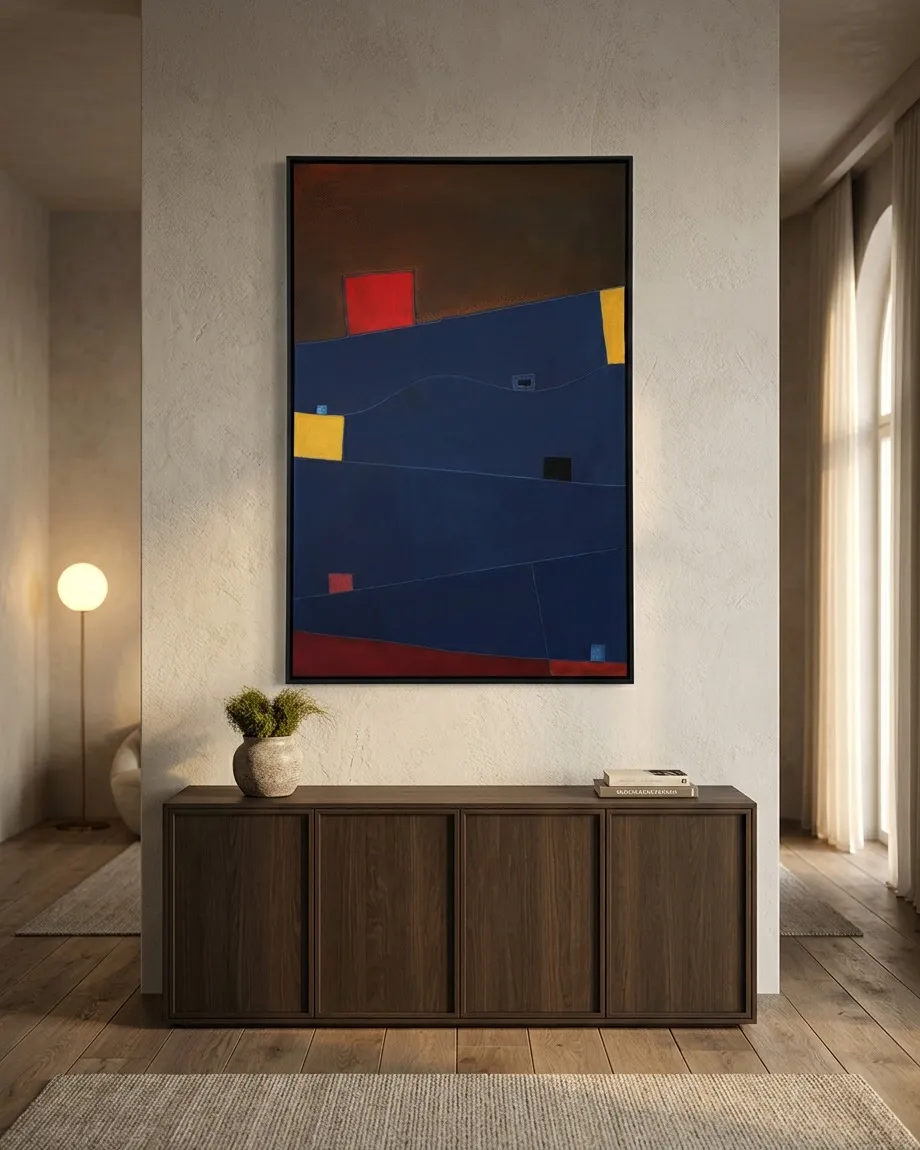
At the crowning of the canvas, the air becomes dense, charged with a brownish vibration pressing downward. It is not an empty sky; it is a thick, almost tactile atmosphere imposing its physical law on the rest of the surface. Right there, at the edge of that suspended abyss, a red block holds itself in a tense quietude.
Summoned here, Jacques Lecoq—the master who taught us to decipher how the body beats before words, translating space and weight into pure movement—observes the scene and invites us to feel it with our backs. For Lecoq, this upper plane is not an image, but a physical score of resistances. If we placed our body under that dark mass, we would feel a downward push forcing us to bend our knees. The red block, far from being an ornament, is a body in full effort: it performs a physical action of pushing against the dark void, resisting being swallowed by the painting's gravity. It is the tension of the neutral mask in the moment prior to movement, a precarious balance where the silence of space weighs as much as the matter itself.
First Interlude: The artist's voice
> "I wanted that red block to float, but painting is always negotiating with the gravity of the gaze. Placing it up there, I felt I was breaking an invisible physical rule: red usually anchors things below, it is too heavy to be suspended in that twilight. For days I doubted its position. I felt a real discomfort in my arm every time I looked at that upper limit, as if the color were about to slip and fall onto the blue. In the end, I decided to leave it there, holding up the sky, assuming the weight of that contradiction."
Stratum II: The Diagonals of Encounter
Below the twilight opens an immense blue territory, fragmented by subtle lines that do not cut the surface sharply, but tilt it, making it sway gently.
This is the territory where the gaze of Paulo Freire intervenes—the thinker who taught us to search in the cracks of silence for the birth of a human encounter, reminding us that no one liberates themselves alone. Freire does not see these inclined lines as borders or insurmountable walls, but as "limit situations": spaces of transition where the monolithic balance breaks to make way for dialogue.
The large blue plane threatens to be a crushing monologue, a plain where nothing occurs. However, this silence is interrupted by small blocks acting as "generating words." On the left, a yellow block appears at the boundary; on the right, another responds from above. In the middle, a black square and a small blue contour float adrift. They are not placed at random; they are mute voices seeking each other in the immensity of the canvas, tensions fracturing the hegemony of the blue to open a question about distance, lack of communication, and the possibility of meeting in a shared territory.
Second Interlude: The artist's voice
> "The blue is not a background for me; it is a silence that stretches and breathes. When I traced that thin diagonal line crossing the large central block, I wasn't seeking to divide the plane, but to listen to the temperature of the color on both sides. Sometimes, a minimal stroke does not separate, but reveals the exact distance we need to look again. In painting, as in life, lines occur without asking permission; one can only accompany their course and accept the new space they open."
Stratum III: The Ground That Burns
Upon reaching the base, the painting settles on a horizontal strip of a deep, burning red that serves as a thermal floor for the entire composition. It is a plane of support, but it does not transmit calm; it vibrates with the accumulated energy of everything pressing from above.
In the bottom right corner of this hot base, a tiny blue square resists alone, almost touching the frame. Looking at this small point, one detaches from all theory and adopts a child's gaze to ask: Why has that little blue square stayed there all alone, cornered in the corner, and why does it look like it's afraid of getting burned by the red floor?
The gravity of the painting seems to rest on that final inch, where the blue immensity of the center has been reduced to its minimal expression, taking refuge in the lowest corner of the canvas. Is that small block about to fall out of the work, or is it the seed from which a new space will sprout? The canvas remains silent, keeping the tension suspended in the air.
- Original artwork
- COACTUS
- Actual dimensions
- 31.5 × 47.2 in / 80 × 120 cm
- Presentation
- Digital contextual visualization
Context references
large painting to hang over sideboard · warm minimalist living room decor ideas · abstract wall art for dining room · elegant modern living room paintings
About this visualization
This visualization places the artwork within an architectural context to help collectors and viewers imagine its presence in a real space. It is an interpretive reference, not an exact reproduction: the original work remains the sole authority for scale, color, surface and material presence.