Context study / CLIVUS
CLIVUS — Context Study
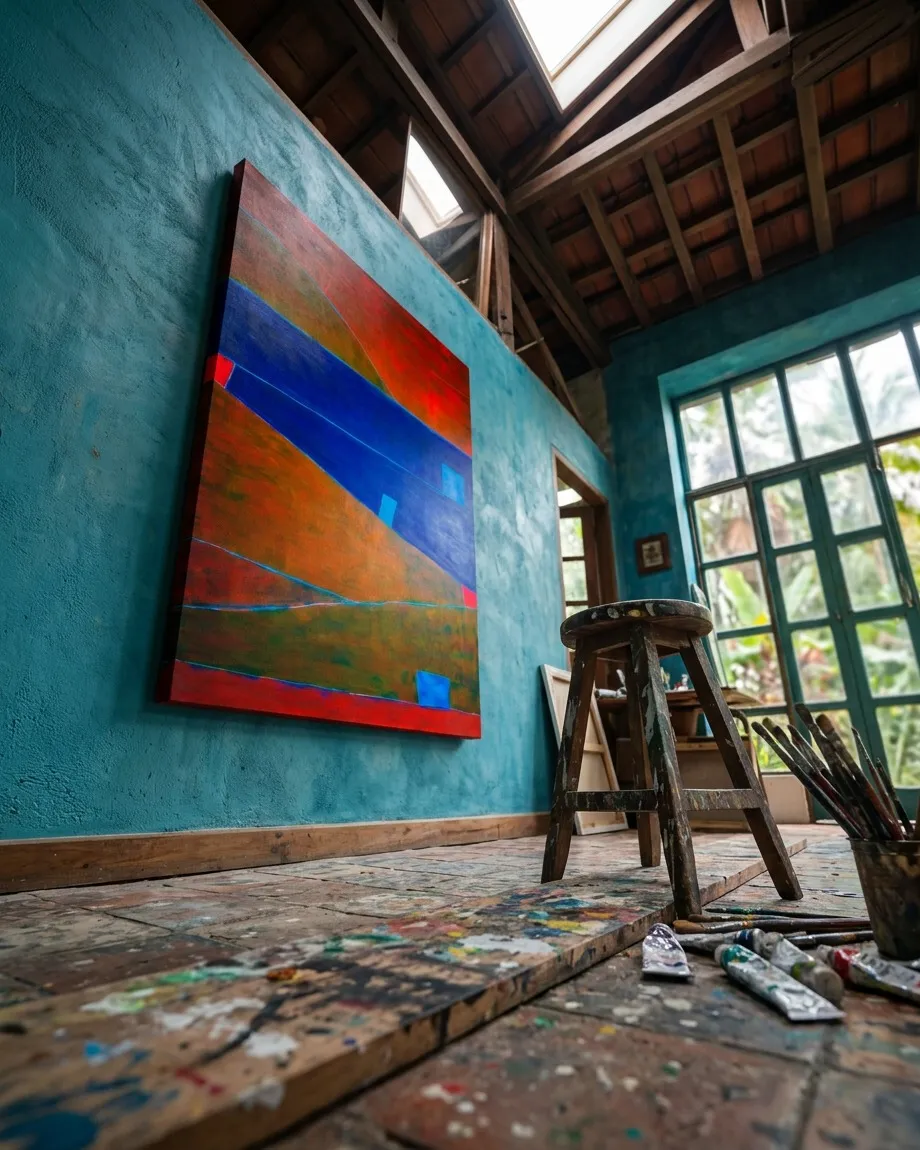
The coarse grain of the canvas, accented by linear incisions, establishes the immediate tactile presence of the surface. From this textured plane, the composition unfolds vertically in chromatic bands where crimson, ochre, and deep blue meet. Three small light blue rectangles emerge on the inclined diagonals, marking visual resting points within the color fields. Installed in a bohemian-style studio on a textured turquoise plaster wall, the 80 by 130 cm painting rises under natural light descending from a wooden skylight. The surrounding space, characterized by a pigment-splattered floor, a rustic stool, and brushes in the foreground, emphasizes the atmosphere of manual craft. The viewer's gaze, after traversing the height of the support and the quiet architectural surroundings, returns to the density of the canvas, where thin incised lines guide the eye back to the relief.
- Original artwork
- CLIVUS
- Actual dimensions
- 80 × 130 cm / 31.5 × 51.2 in
- Presentation
- Digital contextual visualization
Context references
Original painting · Abstract art · Geometric abstraction · Acrylic and oil on canvas · Vertical format · Crimson red · Cobalt blue · Ochre · Textured surface · XL format · Maurizio Valch · original contemporary abstract painting · minimalist geometric canvas art · vertical color field painting
About this visualization
This visualization places the artwork within an architectural context to help collectors and viewers imagine its presence in a real space. It is an interpretive reference, not an exact reproduction: the original work remains the sole authority for scale, color, surface and material presence.