Context study / CLIVUS
CLIVUS — Context Study
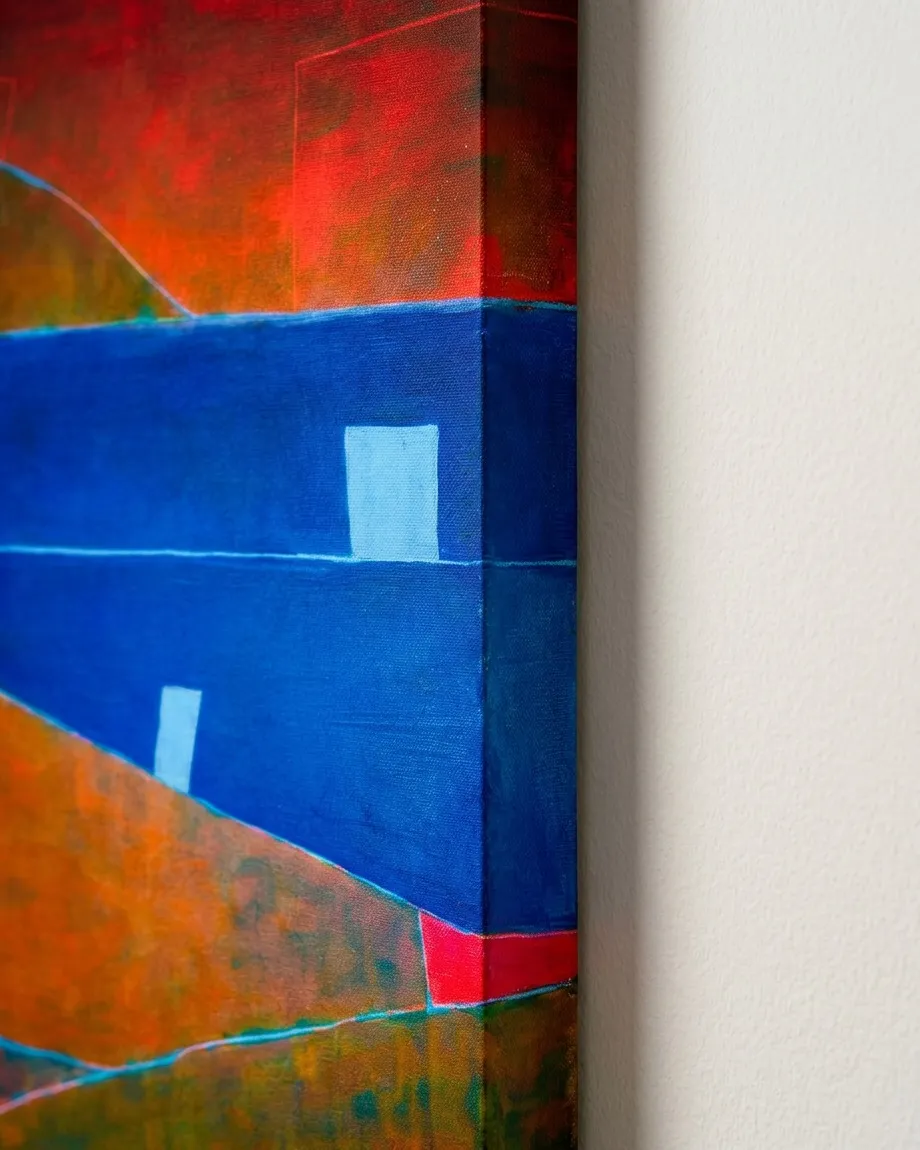
Crisp, direct light from the right side illuminates the physical edge of the stretcher, emphasizing the textured grain of the adjacent white wall. In this sharp close-up, focus centers on the three-centimeter-thick profile, where a block of cobalt blue wraps around the canvas edge in a precise, continuous transition. Extending across the front face, the composition reveals its layered acrylic and oil surface, where the dense blue contrasts with a warm ocher plane below and a rich crimson field above. The atmosphere is quiet, sober, and analytical, capturing the three-dimensional presence of the artwork within a studio context. A fine turquoise incised line cuts through the blue field, bending slightly as it reaches the edge of the canvas.
- Original artwork
- CLIVUS
- Actual dimensions
- 80 × 130 cm / 31.5 × 51.2 in
- Presentation
- Digital contextual visualization
Context references
original vertical geometric abstract painting · acrylic and oil on canvas · large format · blue and crimson · original abstract painting by Maurizio Valch · contemporary abstract art for collectors · buy original minimalist art · large vertical canvas painting · blue and crimson red painting · textured color field painting · fine art for minimalist interiors · original contemporary painting on canvas · large format vertical abstract artwork · minimalist geometric abstract painting for sale
About this visualization
This visualization places the artwork within an architectural context to help collectors and viewers imagine its presence in a real space. It is an interpretive reference, not an exact reproduction: the original work remains the sole authority for scale, color, surface and material presence.