Context study / ATHAR
ATHAR on Brutalist Concrete Wall | Maurizio Valch STRATA
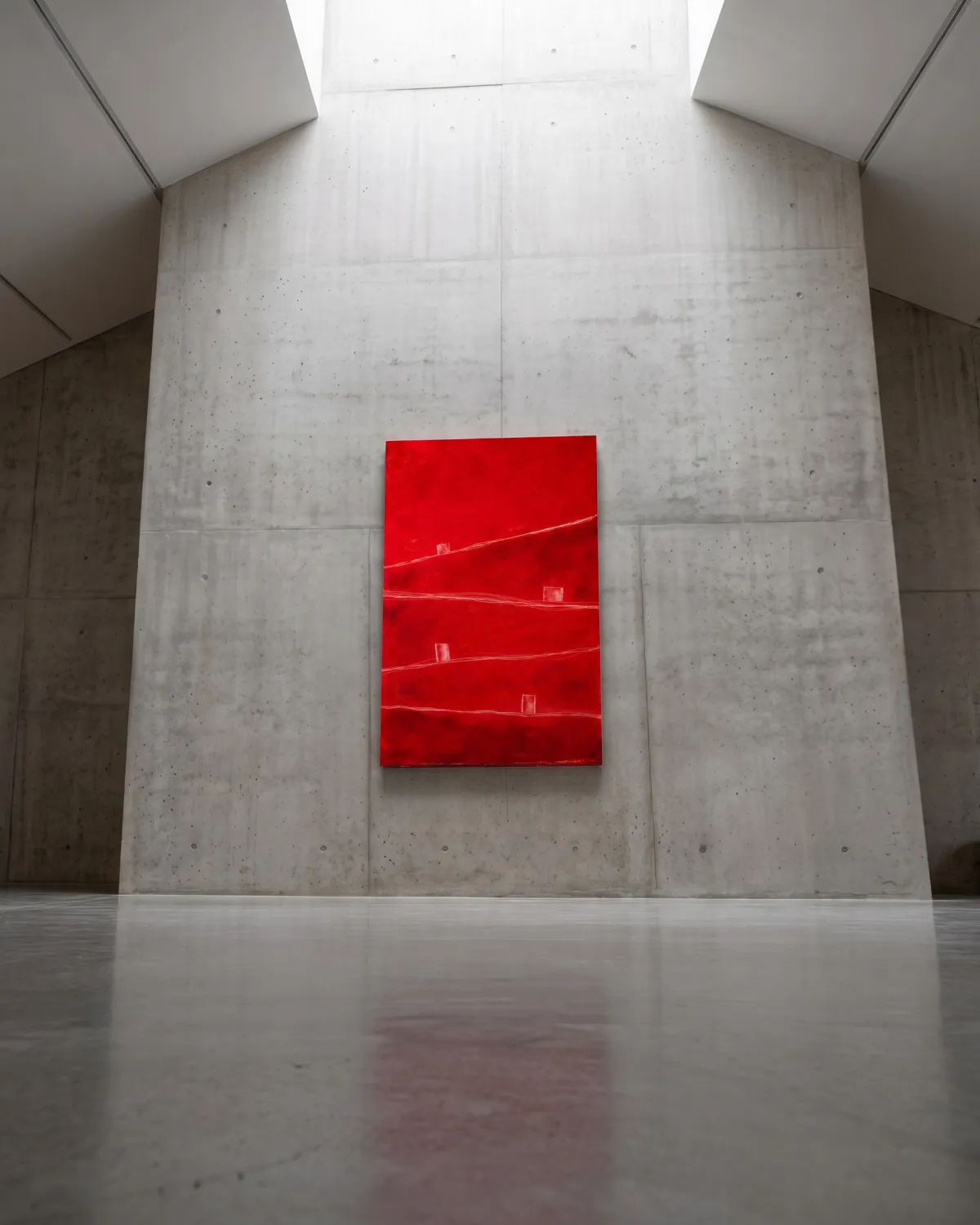
The exposed concrete, cold and tectonic, which surrounds "ATHAR" in this presentation does not function as a mere decorative support; it acts as the necessary echo for a painting that behaves, itself, as a wall. It is impossible to contemplate this mass of vibrant crimson without thinking of Antoni Tàpies and his obsession with the surface as a skin eroded by time. However, where Informalism sought the dispersion of matter and pure accident, the work of Maurizio Valch imposes a severe, almost constructive order. The horizontal incisions are not chaotic tears, but containment lines, territorial divisions that organize the fire of the pigment. The material wound, so beloved by post-war avant-gardes, ceases here to be a historical citation about pain and becomes an instrument of spatial precision.
When I plunge the blade into the fresh oil to trace these incisions, I do not seek to recreate the drama of torn matter that I learned by observing the masters of matter painting. For me, scraping the canvas is an exercise in silent subtraction, a way to find a path through the density that threatens to bury everything. I do not add a line to the painting; I extract it from the very body of the paint. Seeing the work now, suspended under this skylight that bathes the concrete, I understand that this gesture of subtracting is my own way of clearing the horizon: an attempt to shed accumulated theory to let the rustic light of the support speak for itself.
The visual weight of the four small white blocks hanging from the incised lines evokes the compact mass of Nicolas de Staël, that subtle balance where abstraction verges on the presence of an elemental architecture. Nonetheless, in Valch's trajectory, these forms do not operate as masses colliding to form a landscape, but as small monoliths resisting in isolation within an immense expanse. The scale revealed by this brutalist staging emphasizes the solitude of these structures against the immensity of the crimson. The pictorial reference has been digested and metabolized until disappearing into a language where color is not lyrical atmosphere, but physical pressure, a geology pushing the blocks toward the abyss of the slope.
For years I carried the weight of my artistic affinities like one dragging someone else's map along their own path. I wondered if each incision, each suspended block, was nothing more than the echo of voices I admired too much. But in front of this concrete wall, where the painting stands on its own weight and reflects its light on the polished floor, that anxiety of influence dissolves. The work no longer belongs to me nor owes explanations to art history; it has left the studio to assume its own physical vulnerability. I have stopped watching my hands to prevent them from resembling those of others, accepting that the true maturity of the painter begins when learned technique yields to the honesty of a surface that simply resists.
In the verticality of this installation, the diffuse reflection on the polished cement floor duplicates the work, creating the illusion of an inverted abyss sinking beneath the viewer. This duplication transforms the experience of scale: the painting is no longer an object hanging on a wall, but a threshold altering the physical laws of the room. The overhead light, sliding over the relief of the crimson, reveals that the painted surface possesses the same three-dimensional and rough character as the concrete that guards it. In the end, references from the past fade away on this "tactile shore" where the viewer does not attend a history lesson on abstraction, but a direct confrontation with matter, silence, and the gravity of their own body.
- Original artwork
- ATHAR
- Actual dimensions
- 31.5 × 47.2 in / 80 × 120 cm
- Presentation
- Digital contextual visualization
Context references
large format art for brutalist design · modern concrete loft decor · crimson painting in modern gallery · minimalist large format artworks · contemporary paintings Maurizio Valch
About this visualization
This visualization places the artwork within an architectural context to help collectors and viewers imagine its presence in a real space. It is an interpretive reference, not an exact reproduction: the original work remains the sole authority for scale, color, surface and material presence.