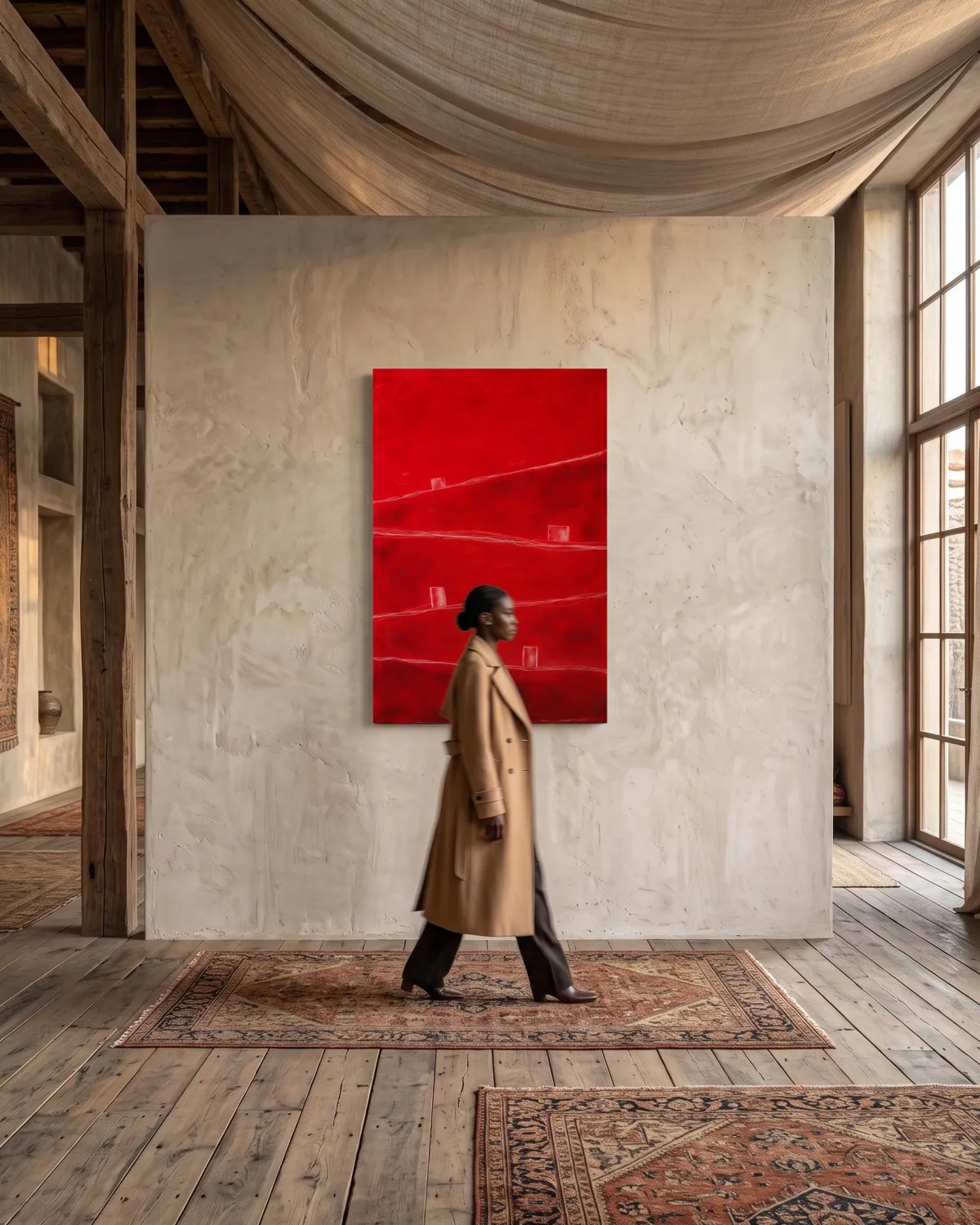
Context study / ATHAR
ATHAR Red Abstract Painting in Design Living Room | Maurizio Valch
The surface of "ATHAR" presents itself to the viewer as an absolute territory of red, a saturated chromatic density oscillating between the quality of an organic epidermis and an incandescent geology. On this vibrant field, four thin incised lines cross the plane horizontally, interrupting the homogeneity of the pigment and suggesting slopes, terraces, or superimposed strata. Resting on these incisions, four small blocks of a light tone rise almost monolithically, defying the apparent instability of the terrain. This elemental arrangement immediately poses a fundamental tension: are these lines and volumes an attempt at rational cartography, an effort of the intellect to parcel and control infinite space, or do they rather represent the inevitable scars of an internal tectonic force pushing from the depths of matter to the surface?
By cutting into the pictorial matter in "ATHAR", I do not seek to trace a descriptive drawing on the canvas, but to make a real incision that dialogues with the physical resistance of the accumulated pigment. The incision is, in my process, an act of profanation of the surface that reveals the hidden layers and sedimentations beneath the density of red, transforming the stroke into an open wound that divides space. Placing those four light-colored blocks on the slopes was an exercise in counterweight and silent containment; I often wonder if I conceived them as fragile shelters to protect the gaze from the immensity surrounding them, as observation posts to contemplate the void, or simply as physical ballasts intended to calm the violent vibration of the underlying red. They are elements that impose a necessary gravity, anchors of lime and light that prevent the painting from dissolving in its own combustion.
Facing this arrangement of levels and structures, an inevitable theoretical confrontation arises between the visions of George Gurdjieff and Carl Gustav Jung. From Gurdjieff's perspective, the repetition of the blocks situated in an ascending manner across different strata evokes the mechanical nature of the "sleeping man," who moves through existence believing he is ascending or evolving when, in reality, he is only automatically repeating the same behavioral pattern at different levels of his psychological prison. Jung, on the contrary, would refute this reading of sterile automatism; for the Swiss psychiatrist, those blocks are not mute gears but crucial milestones in the process of individuation. Each monolith acts as a container of consciousness, an archetypal structure of the Self striving to define its boundaries and maintain its integrity against the devouring, undifferentiated red tide of the collective unconscious that threatens to assimilate everything.
Facing these interpretations that attempt to order my work under systems of awakening or psychological structures, I reclaim the autonomy of the pictorial act; the painting is neither a moral map nor a manual of self-knowledge. During the creation process, the red color did not behave as a modifiable symbol, but as a physical and visceral presence that imposed itself through successive layers of sedimentation, demanding its own sovereignty over the canvas. My task was not to solve an analytical enigma, but to firmly sustain the raw tension between the geometry of the stroke and the almost brutal vibration of pure pigment. As I traced the paths of "ATHAR", I experienced the uncertainty of not knowing whether those incised lines served to connect the blocks in a common transit, or if, on the contrary, they consecrated their absolute isolation within a scarlet desert.
Finally, the apparent geometric domestication proposed by the lines and blocks is questioned by the perspective of Georges Bataille, for whom red embodies the force of excess, the violence of sacrifice, and the immanence of blood and fire. "ATHAR"—whose title in ancient Arabic refers to the notion of "trace" or "track"—thus becomes a critical threshold where the rational structures of civilization attempt to bound a territory that, in the end, refuses to be subdued. The blocks and incisions are mere vestiges of our passing, ephemeral marks upon a pictorial matter that remains sovereign, untameable, and pulsating beneath the order we attempt to impose on it. When the rational structure inevitably erodes under the weight of time, one might ask: what truly remains, the trace we try to leave or the incandescent depth that was always there?
- Original artwork
- ATHAR
- Actual dimensions
- 31.5 × 47.2 in / 80 × 120 cm
- Presentation
- Digital contextual visualization
Context references
paintings for modern design living rooms · large format art for rustic living room · abstract red painting for living room wall · warm minimalist interior decor · contemporary art by Maurizio Valch
About this visualization
This visualization places the artwork within an architectural context to help collectors and viewers imagine its presence in a real space. It is an interpretive reference, not an exact reproduction: the original work remains the sole authority for scale, color, surface and material presence.