Context study / ATHAR
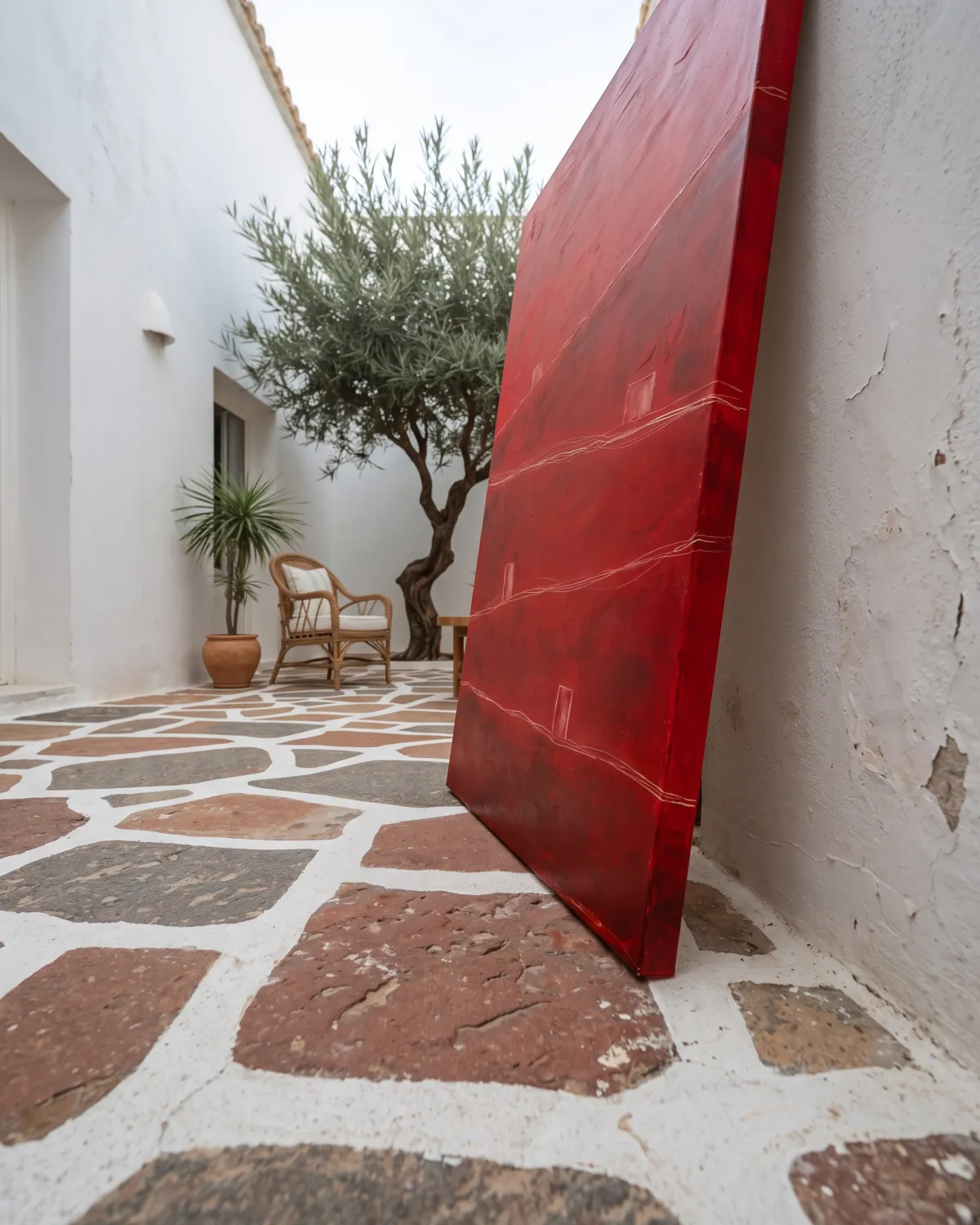
ATHAR by Maurizio Valch in Mediterranean Patio | Wall Art
The physical presence of ATHAR imposes itself from an absolute material density. The large chromatic field of thick crimson red embodies a notion of immutability, a dense plane that seems to have consolidated like a geological stratum immune to the passage of time. However, this apparent temporal closure is interrupted by a gesture of pure physical irruption: four incised lines that horizontally furrow the surface of the canvas. By scraping and lifting the pictorial matter to lay bare the rustic texture of the underlying support, a tactile and internal vibration is introduced. This current of interference destabilizes the inertia of the absolute red, breaking the monolithic flatness of the painting and awakening the surface through the relief of its wounds.
When confronting matter in the studio, I do not seek to add volume, but to subtract it. The act of making incisions on the wet plane of ATHAR is, in reality, an exercise in excavation: I sink the tool to empty and give shape to those small geometric niches that seem to hang from the main lines. Through this process of subtraction, I pursue a form of independence for each element; I wanted each carved cube to free itself from the sovereignty of the large red mass and claim its own space, its own gravity. I often doubt my own gesture and wonder if this action really imposes a rational order on the plane or if, on the contrary, it only serves to allow the painting to become independent of my own creative will, finding its own physical course.
Observing the internal architecture of the work, it becomes evident that the incised lines avoid the rigidity of mathematical horizontality. A subtle decline is perceived in them, a slight slope that tilts the gaze downward and destabilizes the structure. This subtle fall activates a dynamic tension between the apparent immutability of the canvas block and the vibration of a suspended movement. The small cubes do not seem static, but rather simulate sliding or resisting slipping on an invisible slope. There is no clear path of ascent; we witness a physical negotiation of weights where geometric rigidity breaks to become organic, unstable, and vulnerable before the force of gravity implicit in the stroke.
When I observe ATHAR outside the contained atmosphere of the studio, resting directly on the rustic floor and devoid of frames that isolate it, I find that it behaves as a three-dimensional object with full independence. The dense crimson I applied to the canvas does not function as a static color nor as a declaration of immutability; on the contrary, it reacts vividly to the natural light of the environment, generating a changing vibration over the hours. It fascinates me to see how daylight strikes the edges of the cracks I carved, giving birth to a rustic clarity from the depths of the incisions and constantly transforming my own physical relationship with the painting.
Ultimately, ATHAR is defined not as an image to be visually consumed, but as a tactile shore: a membrane of friction where the immutability of the physical support surrenders to the constant vibration of light and the friction with the surroundings. Its true independence is fulfilled when the viewer abandons the need to search for an explanation or a closed symbol, accepting the painting simply as a living territory. Through its reliefs, its furrows, and its declines, this canvas becomes a rough map that does not illustrate foreign ideas, but thinks and resists through its own cuts and material accidents.
- Original artwork
- ATHAR
- Actual dimensions
- 31.5 × 47.2 in / 80 × 120 cm
- Presentation
- Digital contextual visualization
Context references
patio art decoration · large abstract paintings for outdoors · warm minimalist wall art · crimson red artwork in garden · large format painting for farmhouse
About this visualization
This visualization places the artwork within an architectural context to help collectors and viewers imagine its presence in a real space. It is an interpretive reference, not an exact reproduction: the original work remains the sole authority for scale, color, surface and material presence.