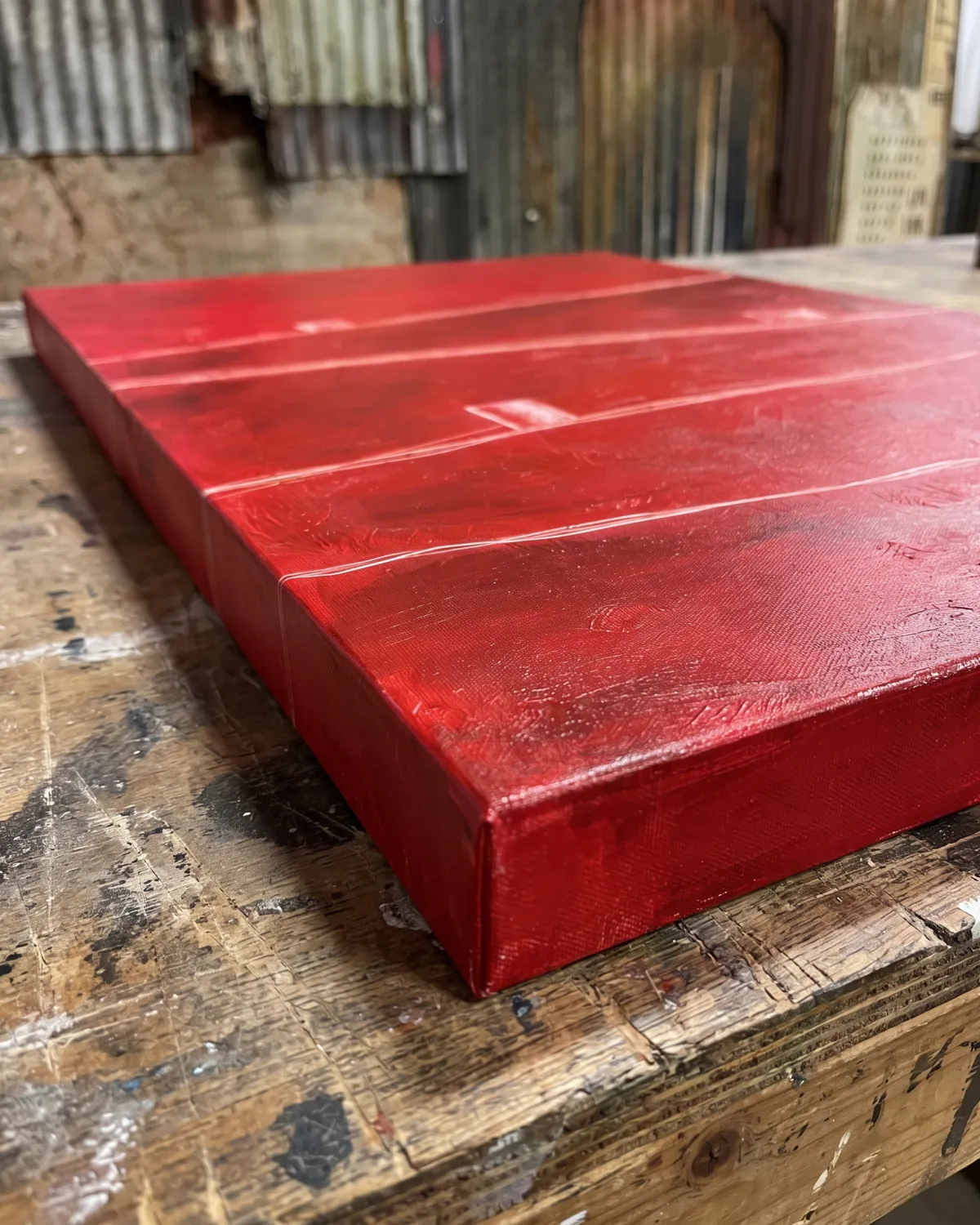
Context study / ATHAR
Detail of ATHAR by Maurizio Valch | Crimson Abstract Painting
From afar, ATHAR does not offer a place: it offers a temperature. The red occupies the vertical field with a warm, thick, obstinate extension; it does not burn exactly, but neither does it allow itself to be looked at as a peaceful surface. It seems composed of layers that have stayed together without fully merging. There are darker areas, others veiled, others retaining a low glow, as if the color held memory of different pressures. Before distinguishing the four white lines, the eye feels it is entering a room without walls, or a page where someone has decided that the margin will be red and that the margin will be everything.
The upper line then appears not as a horizon, but as the suspicion of a rule. It crosses from side to side with a slight slope; it seems to want to stabilize the height, though it fails to do so. Near it, a small light shape interrupts the continuity without imposing a figure: a brief rectangle, a delimited spot, a signal that does not quite admit what it is for. At first, it might seem that the line measures it, that the red sustains it, or that both have agreed on a distance. But a few seconds of looking are enough for the agreement to dissolve.
Ada Lovelace was a mathematician who imagined that a machine could work not only with numbers, but also with relationships, patterns, and possibilities. Faced with this first line, she would not look for a panoramic view but for a series: height, deviation, pause, repetition. The line seems like an instruction written with an unsteady hand: advance, hold, vary slightly, do not arrive just yet. The small light rectangle would be a variable that has entered the system without asking permission. Ada would try to record its distances from the other shapes, wondering if each one appears after an inflection, if each white deviation produces a clear interruption, if the red changes in density when the sequence is altered.
But an anomaly already arises from the top. The line is not a single line. On closer inspection, one notices that it contains friction, duplications, small separations; one scratch seems to accompany another, and then abandon it. It is not the clean stroke that orders a surface, but a gathering of strokes that deliberate poorly. The algorithm becomes fertile precisely because it does not conclude: each time there seems to be a rule, the white opens into two speeds and forces us to start over. A line can be a border, yes, but it can also be a faulty instruction, a bifurcation, a tentative attempt that ceases to obey the one who drew it.
The second line descends with a different temperament. It does not extend the first: it argues with it. More visible and more sloped, it traverses the red without guaranteeing any orientation. If the upper one hinted at a measure, this one alters the measure itself. Between both lies a wide red band, not empty but occupied by a slower breath. The eye descends and notices that the red is not a background across which lines pass; it is that which makes each of them have to negotiate its appearance.
There is a very simple question that begins to bother here: why do those small light shapes not fall from the red, and who decided that the lines could pass so close to them without carrying them away? The question does not ask that the shapes be objects nor that the red be gravity. It only returns something uncomfortable to the adult gaze: it has been accepted too quickly that the lines command and the rectangles obey. Perhaps the lines pass in front; perhaps they remain behind; perhaps there is no front nor back, but a hesitation of space that forces us to imagine depth where none has been granted.
Ada finds a possible sequence: four lines, four shapes; a partitioning that mimics calculation. The heights are not equivalent, nor are the pauses, but there is enough insistence to suggest a structure. The problem is that each unit deviates from its peer. No line repeats the exact slope of another; no light shape occupies the same relationship to the white; no stretch of red accepts being merely an interval. The painting seems programmable, but it changes its rule while being observed. The anomaly is not an accident to be corrected: it is that repetition produces difference without announcing when it does so.
“When a line stands before me as finished, it returns an intention to me that I did not know I had placed in it. I can see it approach a rule, even sustain it for an instant, and yet it does not fully belong to that rule. I am interested in that resistance: not knowing if the line has deviated or if it is I who needed it to obey.”
The third line forces us to descend in another way. We no longer look at it from a comfortable distance: we feel the gesture of having to cross it with our eyes. It is longer than a border and less secure than a path. It slopes, trembles, splits at times; it does not divide the painting into two clear zones, but introduces a physical discomfort. The breath, which from afar could accompany the expanse of red, becomes shorter when following its variations. The red remains wide, but now it seems closer, like a temperature too close to the face.
Rosa Parks was an activist whose refusal to yield a seat converted a small and firm bodily gesture into a collective transformation. She would not simply accept that lines are neutral. She would ask where the body stops before them, which one seems to block the way, which one organizes the crossing, and which one imposes a wait. A line can order, separate, protect, watch, or invite disobedience; its minimal appearance does not make it innocent. Yet here, none succeeds in consolidating its authority. Each has fissures, thicknesses, tremors. Not even the most insistent can say with firmness: this is the way through, this is not.
The small light shape near the third line does not conquer space. It remains. It does not advance, it does not occupy the red like a flag, it does not become a center. That persistence is what holds Rosa: something can stay still without being reduced to passivity. Ada, still attentive to relationships and correspondences, would want to place it in the series of the other three. Rosa distrusts that will for system: counting the shapes can make one lose the particular pressure of this one, its way of not yielding place even when surrounded by red.
However, the discrepancy changes direction when both return to observe the small rectangle. Ada stops calculating its position and perceives the physical effort required to look at it: to avoid losing it, the eye must brake just before crossing the line. It is not a coordinate but a resistance of attention. Rosa, in turn, notices that this permanence is not isolated: the rectangle sustains an irregular relationship with the others, as if each shape responded to a pattern that always arrives late. There is pattern, but no discipline; there is immobility, but no fixation. A mathematical solution is not enough, nor is the single gesture. Each method has been slightly displaced by the other.
“Now the small light shapes demand an attention from me that I cannot decide for them. Before, perhaps I saw them as interruptions within the red; looking at them again, I suspect they are the ones interrupting my way of looking. I do not know if they still belong to me completely, and that doubt does not make them alien: it leaves them working.”
The fourth line, near the bottom, does not gather the previous ones nor summarize them. It arrives like an incomplete farewell. It is closer to the edge, and therefore seems to carry a promise of exit; but it leads out of nothing. It too slopes, it too multiplies into nearby strokes, it too alters the red without dominating it. Near it, the last light shape remains suspended in a relationship that no longer seems decorative. Does the line accompany it, avoid it, contradict it? The secret question has become more precise and less resolvable: if the lines give instructions to cross the red, perhaps each instruction modifies the place from which it is received.
In the end, the lower light shape can no longer be merely a door, a refuge, a marker, or an interruption. It has learned something from the line passing nearby: that a direction can slope without becoming a destination. And the line has learned something from that still shape: that not all orientation consists of advancing. Between the hesitant white and the red that does not quite yield, there remains a small, almost obstinate zone from which the painting seems to look back.
- Original artwork
- ATHAR
- Actual dimensions
- 31.5 × 47.2 in / 80 × 120 cm
- Presentation
- Digital contextual visualization
Context references
red oil painting detail · oil textures on canvas · contemporary art close up · maurizio valch artwork · textured abstract painting · incised marks in contemporary art
About this visualization
This visualization places the artwork within an architectural context to help collectors and viewers imagine its presence in a real space. It is an interpretive reference, not an exact reproduction: the original work remains the sole authority for scale, color, surface and material presence.