Context study / ATHAR
ATHAR — Context Study
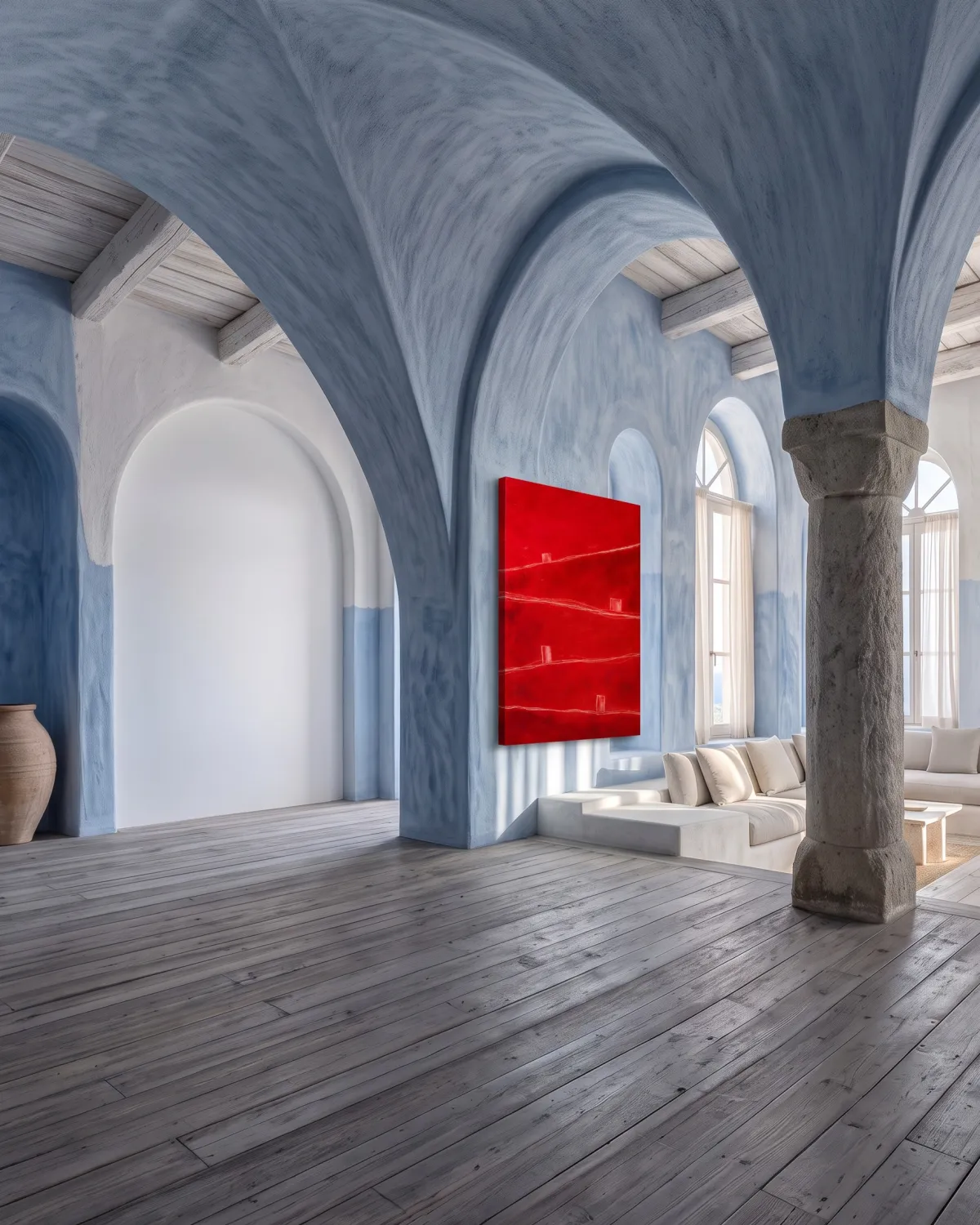
The initial encounter with "ATHAR" confronts us with a surface of absolute crimson red, a chromatic density that does not operate as a simple covering layer, but as a saturated, exposed, and latent skin. On this plane, painting relinquishes its representative function to reveal itself as an organic body that resists the gaze. It is here that the violent encounter between impulse and pain is sparked: the line is not added onto the canvas, it is not a superimposition of pigment, but a physical and subtractive incision, an irreversible scraping that hollows out the dense matter to extract the latent light of the white background from within. This cutting gesture transforms the red into a living tissue that has been traversed; each torn stroke is not a decorative drawing, but an open scar through which the rustic light of the original support emerges. Thus, pain materializes in loss, in the violent revelation of the void that underlies saturation, transforming the pictorial plane into a territory of wound and birth.
As I hold the palette knife in front of this crimson plane, I feel the dense resistance of the oil as a mass that demands to be questioned with severity. In that precise instant of the incision, my creative impulse and the pain of material loss merge into a single blind but accurate movement: it is the act of stripping the canvas of its own flesh to force it to reveal an underlying structure. I do not seek to decorate the surface, but to open a channel within the thickness of the pigment, a groove where my own bodily memory is inscribed through physical effort and the pressure of the hand. Each scraping is a mapping of my breath and my limits within the studio space; there, rational control dissolves to yield to a purely tactile intuition where subtraction is the only path to finding an order, transforming the surface of the canvas into a threshold where void and matter engage in their most honest combat.
Contemplating the suspended geometry of "ATHAR", the gaze confronts a deeply dramatic composition: four quadrangular blocks or niches that seem to ride upon the four oblique incisions dividing the canvas. It is in this arrangement that a strange and unsettling harmony manifests, a precarious yet absolute stability that paradoxically organizes the imminence of a fall. These small white cubes do not float in an abstract nothingness; they settle heavily on the rough edges of the scraped marks, functioning as small refuges or compartments of silence amidst the chromatic cataclysm. The work does not seek a peaceful or complacent equilibrium, but finds its order by structuring the accident itself, transforming the line of the fracture into a passable path, a subtle scaffolding where what was wounded becomes the support of a new and tense visual architecture.
For me, harmony in my work has never been synonymous with appeasement or a decorative truce; on the contrary, it consists of the capacity to sustain, under extreme tension, the coexistence of stillness and fracture. When I contemplate this highly dense canvas resting directly on the stone floor of my studio, or leaning against the rustic walls that absorb its crimson vibration, I understand that the painting has finally escaped the tyranny of the easel. It presents itself to me as an autonomous monolith measuring 80 x 120 x 3 cm, a block of living matter breathing in unison with the irregularities of the real space that welcomes it. It is not a fictitious window to another world, but a physical presence claiming its place in the present, a wounded body whose beauty lies precisely in its capacity to resist and structure the force of the tear.
In the phenomenological resolution of "ATHAR", the irrevocable impulse of the cut and the pain of the flayed stratum ultimately settle into a harmony as brutal as it is indivisible. The painting ceases to be an object of disinterested contemplation to actively challenge the passive gaze of the viewer, inviting them to inhabit a "tactile shore" where the surface recovers its condition of exposed and vulnerable flesh. The wounded canvas forces us to confront the physical dimension of time and the pictorial gesture. Ultimately, the absolute silence emanating from this work sustains a magnificent duality: it is, at once, the mute testimony of what has been subtracted from matter through the violence of the incision and the perennial vibration of what survives on the canvas, consolidating a space where the scar stands as the only possible truth.
- Original artwork
- ATHAR
- Actual dimensions
- 31.5 × 47.2 in / 80 × 120 cm
- Presentation
- Digital contextual visualization
Context references
red painting mediterranean living room · interior design blue arches · minimalist art rustic living room · maurizio valch abstract painting · summer house decor ideas
About this visualization
This visualization places the artwork within an architectural context to help collectors and viewers imagine its presence in a real space. It is an interpretive reference, not an exact reproduction: the original work remains the sole authority for scale, color, surface and material presence.