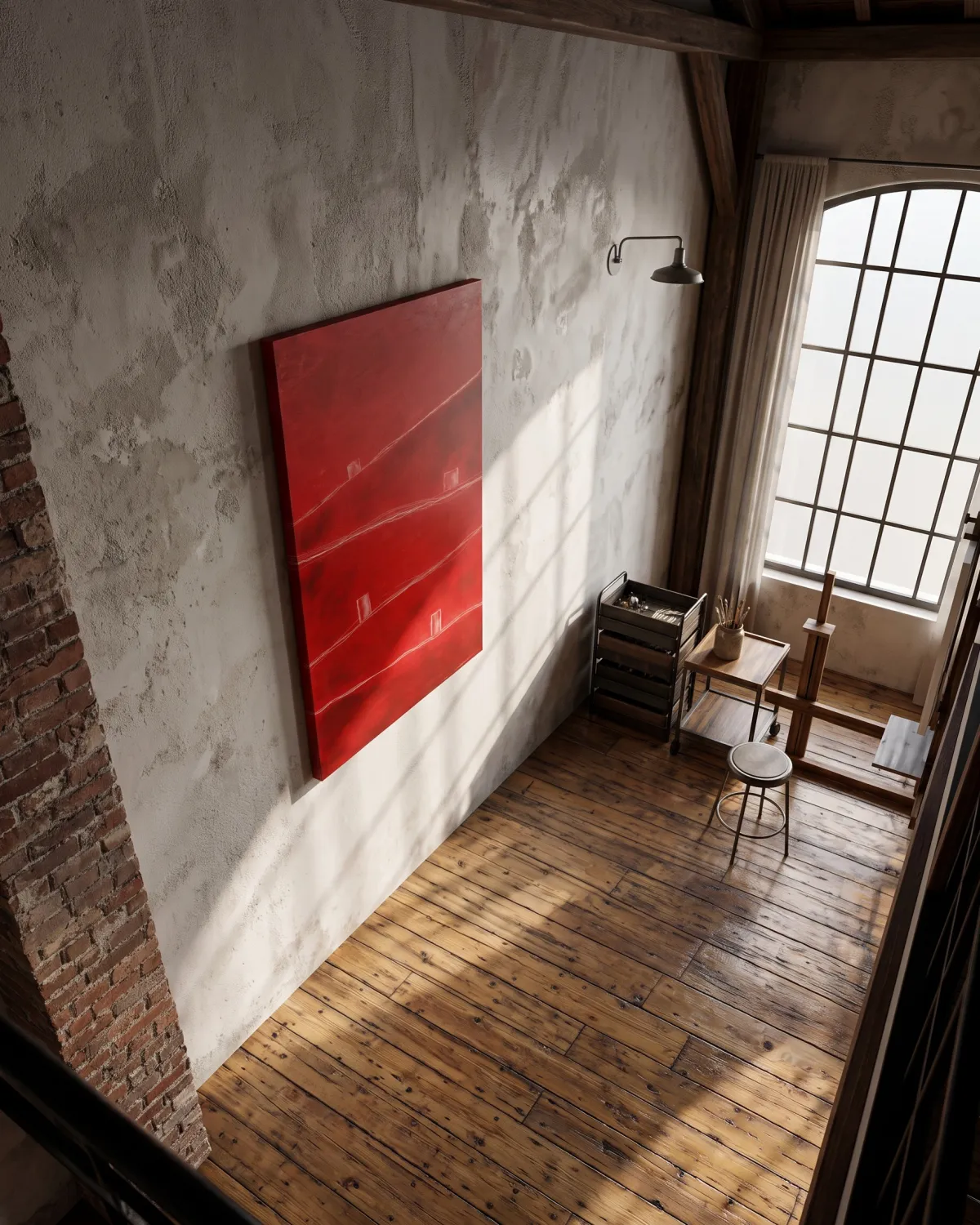
Context study / ATHAR
Red Painting ATHAR in Loft-Style Artist's Studio | Maurizio Valch
Before the work of Maurizio Valch we find ourselves disarmed, confronted by a plane of absolute crimson that does not behave as a simple chromatic background, but as a geological presence of almost visceral density. This saturated red, oscillating between the texture of primal clay and the dense pulsing of blood or fire, evokes the ancestral memory of the Nerja caves, where human art was born from the physical encounter with stone and darkness. It is not a flat color; it vibrates with an internal energy that seems to emerge from the canvas's very material. Upon this chromatic magma, the plane is torn by four thin horizontal white incised lines—subtle lines that support small, lightly sketched quadrangular blocks. These structures seem to ascend or descend with mineral slowness along invisible tectonic slopes, suspended in a territory that defies the laws of traditional perspective to immerse us in a pure existential dimension.
When I sink the spatula or metal into the still wet and dense surface of the paint, I do not seek to illustrate a concept, but to record a physical and temporal resistance. Cutting the pictorial material is, for me, an act of wounding and revelation: the white line is not a stroke added on top of the red, but the light of the canvas emerging as paint is removed, a path clearing its way through the density of color. With these incisions, I seek an elemental structure, a minimal scaffolding for thought that relinquishes the comfort of the recognizable landscape and concentrates on the pure memory of a transit. My hands do not draw perfect shapes, but scrape the canvas looking for the silence of the composition, a space where those small monoliths of barely sketched material serve as coordinates for the solitary wanderer we all carry within.
Contemplating the almost mathematical arrangement of these four blocks on their respective incised lines, it is impossible not to summon George Gurdjieff's warnings about the mechanical nature of human existence. Do these horizontal lines traversing the canvas not represent the invisible tracks of our daily automation, predetermined lanes where each individual, like one of these small isolated blocks, repeats a blind path without ever awakening to the awareness of their own surroundings? Facing this structural rigidity, Osho's gaze would offer a dialectical suspicion: these incisions are the limits of an institutional domestication that fragments the wild flow of life, represented here by that red background pulsing with no apparent order. Yet the opposite interpretation is also possible; perhaps these discreet horizontal structures are not prisons, but the minimal, necessary architecture that consciousness requires to sustain attention and avoid dissolving entirely into the absolute chaos of the red abyss.
I listen to these theoretical reflections and wonder if my small blocks are truly prisons or, conversely, the only possible shelters against the immensity surrounding them. Painting the distance and scale of these tiny shapes, I think of the isolation that defines contemporary experience, of that silent fatigue of one attempting to climb a slope that barely supports itself. For me, this red background does not represent a psychological drama or a stormy agitation; it is a living ground pulsing beneath our feet, an original earth that breathes. The incised marks I make on the canvas are signs of historical and personal time, scars that order space and allow the gaze to rest; that is why I prefer to maintain the work's ambiguity against definitive explanations, letting each person decide whether those blocks are climbing or descending the mountain of their own life.
From Carl Gustav Jung's perspective, this canvas unfolds as an archetypal map of the individuation process, where each of the quadrangular shapes represents a fragment of the psyche seeking its alignment and place in the world—what the Swiss psychiatrist termed the Self's Situs. The very title of the work, Athar, which in its etymology evokes the trace or vestige of what has ceased to exist, reinforces this dimension of interior archaeology, suggesting we contemplate the ruins of an extinct civilization or the definitive marks left by the soul's passage over matter. In the end, all interpretation dissolves upon returning to the physical presence of the eighty by one hundred twenty centimeter painting, where the tension between dense acrylic and subtle oil incisions remains in absolute silence, demonstrating that the stillness of painting is not an absence of movement, but a contained force in perpetual transformation.
- Original artwork
- ATHAR
- Actual dimensions
- 31.5 × 47.2 in / 80 × 120 cm
- Presentation
- Digital contextual visualization
Context references
abstract painting artist studio · rustic industrial style decor · red artwork on concrete wall · maurizio valch painting workshop · loft decor with original art
About this visualization
This visualization places the artwork within an architectural context to help collectors and viewers imagine its presence in a real space. It is an interpretive reference, not an exact reproduction: the original work remains the sole authority for scale, color, surface and material presence.