Context study / ATHAR
ATHAR — Context Study
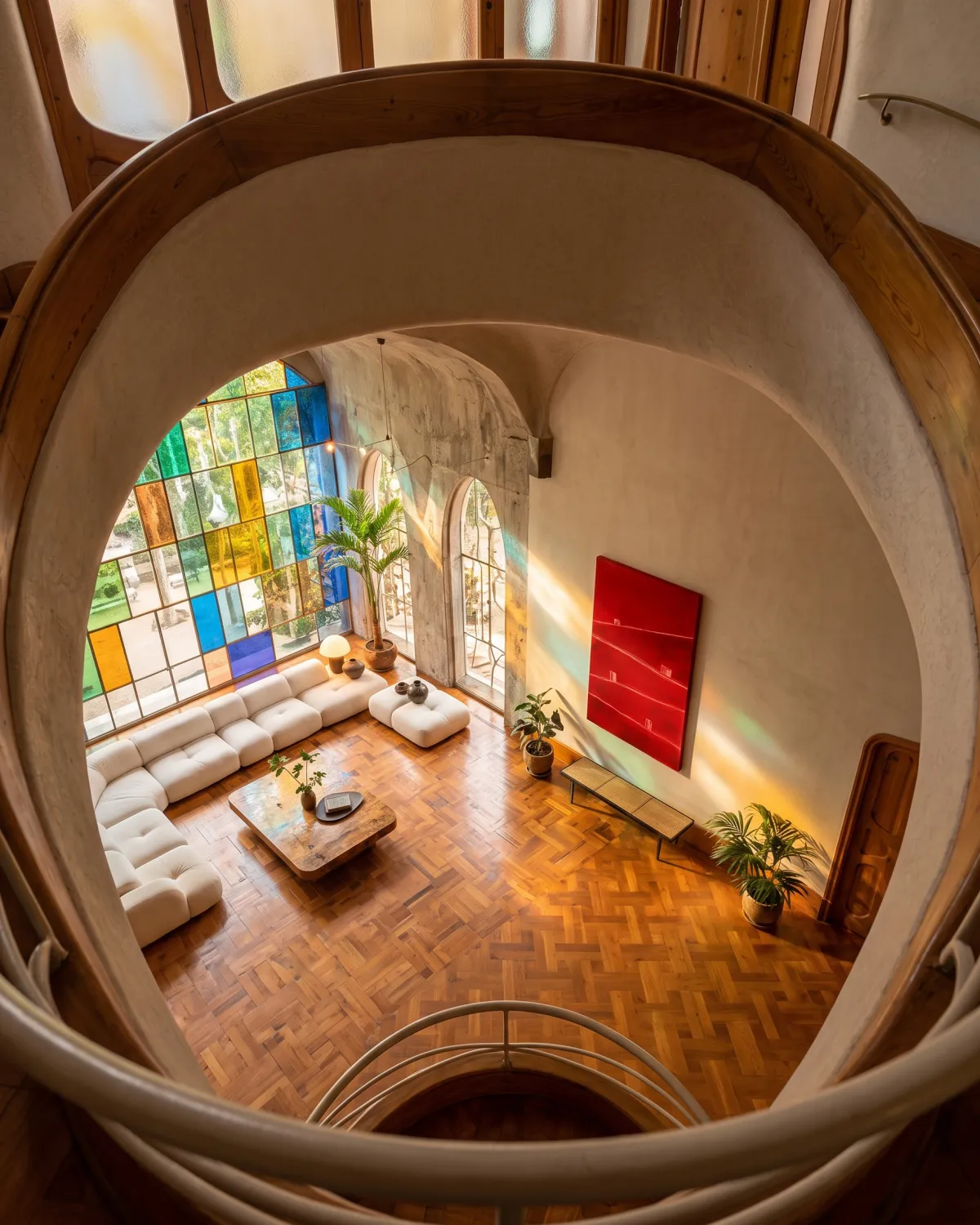
The viewer's eye does not descend directly onto the canvas; it is first caught by the dizzying wooden ring of the circular staircase that frames the scene from above. This forced perspective, a bird's-eye descent over the living room, establishes an initial visual hierarchy where the red painting competes with the spectacular nature of the massive multicolored stained-glass window that floods the room. However, once the impact of the great architectural space is overcome, the gaze is inevitably drawn toward that crimson block suspended on the wall. The composition of the scene acts here as a filter of discovery: the monumental and luminous is revealed immediately, leaving the subtle map of incisions in the artwork in a perceptual penumbra—a secret that yields only to those who choose to descend and shorten the physical distance to the material.
When working on the surface of "ATHAR", my obsession was not to crowd the canvas with information, but to regulate the speed with which the painting would reveal itself. In applying the dense layers of red oil, I knew I was building a barrier, a wall that the eye would have to learn to cross slowly. The incised marks I made with the spatula are not lines intended to guide the gaze comfortably; they are interruptions, trenches in the material that simultaneously hide and reveal the underlying light support. I wanted the small white blocks to seem almost invisible at first, suspended in the crimson abyss, forcing the viewer to abandon the rush to decipher the whole at once and to accept the patience required by visual excavation.
The dialogue established between the painting and the architecture of the space reveals a tension between the vertical order of real space and the discreet horizontality of the work. While the imposing concrete archway and the large window direct attention upward, the incised traces of the painting propose a tactile resistance, a detour toward the minuscule. This organization evokes the latent influence of Barnett Newman, where a linear intervention reorganizes a broad field, but here the line is not a statement of absolute presence, but a physical crack, an accident that interrupts continuity. What seems a clear distribution of light and shadow in the living room destabilizes upon approaching the canvas, where depth depends not on the building's perspective, but on the sedimentation and wear of the material itself.
From this circular railing that frames the void, I watch how the afternoon light passes through the colored glass and brushes the canvas without fully igniting it. There is a very intimate analogy between this real vantage point and the way I understand thought: we often stay on the periphery, contemplating the movement of the world from a distance that protects us from direct contact. In painting, I seek precisely the opposite: to break that panoramic gaze and force myself to fall into the roughness of the physical fact, into the vibration of the resisting pigment. I do not know if these blocks hanging from the slots will manage to hold themselves up in front of the viewer or if gravity will eventually swallow them; I am content with them acting as small silent shelters, reminders that the true journey occurs where the gaze stops because it has found a question it cannot answer immediately.
Ultimately, this staging demonstrates that the value of a work does not lie in its capacity to impose itself on the space, but in its power to establish an interval of silence amid visual noise. The gaze, trained to consume refined architecture and designer furniture, is forced to slow down in front of the painting's red wound. The subtle vibration of the incised marks remains like a background murmur, hidden behind the first layer of spectacularity but firmly anchored to the wall. By collapsing analytical distance, the viewer discovers that what is truly important is not the surrounding room, but the persistence of that tactile shore resisting complete translation, reminding us that every territory, before being explained, must simply be inhabited.
- Original artwork
- ATHAR
- Actual dimensions
- 31.5 × 47.2 in / 80 × 120 cm
- Presentation
- Digital contextual visualization
Context references
abstract painting living room with stained glass · spiral staircase interior design · contemporary wall art · elegant living room decor natural light · maurizio valch red painting
About this visualization
This visualization places the artwork within an architectural context to help collectors and viewers imagine its presence in a real space. It is an interpretive reference, not an exact reproduction: the original work remains the sole authority for scale, color, surface and material presence.