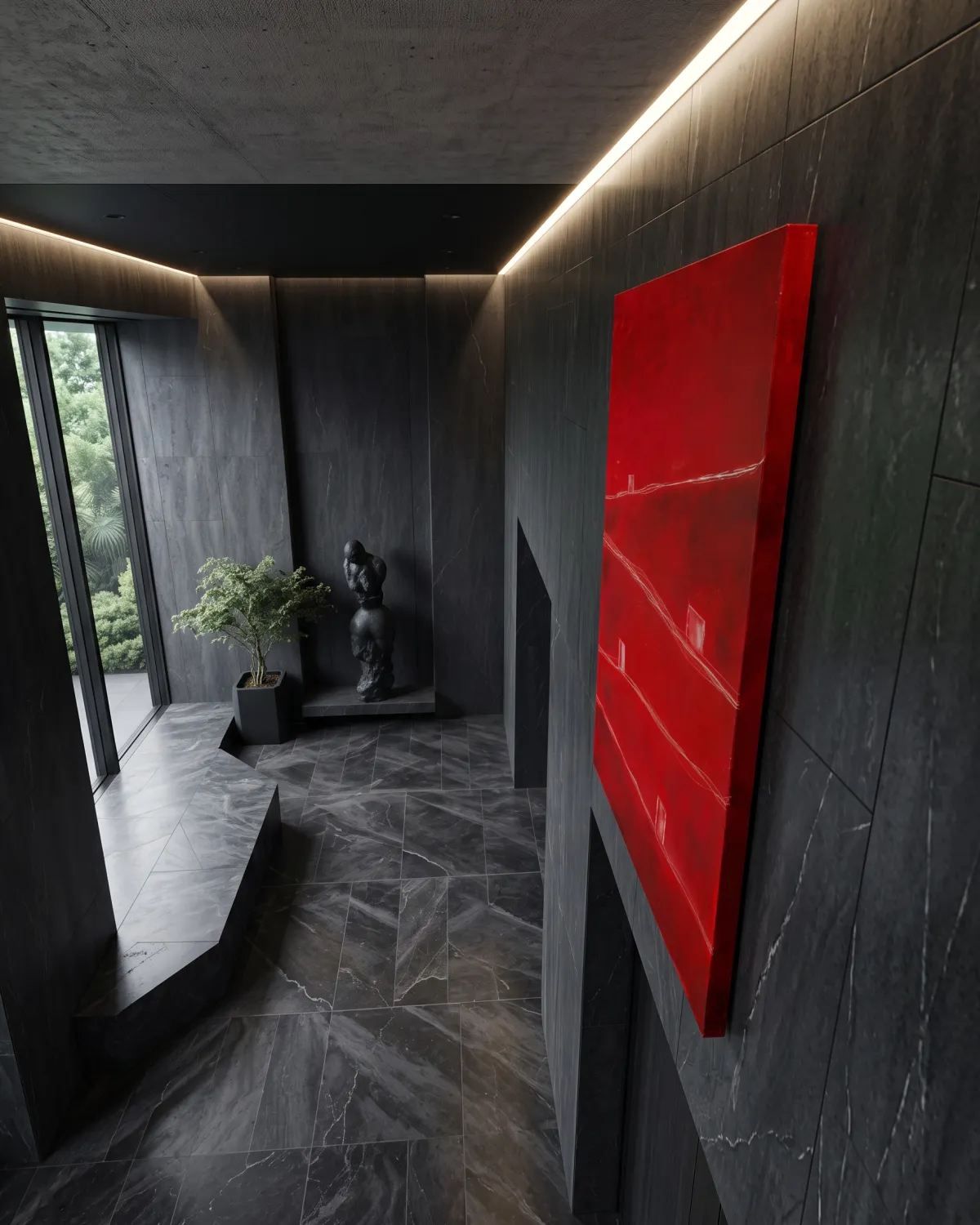
Context study / ATHAR
Abstract Red Painting ATHAR in Dark Stone Living Room | Maurizio Valch
Manual for Crossing a Red That Does Not End
Look at the painting for a few seconds and decide which of the four small light shapes seems least secure in its place. Do not explain the choice. Just hold on to it.
The first crossing begins before touching a line. In front of this red rectangle, so high that it seems to grant neither top nor bottom, the breath seeks a measure and cannot find one. The eyes attempt to correct the vertical, to turn it into a wall, a banner, a precipice, a field; but the red does not easily accept any function. It has a temperature that does not warm, a density that does not weigh in any stable way. At times it approaches until it occupies all available distance; at times it expels the gaze toward the edge, as if looking were a clumsy way of keeping oneself safe.
The first white line seems like a horizon. It is tense, long, slightly wavy. However, it does not divide a sky from an earth. It merely crosses the red and leaves behind a suspicion of height. What kind of place can have several horizons and offer no solid ground? This line does not order: it displaces. It suggests that the red field continues beyond the frame, but also that it has been accumulating in front of it, layer after layer, until erasing any orientation.
César Vallejo knew that a sentence can continue to breathe after it is broken.
Upon approaching the line, one takes it for a sentence that is too long. Not for a sentence that tells something, but for one that insists without finding a final verb. The minimal curve in its path seems like a stumble of the voice: a syllable that falls, rises, and continues. The small, still distant light figures could be words lacking an action: door without entry, house without inhabitant, mark without territory, error without correction. But that reading does not last. The red does not allow language to settle. Every time a shape seems to say "here," the surface responds "not yet."
It is hard for me to stop in front of this red because it does not remain still even though the painting remains. I look for a distance to see it, but that distance moves and places me too close again. The lines began to ask something of me that I could not fully translate: they did not want to be boundaries, nor paths, nor explanations. I do not know if I order them or if they force me to follow a gravity that was already there.
The second line arrives lower down, or perhaps deeper in. Its wave has a different weight: it seems less secure in its continuation, but it does not break. After the first, which promised a separation, this one reveals that there was no separation at all. Only different attempts to cross. The red becomes thicker between the two, as if it had absorbed the space that was meant to be left free. There is no longer a landscape behind the line: there is a red that has learned to occupy the distance.
One of the light figures remains close to that path. It has the uncertain size of something seen from very far away or of something too close to be recognized. Vallejo tries to give it a phrase: "a door." The phrase breaks immediately. A door to what, if there is no exterior side; a door for whom, if the red leaves no place to stand. The small shape is then suspended between two errors: it manages to be neither object nor word. This insufficiency makes it more active. It does not rest upon the painting; it seems to make the painting hold itself up around it.
The third line demands another kind of gaze. It is no longer enough to follow it: one must step back to imagine that it traverses an extension. Caspar David Friedrich sought in the landscape a place from which the gaze could inhabit the immense.
Here, that place is missing. There is no figure from behind to receive the extension in silence, no promontory, forest, ruin, or horizon capable of gathering the view. The painting offers height, but withdraws the ground. It offers depth, but denies distance. Friedrich measures with his eyes, seeking an edge from which the red can turn into landscape; as he steps away, he discovers that the edge has moved with him. The line, which seemed like a point of support, curves slightly and turns his calculation into another form of displacement.
Then Vallejo returns, but he no longer stumbles only over words. He stumbles over distance. He cuts a line in two with his thoughts and discovers that both halves are still joined by a rhythm he cannot name. Friedrich attempts to repair the cut, to return spatial continuity to it, but the rhythm does not occupy a fixed place. An almost imperceptible wave makes the line simultaneously a contour, a phrase, a crack, and a held breath. Neither completely imposes itself on the other: one displaces language until the landscape stutters; the other seeks a shore until the phrase acquires depth.
"Why don't those little houses fall if the red has no floor?"
The question remains between the third and fourth lines. It does not answer the painting: it forces it to change. From that moment on, the four light figures can no longer be reduced to signs, doors, or details. They are too fragile to support an architecture and too stubborn to disappear. They seem subject to a law that is not seen. Perhaps they float. Perhaps they are embedded. Perhaps the red has left them in peace only because it has not yet decided how to absorb them.
Friedrich moves a bit further away, trying to restore their scale. If they were shelters, one would have to imagine who they shelter; if they were windows, one would have to conceive a facade; if they were game pieces, one would have to find the board. But each hypothesis adds a ground that the painting does not grant. Vallejo, less patient with this need to build a world, lets one of the shapes be merely a white interruption: a small "but" installed in the red matter. Friedrich does not fully accept this poverty; Vallejo does not fully accept this architecture. The disagreement keeps the figures awake.
The fourth line is closer to the lower edge, though there is no descent there either. It slides with an almost fugitive tension. Returning to it, the white lines stop looking like divisions: they look like escape attempts. They do not leave the red; the red retains them, borders them, makes them visible against itself. But in their minimal detours there is an insistence that no longer seems to obey the field. As if each line had begun to seek a different exit and had left, instead of a path, the trace of its failure.
Now, the shape chosen at the beginning returns: the one least secure of remaining in its place. It does not need to be the smallest or the most tilted. It might have been the one that looked like a door, the one that looked like a fallen piece, the one that seemed too white, the one that was barely visible. The choice reveals a relationship with the desire to enter, escape, measure, or stay. That rectangle transforms when looked at again. It no longer offers an answer, but a test: what changes if it is not a door, but a piece of wall that has forgotten the building to which it belonged?
If it were a wall, it would neither close nor open anything. It would be the memory of a boundary without the place that justified it. Vallejo would want to displace it within a sentence to see if it recovers movement. Friedrich would seek to place it at a distance where it could once again become part of a world. But the shape resists both operations. It remains too light, too small, too uncertain. It does not fall, even though there is no ground. It does not open, even though it resembles a threshold. It does not disappear, even though the red seems capable of swallowing anything.
Seeing it finished again, I do not always recognize the same red. A line continues to do something I did not ask of it, and one of those figures preserves a distance I cannot reduce. I do not need to call it landscape to feel that it forces me to look in another way. It remains there, and that permanence does not entirely obey me.
The painting remains open in that disobedience. The four lines have been crossed without any of them truly leading to the other side. The small shapes have changed scale several times: shelters, errors, little houses, remnants of wall, signs that look back. The red, instead of becoming a background, continues to approach and retreat, like a matter that does not allow the gaze to stabilize.
Near one of the waves, just where the white loses firmness before recovering it, a minimal tremor remains. Beside it, the pale edge of a figure seems less defined than a moment ago. There, the red becomes slightly denser, and no one manages to cross that variation.
- Original artwork
- ATHAR
- Actual dimensions
- 31.5 × 47.2 in / 80 × 120 cm
- Presentation
- Digital contextual visualization
Context references
minimalist red painting · contemporary abstract painting · modern stone living room decor · crimson red wall art · maurizio valch strata athar
About this visualization
This visualization places the artwork within an architectural context to help collectors and viewers imagine its presence in a real space. It is an interpretive reference, not an exact reproduction: the original work remains the sole authority for scale, color, surface and material presence.