Context study / ATHAR
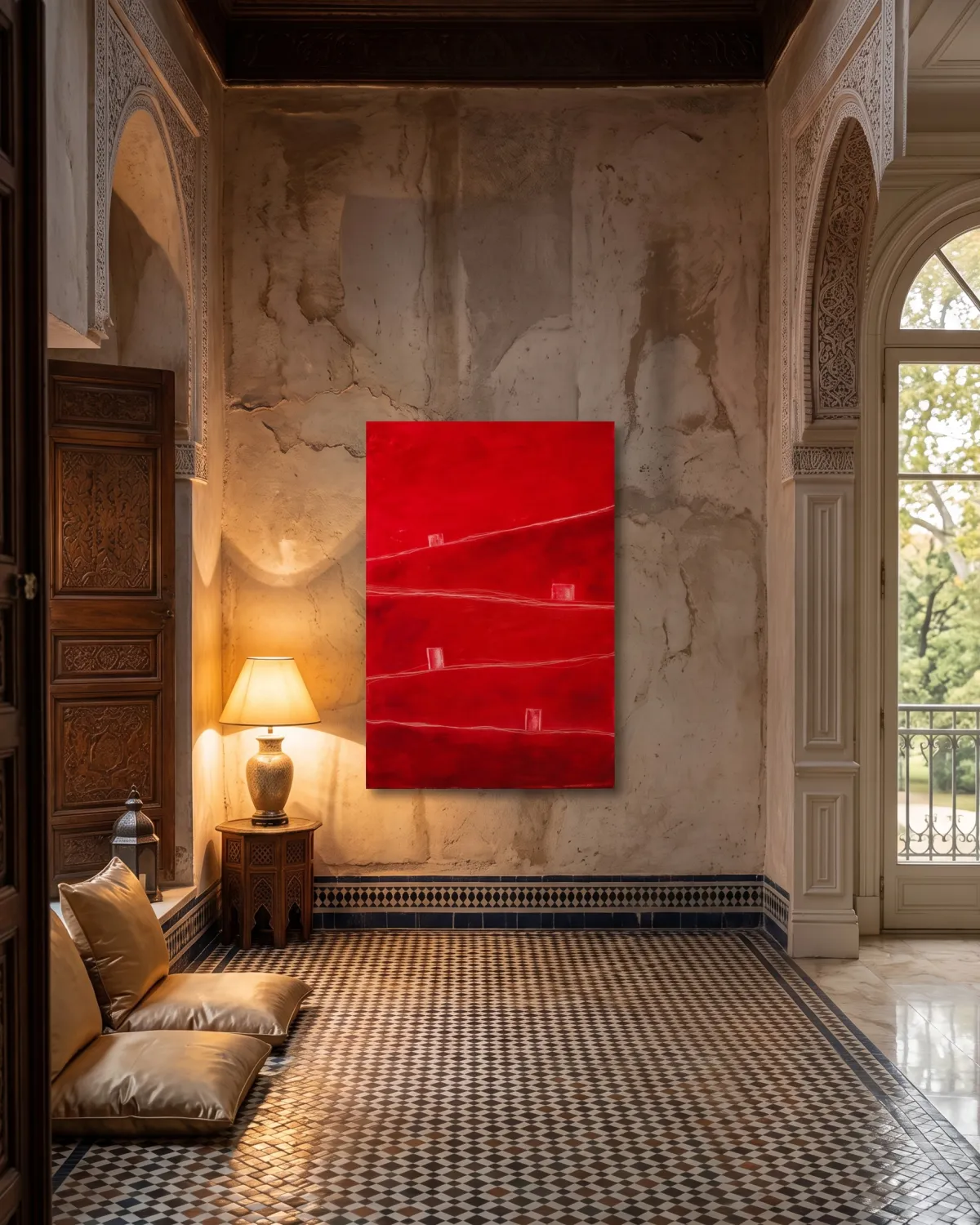
ATHAR red abstract canvas by Maurizio Valch in Moorish courtyard
"ATHAR" (ID: 10106) presents itself to the viewer as a dense and vibrant crimson territory, a field of thick oil paint that does not act as mere decorative pigment, but as a geological mass subjected to enormous internal pressure. In this work by Maurizio Valch, depth refuses to submit to the conventions of illusionistic perspective or atmospheric gradients; on the contrary, it imposes itself through a rigorous subtractive process, a physical violence that wounds the skin of the painting. By determinedly scraping the accumulated oil paint to trace his four distinct horizontal incisions, the artist does not add material, but unearths the rustic and latent light of the underlying white support. In this way, the canvas becomes an archaeological excavation where depth is not an abyss of abstract emptiness, but an open scar that brings to light the geological memory of the matter and the resistance of its layers.
In my pictorial process, I have understood that the creator's true generosity does not lie in the cumulative gesture of saturating the surface with endless layers of color or rhetorical discourses, but in the painful and liberating act of subtracting, of knowing how to let go. Assaulting the absolute sovereignty of this crimson plane with a sharp tool is, in reality, an act of surrender: I break the perfection of the red plane so that the painting can breathe and reveal its vulnerability. Working in this eighty by one hundred and twenty centimeter format, often off the easel and allowing the canvas to rest on rough wood or directly on the floor, I renounce absolute control and surrender the work to its own physical laws of weight and gravity. My hand does not seek to govern the surface, but to offer it honestly, assuming that the tearing of the material is the only way to give the viewer a space of experience free of artifice.
Distributed in subtle imbalance along the trajectory of these incised lines are four small rectangular blocks that operate as discreet monoliths or niches of suspended matter. It is in the arrangement of these apparently isolated elements that the most subtle dimension of communion unfolds. These blocks, situated at autonomous levels and unequal slopes within the plane, do not communicate through physical proximity or conventional compositional harmony, but by sharing the same condition of gravity and decline. The horizontal scars crossing the canvas function as the terraces of their resistance; communion in "ATHAR" is not born from closeness or visual consensus, but from shared weight and a common belonging to a ground that has been previously wounded and tilled by the artist's hand.
When I sink the metal into the density of the wet oil and hear the dull crackle of the matter yielding under physical pressure, the distance between my body and the canvas completely dissolves. These clefts are not cartographic boundaries designed to govern space, but channels of search where the depth of the support seeks to enter into direct communion with the gaze of the other. I constantly ask myself whether these incisions represent navigation maps for getting lost or elemental routes for finding oneself in the midst of the crimson. In the end, I accept the painting as a "tactile shore," a boundary space where my own material uncertainties and the expectant silence of the observer manage to physically touch each other through the seam of the relief, dissolving the boundaries of the self.
Ultimately, "ATHAR" consolidates this triune experience—where the generosity of the cut and the depth of the exposed matter transform our understanding of communion—into an aesthetic revelation of unyielding honesty. Confronting the work, the observer is stripped of contemplative distance and forced to inhabit a living surface that does not hide its wounds. Maurizio Valch invites us to lay down the neurotic demand for symmetry and control, urging us to accept the decline, the weight, and the stark beauty of that which wears itself away in order to signify. It is precisely in this shared wear, in the acceptance of the common fracture that unveils the inner light of the painting, where the possibility of a genuine, silent, and selfless human connection resides.
- Original artwork
- ATHAR
- Actual dimensions
- 31.5 × 47.2 in / 80 × 120 cm
- Presentation
- Digital contextual visualization
Context references
paintings for high ceiling living rooms · tile decor with modern art · large format minimalist art · contemporary red paintings
About this visualization
This visualization places the artwork within an architectural context to help collectors and viewers imagine its presence in a real space. It is an interpretive reference, not an exact reproduction: the original work remains the sole authority for scale, color, surface and material presence.