Context study / ATHAR
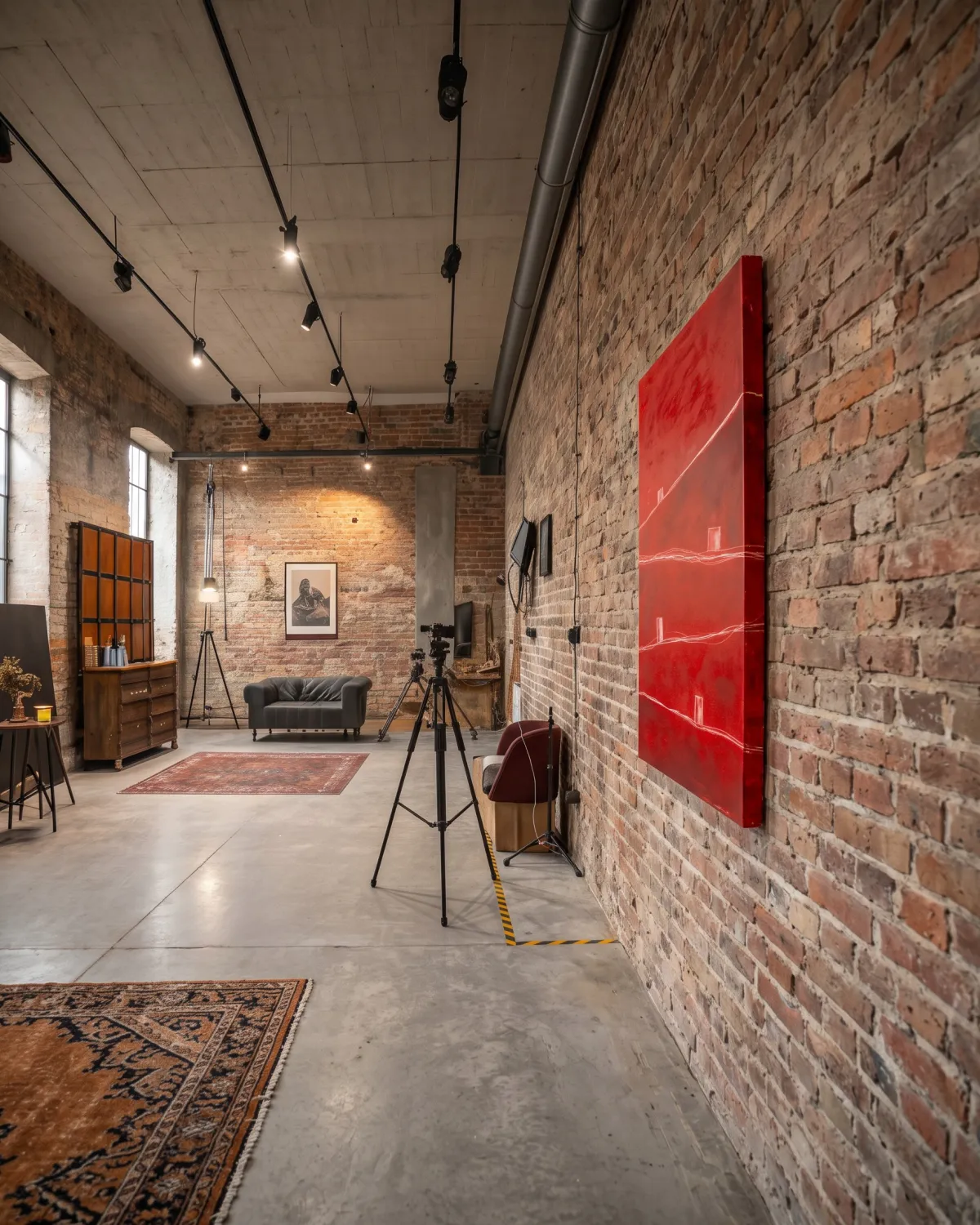
Modern red painting ATHAR in exposed brick loft
Hanging ATHAR on an exposed brick wall, surrounded by the roughness of concrete and the warm light of an active studio, strips the painting of any pretense of sacred purity. The large crimson canvas does not present itself as a window toward an immaterial absolute, but as a dense body that competes in weight and texture with the very architecture supporting it. Faced with this coincidence of rugged surfaces, the gaze stumbles upon the impossibility of reducing the work to a clean idea or a coded message. The red color does not function here as an emotional adjective; it is a thick ground, a physical presence that arrests the analytical inertia of the viewer and forces them to confront the pure immediacy of matter.
When I sink the palette knife into the wet oil paint to open those thin white lines, I am not seeking to trace a walkable path or delimit an intelligible map. At first, in the studio, there is always the temptation to justify every cut, to seek a theory that might appease the uncertainty of the arm before the wound solidifies on the canvas. But painting possesses a physical intelligence that disrupts my own arguments: by subtracting pigment, by scraping the surface to expose the base, I understand that the value of the stroke does not lie in what it explains, but in what it keeps silent. These incisions are accidents that stop my own mental noise; they are not questions waiting for answers, but the record of a physical encounter where thought finally relinquishes its urgency for control.
The small geometric blocks hanging from the incisions at different heights suggest a structure, a precarious architecture suspended in the midst of falling. It is easy to succumb to the temptation of interpreting these niches as hermetic symbols of protection or as refuges of an obscured truth, evoking Saint-Exupéry's famous sheep box. However, in the real space of this room, the tension of their subtle decline voids any moral or mystical translation. In the manner of Antoni Tàpies, for whom the pictorial surface operated as a wall marked by time and erosion, these monolithic presences do not illustrate a prior concept; they are forces in friction with the support, minimal volumes that resist gravity without offering a resolution to their instability.
Seeing the work now integrated into this environment, suspended alongside the technical gaze of the tripod and the worn warmth of the rugs, brings back a strange feeling of detachment. There was a time when I believed that finishing a painting was equivalent to reaching a destination, a revelation that would justify all the muscular effort and the uncertainty of the journey. Now, observing the relief of ATHAR exposed to the side light that reveals its irregularities, I understand that painting begins to breathe precisely where I stop needing a conclusion about it. The canvas holds itself by its own physical laws, and its silence frees me from the need to explain who I am through what I paint.
Faced with the remembering surface, the viewer is invited to inhabit a "tactile shore" where analytical distances eventually dissolve. The visual syncopations of the incised lines, which cut off and continue over the edges of the stretcher, do not propose a narrative resolution; they demand clean attention, a rest in the very uncertainty of the present. Understanding the work does not consist in deciphering an enigma hidden behind the crimson, but in accepting the suspension of the search, allowing the gaze to travel down the slope without the anxiety of the goal. At that moment when the demand for a final explanation ceases, the painting stops being a psychological problem to become a territory where one simply is, as real and mysterious as the stone that surrounds us.
- Original artwork
- ATHAR
- Actual dimensions
- 31.5 × 47.2 in / 80 × 120 cm
- Presentation
- Digital contextual visualization
Context references
large industrial decor paintings · red painting on exposed brick · contemporary abstract art for loft · large modern paintings
About this visualization
This visualization places the artwork within an architectural context to help collectors and viewers imagine its presence in a real space. It is an interpretive reference, not an exact reproduction: the original work remains the sole authority for scale, color, surface and material presence.