Context study / ATHAR
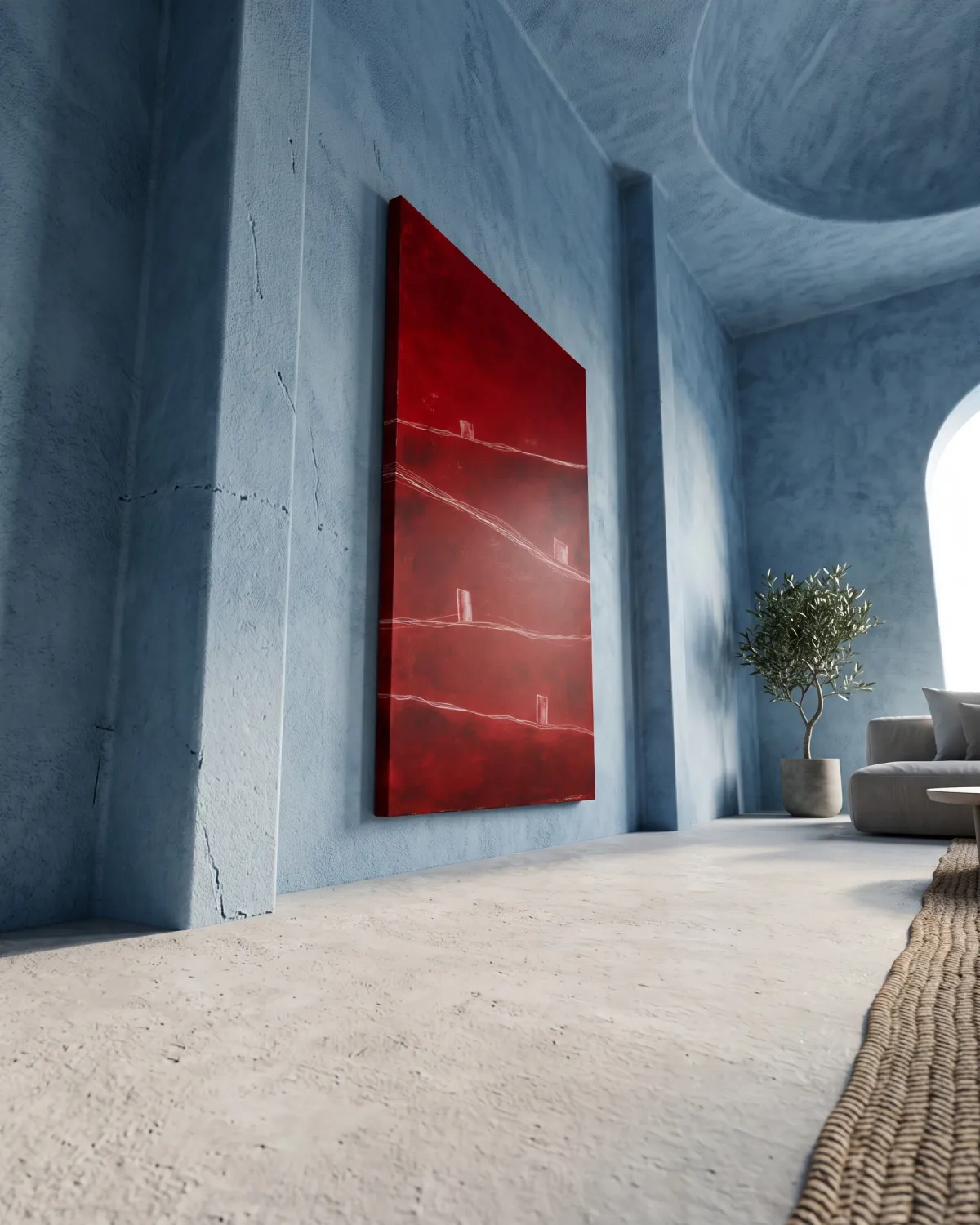
Red abstract painting ATHAR in minimalist blue interior
The surface of "ATHAR" presents itself to the viewer as an incandescent territory, a vast plain of crimson red that transcends the mere condition of pigment to become a magmatic substance, dense and charged with a latent mineral memory. On this vertical plane, the pictorial matter seems to have been subjected to a tectonic force; the four horizontal lines crossing the canvas are not superimposed strokes, but physical incisions, longitudinal wounds that crack the density of color to structure the void. This action of cleaving the matter inevitably evokes the first graphic gestures of humanity in the Iberian Peninsula, such as the abstract signs and Paleolithic incisions found in the Cave of Nerja, where prehistoric humans scratched the stone to establish a space of meaning. By dividing this chromatic abyss, the work interrogates the very origin of the concept of situs: that primordial moment in which human consciousness interrupts the chaos of nature with a linear mark, delimiting a territory of its own and transforming the hostile immensity into a place of belonging and contemplation.
When I sink the tool into the wet density of the canvas, I am not seeking the precision of a geometric design, but rather to experience the physical resistance that the pictorial layer itself opposes to my hand. I feel that each incision is an act of unveiling, a cut that interrupts the uncontrolled expansion of the crimson and reveals the structure hidden beneath the surface. For me, those small whitish and pinkish blocks resting on the lines are not representations of architectural elements or human figures; I perceive them as mute presences, minimal monoliths that anchor my own memory to the material support of the painting. By carving them directly into the thick oil paint, I seek a formal tension where the weight of these compact forms seems to hold itself in a precarious, almost suspended balance, defying the tilt of the invisible slopes I have traced on the canvas.
From an external perspective, the arrangement of these blocks on their respective lines invites a deep reflection on the dynamics of existence, resonating with the warnings that the philosopher and mystic George Gurdjieff raised about the mechanical nature of everyday life. The blocks seem to embody the condition of sleeping individuals, each confined to their own level of reality, automatically repeating their position on a predetermined rail that prevents them from ascending or descending freely. The oblique lines operate here as fixed paths or deterministic structures that impose an apparent immobility despite the suggestion of a slope. However, the calculated distance and the silence separating each block from the next should not be interpreted solely as a condemnation to isolation; it is possible that this empty space is the critical distance necessary for "self-remembering" to occur, that inner friction indispensable to awaken from collective uniformity and begin a conscious movement.
I understand that one might attempt to decipher my work through the lens of philosophical or sociological systems, but when I work in the solitude of the studio, my search is much more intimate and stripped of preconceived theories. For me, painting does not illustrate a treatise on human alienation; it is a direct record of my own attempt to find a center of gravity amidst daily dispersion. The absolute silence that surrounds me while I paint translates physically into the exact distance I have left between each of the blocks, a void that demands respect and prevents the forms from collapsing into one another. I am particularly interested in the play of scales: how these small elements, barely a few scrapings of pale matter, acquire a heavy, brutalist monumentality when confronted with the immensity of the crimson void that surrounds and contains them.
Under the analytical gaze of Carl Gustav Jung, the ascending structure of "ATHAR" reveals itself as a visual representation of the process of individuation, an inner ladder where the psyche seeks integration through successive levels of consciousness. The crimson background ceases to be a mere physical space to become the stage for alchemical transformation, where the fire of rubedo confronts the passions and the collective unconscious. Each whitish block, emerging from the scraping and subtraction of the dark matter, symbolizes a fragment of the Self slowly surfacing toward understanding, seeking a balance against the gravitational force of the shadow. In this way, "ATHAR" honors its name by presenting itself as a map of archetypal traces and footprints, a threshold where the viewer is confronted with their own internal distances and challenged to decipher on which layer of their own verticality they find themselves suspended.
- Original artwork
- ATHAR
- Actual dimensions
- 31.5 × 47.2 in / 80 × 120 cm
- Presentation
- Digital contextual visualization
Context references
crimson minimalist painting · living room minimalist wall art · red paintings for modern interiors · scandinavian minimalist art decor
About this visualization
This visualization places the artwork within an architectural context to help collectors and viewers imagine its presence in a real space. It is an interpretive reference, not an exact reproduction: the original work remains the sole authority for scale, color, surface and material presence.