Context study / ADITUS
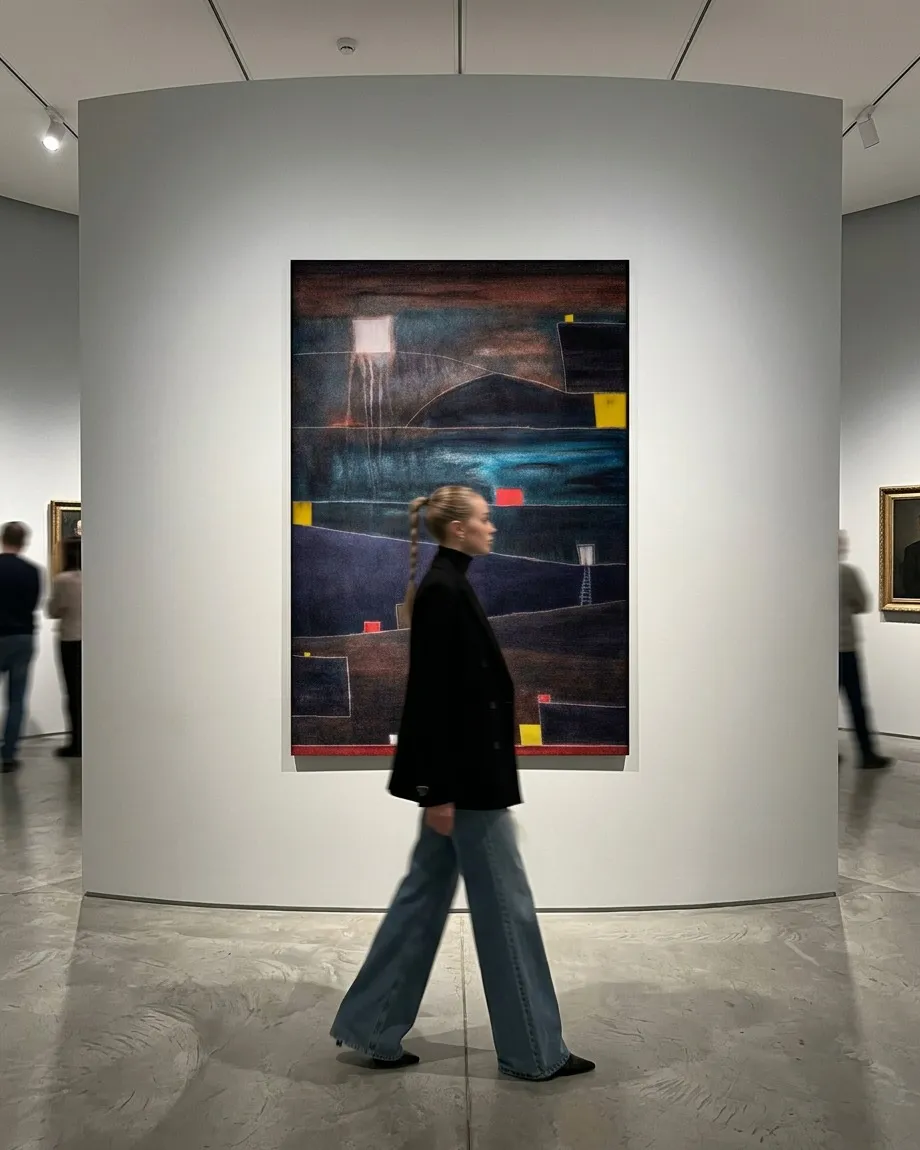
ADITUS by Maurizio Valch on a curved wall
Each step around the wall requires the viewer to reassemble the field of ADITUS: the horizontal bands, incised contours, and small rectangles never settle into a fixed front, even as they persist in offering points of support. This delicate resistance belongs to Maurizio Valch’s documented visual language, in which divisions and incisions pass through the material rather than merely outlining it. In this 80 × 120 cm canvas, the compressed turquoise band, dark slopes, and incomplete arch sustain an organization made vulnerable by seepage and glazes. The curve of the wall intensifies this condition: whether approached from the side or seen from a distance, the order changes without the painting losing its marks of orientation.
The experience of passage holds a persistent place in Valch’s thinking, though he distinguishes a traceable route from an inner movement with no assured direction. ADITUS allows this difference to be felt without turning it into a biographical narrative: its minimal stairway and luminous forms propose a possibility of passage, but do not resolve what may be reached or from where one is looking. The momentary crossing of people before the canvas adds a bodily and temporal measure to this uncertainty. The gaze does not master the territory all at once; it must readjust, accepting that a sign may be obscured, reappear, or acquire a different weight from another position.
In “From Dream to Territory,” Valch places LIMINA at the moment when space begins to organize itself without abandoning the instability of the threshold. ADITUS makes this coexistence visible: its bands are not a sovereign grid, but levels subject to deviations, drips, and shifts. “The Missing Beat” offers another key: an interruption in rhythm does not cancel structure, but requires the body to sustain internally what is missing. The curved room produces a comparable experience on the perceptual plane. As expected frontality is lost, the gaze provisionally completes the painting’s directions; each movement alters that adjustment and keeps attention active.
The affinity with Paul Klee is relevant to the function of the small red, yellow, and pale rectangles, which introduce signs and measures of scale within a larger expanse. Yet in Valch these indications do not construct a light architecture or a play of equivalences: they remain embedded in a dense, eroded atmosphere crossed by dark strata. Against the enveloping continuity of the wall, such forms sustain partial, almost fragile orientations. The access announced by the title thus ceases to be a locatable doorway and becomes a practice: finding, losing, and readjusting the place from which one looks.
- Original artwork
- ADITUS
- Actual dimensions
- 31.5 × 47.2 in / 80 × 120 cm
- Presentation
- Digital contextual visualization
Context references
ADITUS Maurizio Valch · abstract painting on a curved wall · 80 x 120 cm vertical abstract artwork · contemporary art for a gallery · abstract painting with dark and turquoise bands · geometric abstract painting with red and yellow accents
About this visualization
This visualization places the artwork within an architectural context to help collectors and viewers imagine its presence in a real space. It is an interpretive reference, not an exact reproduction: the original work remains the sole authority for scale, color, surface and material presence.