Context study / ADITUS
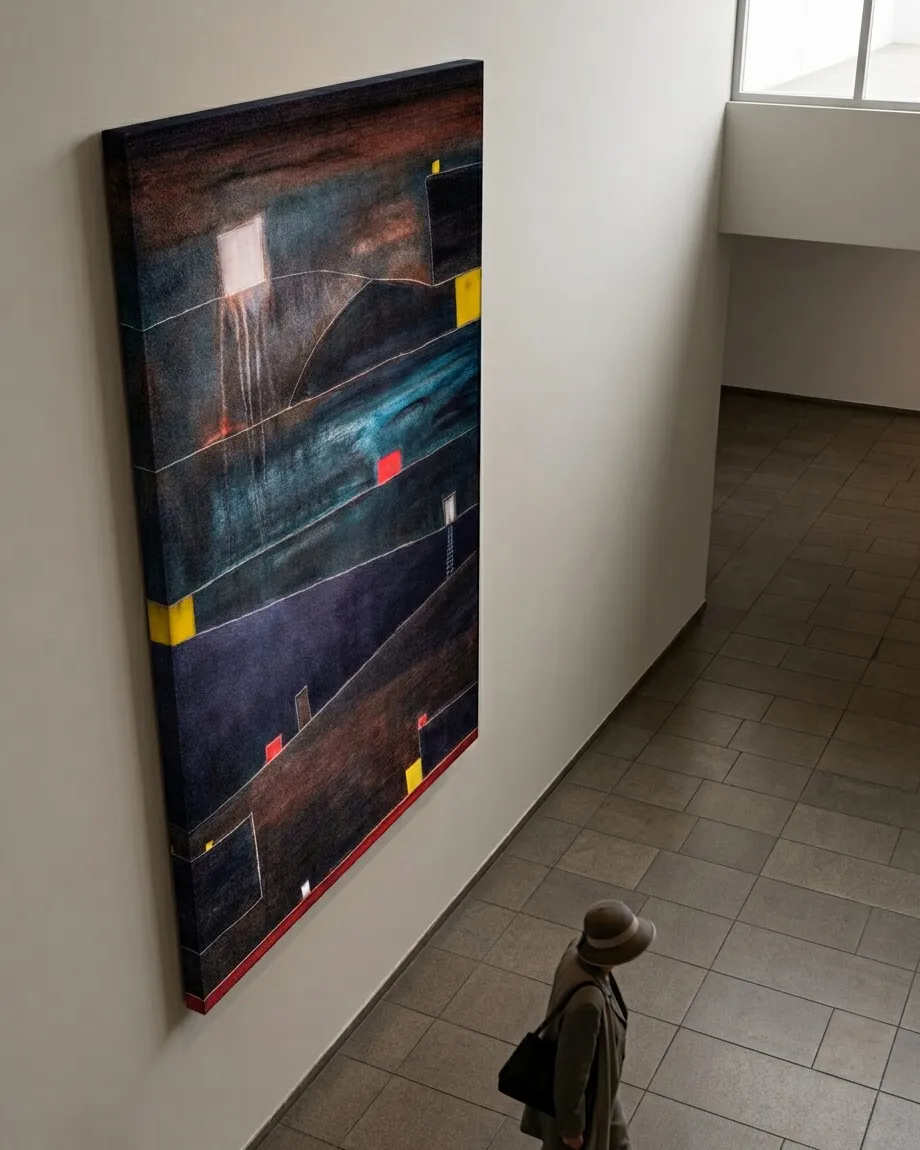
ADITUS by Maurizio Valch beside a staircase
The height of the landing turns the canvas into a lateral presence that does not accompany the descent: it suspends it. ADITUS, its 80 × 120 cm format arranged vertically, concentrates a sequence of bands, cuts, and small points of colour that, viewed from above, read like the façade of an impossible construction. The veiled white at the top, the incomplete arch, the red and yellow rectangles, and the minimal stairway open up different scales within a single plane; none offers a usable entrance. This refusal accords with Maurizio Valch’s visual language: stratified fields, divisions, and incisions do not describe recognizable architecture, but instead turn the surface into a territory where boundaries are also routes and order retains its vulnerability.
The real corridor and staircase continue downward with a practical clarity that the painting refuses to confirm. The difference matters: the body knows where to go, while the eye is held before entrances that never quite resolve themselves. Experiences of movement, journeys, and provisional belonging have given the artist a sustained attention to the distance between a route that can be followed and an inner direction that cannot be mapped. There is no need to turn the forms in ADITUS into biographical episodes to register this resonance. Its signs remain a question: they orient just enough for orientation to cease being automatic.
In “When the Ground Appeared,” Valch places LIMINA at the moment when a structure both supports and separates, yet has begun to lose its rigidity. ADITUS makes this condition tangible: the dark bands seem to order levels, although drips, glazes, and fine contours do not consolidate a building; they introduce seepage into its wall-like appearance. “The Tactile Shore” makes it possible to shift the reading of the boundary further. An edge need not be a defence between inside and outside, but may instead be a zone of contact. Seen beside the stairwell, the painting sustains this ambivalence: it remains physically apart from circulation and yet makes the visitor’s passage brush against a pictorial circulation that cannot be completed.
The affinity with Paul Klee helps clarify the role of the small luminous blocks. In both cases, certain elemental forms can measure space and act as signs without being fixed to a single meaning. Yet where Klee often allows the sign to activate a light or rhythmic architecture, Valch subjects it to a denser, more nocturnal and eroded expanse. The glowing rectangles in ADITUS neither clarify the route across the landing nor reproduce its doors, windows, or landings; they interrupt the continuity of the bands and delay the gaze. Between the step that descends beyond the canvas and the steps only suggested within it, the painting creates a pause: two modes of orientation that brush against one another without ever coinciding.
- Original artwork
- ADITUS
- Actual dimensions
- 31.5 × 47.2 in / 80 × 120 cm
- Presentation
- Digital contextual visualization
Context references
ADITUS Maurizio Valch · abstract painting beside a staircase · art for a staircase landing · vertical abstract painting for a hallway · abstract painting with staircase and geometric forms · contemporary art for a transitional space
About this visualization
This visualization places the artwork within an architectural context to help collectors and viewers imagine its presence in a real space. It is an interpretive reference, not an exact reproduction: the original work remains the sole authority for scale, color, surface and material presence.