Context study / ADITUS
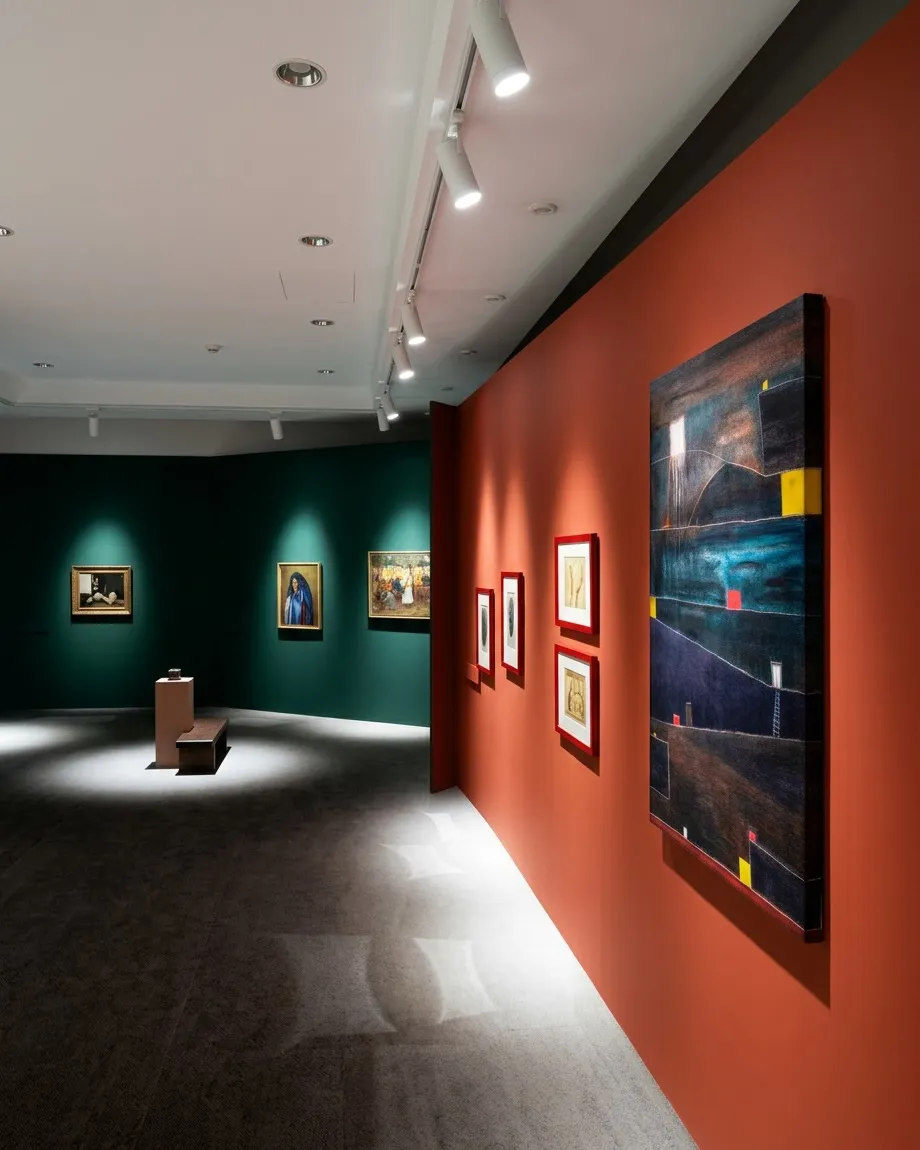
ADITUS by Maurizio Valch in a gallery space
Narrative becomes impossible at once: beside the small figurative paintings and their red frames, ADITUS concentrates the gaze on signals that refuse to become characters, buildings, or episodes. The vertical 80 × 120 cm format holds an expanse of dark bands crossed by a turquoise strip; a fine arc, yellow, red, and white rectangles, and a minimal stair distribute points of attention without arranging them into a legible scene. This reserve corresponds to Maurizio Valch’s language, built through stratified fields, divisions, and incisions that operate as boundaries, traces, or routes rather than as a vocabulary of fixed equivalences. The visible seepage and glazes do not dissolve the structure: they make precarious the promise that this structure can orient us.
This delay also finds a resonance in an enduring concern of the artist: the distance between a path that can be traced and an inner movement whose direction remains unknown. Far from turning this relation into autobiography or assigning a psychological state to each form, ADITUS allows its perceptual consequence to be felt. The stair offers a concrete direction, but no guarantee; the arc suggests a passage, but does not delimit an enclosure. Before the neighbouring images, which offer figures and motifs to recognise, the painting lets thought become aware of its impulse to complete what is incomplete. Uncertainty thus appears not as a lack, but as the condition for looking before explaining.
In “When the Ground Appeared,” Valch places LIMINA at the moment when a territory can already support, separate, and order, even as its divisions have begun to lose rigidity. ADITUS makes this condition perceptible without illustrating it: its levels suggest an organised ground, yet drips, pale lines, and shifts of colour prevent it from stabilising as architecture. The essay proposes that the threshold is neither arrival nor departure, but a zone where the past still acts and what is to come has not yet taken shape. On the gallery’s red wall, this idea gains particular intensity: the nearby frames clearly administer an inside and outside of the image; the large canvas, by contrast, keeps its own edges in suspension and extends attention toward what has not yet received a name.
A specific affinity with Paul Klee helps clarify the role of the small rectangles and the stair: they function as signs and measures of scale within a larger expanse. Yet where Klee may lead elemental architecture toward an agile or playful rhythm, Valch subjects his indications to a more compact, nocturnal atmosphere. The luminous accents neither animate an imagined city nor resolve an itinerary; they remain isolated, almost exposed, within dense planes. Moving along the wall from the framed figurative works to ADITUS, the painting does not seek to compete with them through another story. It does something quieter: it preserves the interval in which a signal can still be simply a signal and, for that reason, demand a more attentive gaze.
- Original artwork
- ADITUS
- Actual dimensions
- 31.5 × 47.2 in / 80 × 120 cm
- Presentation
- Digital contextual visualization
Context references
ADITUS Maurizio Valch · vertical abstract painting in a gallery · abstract art with turquoise band and red accents · large contemporary geometric painting · abstract artwork for a gallery wall · minimalist abstract wall art
About this visualization
This visualization places the artwork within an architectural context to help collectors and viewers imagine its presence in a real space. It is an interpretive reference, not an exact reproduction: the original work remains the sole authority for scale, color, surface and material presence.